By Allan R. Ellenberger
Before Hollywood had soundstages, backlots, studio gates or movie stars, motion pictures were being created inside a peculiar black building on the grounds of Thomas Edison’s laboratory in West Orange, New Jersey. It was cramped, awkward, covered in tar paper and designed to turn with the sun. Yet from that unlikely structure came some of the earliest films ever made for commercial exhibition. The building became known as the Black Maria, and it is widely recognized as the first purpose-built motion-picture studio in the United States.
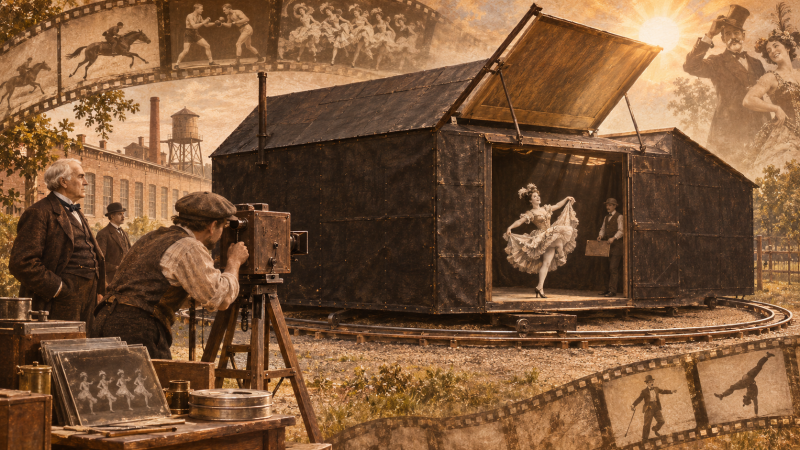
Its story began with Edison’s ambition to do for the eye what his phonograph had done for the ear. In the late 1880s he assigned much of the practical work on motion pictures to William Kennedy Laurie Dickson, a gifted member of his West Orange laboratory staff. Dickson and his colleagues developed the Kinetograph, an early motion-picture camera, and the Kinetoscope, a cabinet-like viewer through which one person at a time could watch a short film through a peephole. Edison filed patent applications for the two devices in 1891, and the Kinetoscope was ready for public demonstration by 1893.
There was one major problem. Early motion-picture film required enormous amounts of light, and the electric lamps available at the time were not powerful enough to illuminate a studio adequately. Dickson and Edison therefore needed a building designed around the sun itself. Construction began late in 1892 on the laboratory grounds, and the studio was completed in February 1893.
Nothing about it looked glamorous. The wooden structure was covered in black tar paper and resembled the dark police wagons then commonly called “Black Marias,” pronounced “Ma-RYE-ah.” Edison’s employees adopted the nickname, and it stuck. The building had a large section of roof that could be opened to admit direct sunlight, while the entire studio rested on a central pivot and circular track so workers could rotate it as the sun moved across the sky. The idea was simple but ingenious: instead of bringing artificial light into a studio, the studio itself followed the light.
Inside, conditions were far from comfortable. The tar-paper walls absorbed heat, the space was tight, and performers had to work beneath a blazing roof opening whenever filming took place. Yet the Black Maria did exactly what Edison and Dickson needed it to do. Against a dark backdrop, performers could be placed in the strongest possible sunlight while the cumbersome Kinetograph recorded their movements on strips of 35mm film.

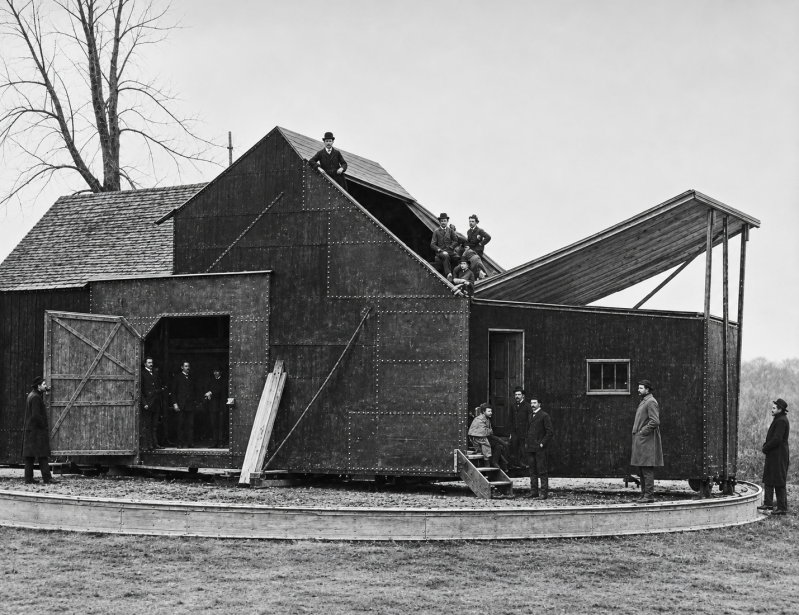
Above is Edison’s Black Maria, the world’s first purpose-built motion picture studio, constructed in West Orange, New Jersey, in 1893. Painted black inside and out, the unusual structure rotated on a circular track to follow the sun, providing ample light for filming against a dark backdrop. Its total cost was just $637.67.
The first films produced there were less like the movies we know today than moving photographs. There were no elaborate plots, editing patterns or feature-length stories. The novelty was movement itself. Audiences wanted to see bodies dance, fight, sneeze, lift weights or perform familiar stage acts. In 1894 alone, Dickson and cameraman William Heise produced more than seventy-five films, many of them inside the Black Maria.
One of the most famous was Edison Kinetoscopic Record of a Sneeze, better known as Fred Ott’s Sneeze. Filmed on January 7, 1894, it showed Edison employee Fred Ott taking a pinch of snuff and sneezing for the camera. The moment lasted only seconds, but it became the earliest surviving copyrighted motion picture from the Edison operation. Because copyright law had not yet caught up with film, Edison’s people protected their work by submitting individual frames printed on paper to the Library of Congress rather than depositing a motion-picture print.

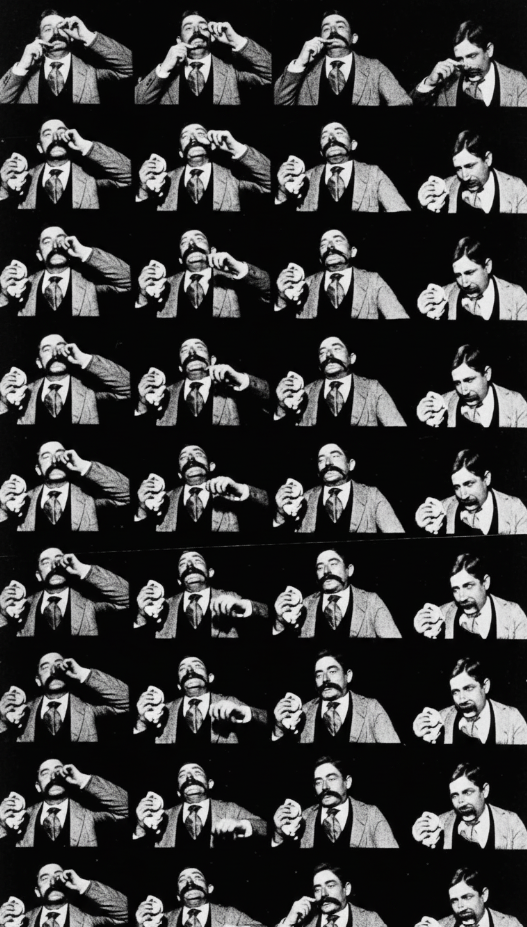
Above, Fred Ott sneezes in Edison’s Fred Ott’s Sneeze (1894), filmed at the Black Maria. The five-second film is among the earliest surviving motion pictures and the first copyrighted motion picture. Left: Frame from The Dickson Experimental Sound Film (1894/95).
Soon the Black Maria was attracting professional entertainers. Strongman Eugen Sandow flexed his muscles before the camera. Spanish dancer Carmencita performed her celebrated dance. Annabelle Whitford swirled through her Butterfly Dance, her flowing skirts creating movement ideally suited to the new medium. Acts from Buffalo Bill’s Wild West appeared as well, including Annie Oakley and Native American performers whose dances were captured in films such as Sioux Ghost Dance and Buffalo Dance. Boxing matches, cockfights and other physically energetic subjects also became popular attractions.
The studio also became a laboratory for experimenting with sound. Around 1894 or 1895, Dickson and his colleagues made what is now known as the Dickson Experimental Sound Film, in which a man plays a violin while two other men dance nearby. The surviving image was intended to accompany sound recorded separately on a phonograph cylinder, an extraordinarily early attempt to synchronize recorded sound with moving pictures decades before talking films became commercially practical.
Perhaps the most famous Black Maria production came in April 1896, when Broadway performers May Irwin and John C. Rice reenacted a kiss from the stage comedy The Widow Jones. The resulting short, generally known as The Kiss, showed the couple exchanging an exaggerated embrace in extreme close-up. It became one of Edison’s most popular films and one of cinema’s earliest famous screen kisses. What seems harmless today caused considerable comment at the time because audiences had never seen such intimacy enlarged and repeated through a motion-picture machine.
The films were initially made for the Kinetoscope, not for projection onto a large theater screen. Beginning on April 14, 1894, customers in the first commercial Kinetoscope parlor at 1155 Broadway in New York could pay to peer into individual cabinets and watch the brief films one at a time. The system was successful, but it contained the seeds of its own obsolescence. Projected motion pictures soon allowed entire audiences to watch together, and cinema rapidly moved away from the solitary peephole experience.
The Black Maria also became increasingly impractical. Film production was growing more ambitious, and portable cameras allowed crews to leave the studio and photograph streets, trains, sporting events and everyday life.

May Irwin and John C. Rice share one of cinema’s earliest screen kisses in Edison’s The Kiss (1896), filmed at the Black Maria studio. The brief scene caused a sensation and sparked controversy.

A precursor to the nickelodeon, the first commercial Kinetoscope parlor opened at 1155 Broadway in New York City on April 14, 1894. Patrons came and went freely, viewing short motion pictures through individual peephole machines.
In January 1901, Edison opened a new glass-enclosed rooftop studio in New York City, where filmmakers had more space, better access to performers and greater flexibility. The Black Maria’s productive life was effectively over.
For a few more years, the strange black building remained on the West Orange grounds, unused and increasingly obsolete. In 1903, the Edison company finally dismantled it. The first purpose-built movie studio had existed for only about a decade, and its most important period had lasted even less. Yet in those few years, Edison’s staff produced somewhere between 200 and 300 films there and helped transform motion pictures from a laboratory experiment into a commercial form of entertainment.
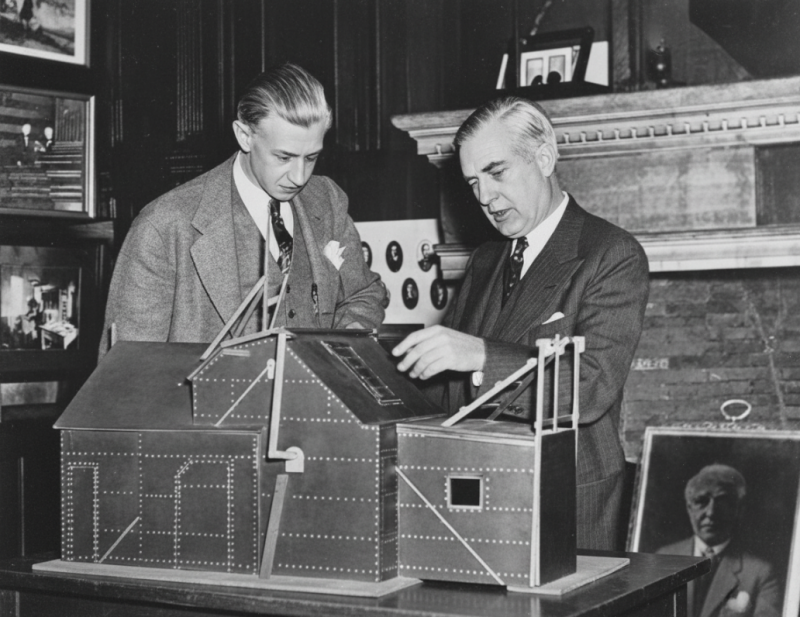
Commemorating the Black Maria’s 50th anniversary, a replica of Edison’s pioneering film studio appears in Universal’s The Birth of the Movies. Pictured are John Coakley, historian of the Edison Pioneers, and Charles Edison, son of Thomas A. Edison.

Adolph Zukor (left), guest speaker, and Vice Admiral Harold G. Bowen, director of the Edison Foundation, examine a replica of Edison’s pioneering Black Maria film studio during its 1954 dedication ceremony.
The original Black Maria is gone, but its story did not disappear. In 1954, the Thomas Alva Edison Foundation constructed a full-scale reproduction at the West Orange laboratory complex using historic photographs and documentation. Like the original, the replica can rotate on a track and has a roof section that opens toward the sky. After a major rehabilitation, it reopened to the public in 2024 with new displays, replica Kinetoscopes and a replica Kinetograph, along with screenings of films produced in the original studio.
Today the Edison laboratory complex is preserved as Thomas Edison National Historical Park, where visitors can walk through the same grounds on which the motion-picture industry took some of its earliest steps. The Black Maria replica stands among surviving laboratories, workshops and factory buildings, a stark black shape that still looks almost absurdly primitive compared with a modern soundstage.
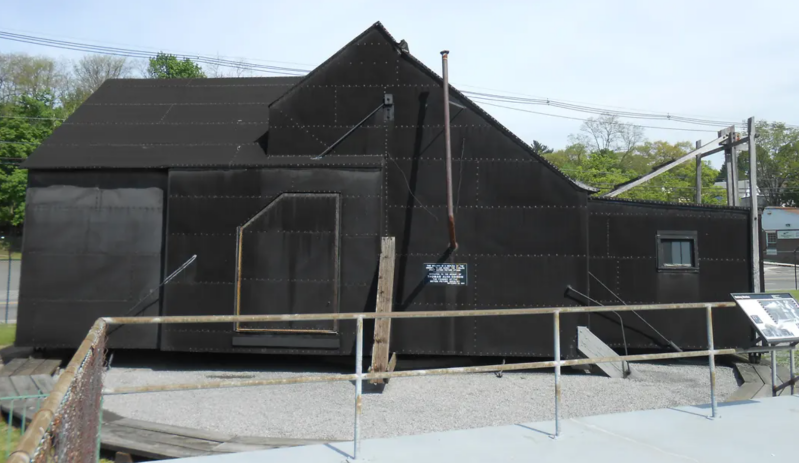
Above is the replica of Edison’s original "Black Maria" studio as it appears today, constructed as a movie set for Edison, the Man (1940), starring Spencer Tracy, and dedicated at the Edison National Historic Park in 1954.
That contrast is precisely what makes it so extraordinary. There were no stars’ dressing rooms, no studio commissary, no art department and no rows of soundstages stretching toward the horizon. There was simply a camera, a performer, a patch of sunlight and a black wooden building that could be pushed around a circular track.
Hollywood would eventually build an empire out of motion pictures, but the idea of the movie studio was already taking shape thousands of miles away in West Orange. Before the palm trees, premieres and studio gates, there was the Black Maria—turning slowly toward the sun while an entirely new art form learned how to move.
Before Hollywood became the movie capital of the world, there was Edison’s Black Maria, where the motion picture industry took its first steps. Have you heard of this pioneering studio? Please comment, rate, and share my latest Hollywoodland Revue feature and help keep this fascinating chapter of film history alive!
Add comment
Comments