

For more than a decade, six enormous faces from Hollywood's golden past looked down upon the traffic and pedestrians of Hollywood Boulevard. Marilyn Monroe, Humphrey Bogart, Fred Astaire, Bette Davis, James Dean and Clark Gable stood shoulder to shoulder, larger than life, transforming an otherwise ordinary wall into a colorful monument to the movies. Then, in a matter of seconds on the morning of January 17, 1994, they were gone.
By Allan R. Ellenberger
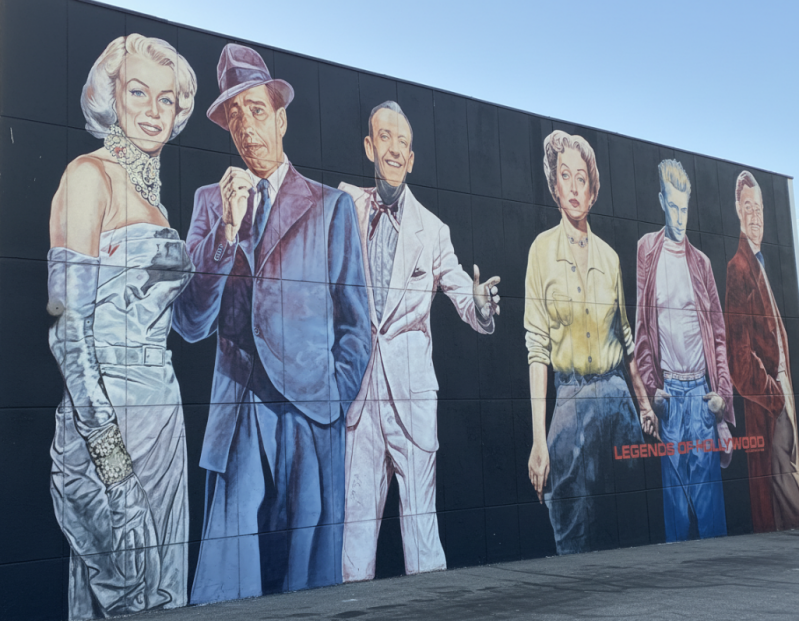
The "Legends of Hollywood" mural by artist Eloy Torrez /1983. (Photo: Allan Ellenberger / 1986)
The mural, Legends of Hollywood, was created in 1983 by artist Eloy Torrez. Measuring approximately 25 feet high and 72 feet wide and painted in acrylic, it covered the west-facing wall of a building at 1600 North Hudson Avenue (now Schrader Boulevard), just off Hollywood Boulevard. The Mural Conservancy of Los Angeles now classifies it simply as “historic.” Still, for those who remember Hollywood in the 1980s and early 1990s, it was once a very visible part of the neighborhood.
Torrez was still a young artist when the commission came his way. Born in Albuquerque, New Mexico, he grew up partly in Barstow before coming to Los Angeles to study art. At Otis Art Institute, one of his important teachers and influences was the celebrated African American artist, Charles White. After graduating, Torrez found work restoring murals in South Los Angeles through the federal Comprehensive Employment and Training Act program. Those jobs provided both experience and contacts, eventually leading him to his first major mural commission. That commission was Legends of Hollywood.
Torrez later recalled that at the time he didn't really think of what he was doing as “murals.” To him, they were simply very large paintings. He had been impressed by the monumental scale of Los Angeles mural art, particularly Kent Twitchell's work, and suddenly Torrez had an enormous Hollywood wall of his own. He admitted that the project took a long time and taught him a great deal.
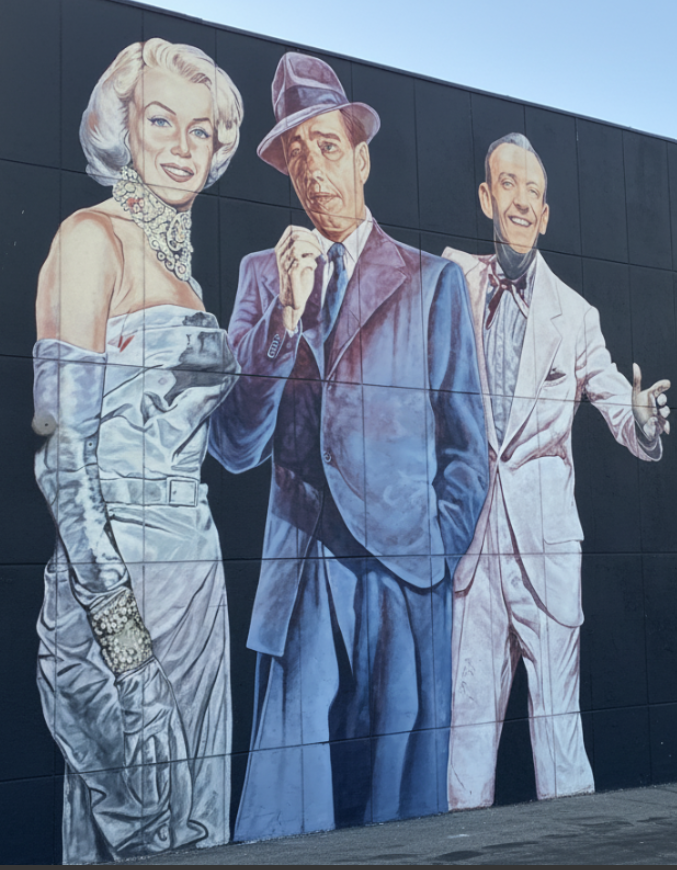
The subject could hardly have been more appropriate for its location. Across the wall, Torrez assembled six instantly recognizable screen icons. Marilyn Monroe appeared in the glamorous pink gown associated with “Diamonds Are a Girl's Best Friend” in Gentlemen Prefer Blondes. Nearby were Humphrey Bogart, wearing the fedora and trench coat that had become shorthand for his tough, romantic screen persona; the elegant Fred Astaire; formidable Bette Davis; eternally young James Dean; and debonair Clark Gable.
They weren't presented as distant museum pieces. Torrez gave them personality and movement, turning the side of the building into what amounted to a giant Hollywood cast photograph.

Muralist Eloy Torrez in November 1988. (Photo: Ellen Jaskol/Los Angeles Times)
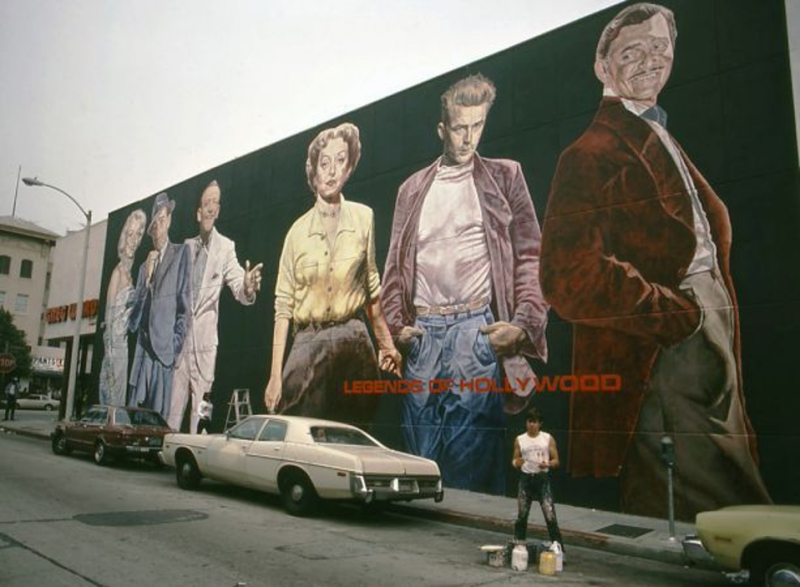
Torrez standing before the finished Legends of Hollywood in 1983. (Photo: Mural Conservancy of Los Angeles)
The mural quickly became part of the Boulevard's visual landscape. Photographs of it appeared on postcards, and its sheer size made it difficult to miss. It even made a fleeting appearance in popular culture: a shot of Legends of Hollywood can be seen in the 1986 Magnum, P.I. episode “L.A.” Yet as Torrez matured as an artist, he began looking at his first mural differently.
The six people he had selected were all white. Torrez later acknowledged that as he learned more about Los Angeles and its cultural history, he regretted missing the opportunity to recognize performers of color. That realization influenced one of his next—and ultimately most famous—works.
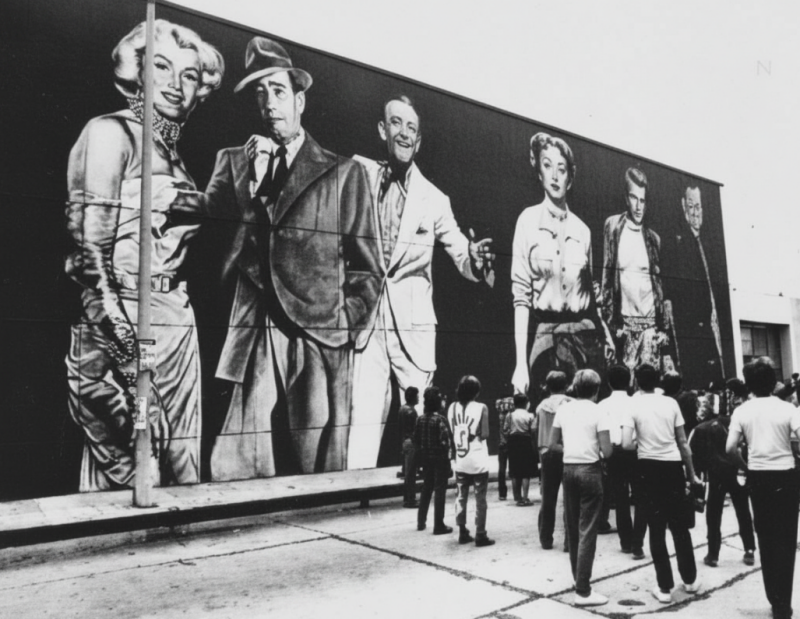
Spectators gather in November 1983 for the dedication of Eloy Torrez’s Legends of Hollywood mural on the side of a building on Hudson Avenue near Hollywood Boulevard. Sponsored by the City of Los Angeles and the property owners, Torrez spent two months creating the 30-foot-high tribute to Hollywood’s screen legends. (Photo: Joe Kennedy/Los Angeles Times)

After Legends of Hollywood was completed, Torrez was approached about painting another movie star, this time on the Victor Clothing Company building (at left) in downtown Los Angeles. The request was specifically for a Latino actor who could represent Hollywood's classic era. Torrez immediately thought of Mexican-born Anthony Quinn, who had grown up in East Los Angeles. The result was the monumental The Pope of Broadway, depicting Quinn exuberantly dancing as Zorba the Greek. Torrez later said the Quinn portrait allowed him to address something that had been missing from Legends of Hollywood.
Back in Hollywood, however, the original six legends remained on their wall year after year, until the earthquake. At 4:30 a.m. on January 17, 1994, the Northridge earthquake violently shook Southern California. Buildings were damaged, freeways collapsed, and dozens of people died. In Hollywood, the wall supporting Legends of Hollywood could not withstand the shaking. It came crashing down.
The destruction was particularly cruel because this was not a mural that slowly faded beneath decades of sun and neglect. One day the six stars were there; the next, the landmark that had occupied the corner for more than ten years lay shattered in pieces. Both the Mural Conservancy of Los Angeles and Torrez's subsequent histories record the Northridge earthquake as the event that destroyed the work.
But that wasn't quite the end of Legends of Hollywood. At first, there was hope that something could be salvaged from the wreckage. The Hollywood Arts Council hired conservators to recover sections of the fallen mural and transport them to Torrez's home in Echo Park. The broken pieces were stacked there, some reportedly reaching about five feet high. An unusual plan emerged: recognizable fragments—including pieces of Marilyn Monroe and Fred Astaire—might be sold, with the proceeds helping finance a replacement mural.
It was an intriguing idea. Pieces of a destroyed Hollywood landmark might find homes with collectors while simultaneously paying for its successor. But the plan stalled. Years passed, and the enormous fragments remained at Torrez's home. Torrez later candidly admitted that he had “dropped the ball.” Eventually he hired workers to remove the stacks of broken mural pieces. They were taken to a dump.
Thus, the answer to the question “Where is Legends of Hollywood today?” is a sad one: it no longer exists. No complete mural is in storage awaiting restoration and, as far as the documented record shows, no substantial collection of the original pieces survives. What remains are photographs, postcards, memories, and images such as the photograph that I personally took in 1986 that accompanies this article. The story nevertheless has an unexpected second act.

Above is the Hollywood High School mural by Torrez call "Portrait of Hollywood" / 2002. (Photo: Hollywood Senior High School)
Beginning around 2000, Torrez turned his attention to another enormous Hollywood wall—the auditorium at Hollywood High School. His eventual Portrait of Hollywood became, in some respects, a spiritual descendant of Legends of Hollywood. This time Torrez deliberately embraced the diversity he felt had been absent from his earlier work, portraying entertainers from different ethnic and cultural backgrounds. PBS SoCal has described the Hollywood High mural as having partly “resurrected” the lost Legends of Hollywood.
It also demonstrates how much Torrez himself had changed during the years separating the two works. The young artist who painted six familiar movie stars in 1983 had grown into an artist thinking more deeply about whose faces become part of Hollywood's public memory—and whose do not.
Torrez went on to become one of Los Angeles' notable muralists. His works have included The Pope of Broadway, Entrada a un Nuevo Mundo, Water, Essence of Life, and numerous other public projects. His Anthony Quinn mural, unlike Legends of Hollywood, survived and was extensively restored in 2016–2017.
There is something especially poignant about the fate of Legends of Hollywood. Los Angeles is filled with vanished landmarks—movie palaces demolished for parking lots, studios swallowed by development, restaurants that exist only in photographs, and houses once occupied by stars that disappeared beneath apartment buildings. But murals are even more fragile. Their canvas is the city itself. When the wall disappears, the artwork can disappear with it.
For eleven years, Marilyn Monroe, Humphrey Bogart, Fred Astaire, Bette Davis, James Dean and Clark Gable watched over Hollywood from a wall on Hudson Avenue. Thousands of tourists passed beneath them. Residents drove by them on their way to work. Their faces appeared in vacation photographs and on postcards carried far beyond Los Angeles. Then the earth moved.

Eloy Torrez mural of actor John Ritter, an alumnus of Hollywood High, class of 1966., added to the north side in 2007.
Today, nothing remains at the location to suggest the enormous painting that once dominated the corner. Yet photographs preserve a glimpse of a very different Hollywood Boulevard—a time when six giants of the screen occupied an equally gigantic canvas in the heart of the town that made them legends.
Eloy Torres called his mural Legends of Hollywood. More than forty years after he painted it, and more than thirty years after it came tumbling down, the title seems particularly fitting. The legends remain. Their wall is Lost Hollywood.
If you enjoyed looking back at Eloy Torrez’s Legends of Hollywood and the story of how this once-familiar Hollywood mural was lost, I’d love to hear your memories and thoughts. Please leave a comment, rate the article, and share it with others who enjoy Hollywood history and the landmarks that have vanished from the cityscape. Your support helps The Hollywoodland Revue preserve and share the stories of a Hollywood that can no longer be seen.
Add comment
Comments