

To movie audiences of the 1930s and 1940s, Wallace Beery was one of Hollywood’s most dependable stars. He was big, rumpled, gravel-voiced and rough around the edges, the sort of actor who could play a washed-up boxer, a pirate, a sailor, a crook or a blustering old reprobate and still somehow win the audience over. MGM understood exactly how to use him. His characters were often crude, selfish or dangerous at first, but underneath there was usually a sentimental heart waiting to emerge. Offscreen, the picture was considerably less flattering.
By Allan R. Ellenberger

Beery was born in Kansas City, Missouri, on April 1, 1885, and had already spent years on stage and in silent films before sound unexpectedly transformed him into a major star. His career had faltered at the end of the 1920s, but MGM revived it spectacularly. His performance as the brutal convict Butch in The Big House in 1930 brought him an Academy Award nomination. That same year, Min and Bill, opposite Marie Dressler, helped establish the screen personality that would carry him through the decade: the hulking, uncouth fellow who might look dangerous but ultimately proved human. He has been described as the “lunky, likeable blue-collar guy.”
Then came The Champ in 1931. As a broken-down boxer whose love for his young son survives his drinking, gambling, and bad decisions, Beery gave the performance most closely associated with his career. Jackie Cooper, who was only nine, played his son. The picture was a tremendous success, and Beery shared the Academy Award for Best Actor with Fredric March. Audiences wept for him.
That was the paradox of Wallace Beery. Millions of people loved the man they saw on the screen while a surprising number of people who actually worked beside him did not.
Robert Young spent years under contract at MGM and had ample opportunity to observe the studio’s stars. He later described Beery in extremely harsh terms, calling him “a highly disagreeable man” and noting that he was frequently petty, intensely competitive, and constantly worried about being upstaged, especially by children.
That fear of being upstaged has shaped much of his behavior. Film historians have accused him of poor manners, improvising at other performers’ expense, and making scenes harder than they needed to be. Authors James Robert Parish and Ronald L. Bowers describe him as someone who habitually upstaged coworkers and whose manners were “at best gauche.” MGM kept him on because the public loved him and he remained highly profitable.
His relationship with Jackie Cooper became one of the clearest examples of the gulf between Beery’s screen image and his private behavior. After the success of The Champ, MGM repeatedly reunited the two because audiences responded warmly to the sight of the giant, battered Beery paired with the small, emotional Cooper. Onscreen, their bond could be enormously affecting. Cooper’s later memories were far less affectionate.
Beery was also notorious for turning scenes into contests. That became especially troublesome when he worked opposite children, whose natural spontaneity could draw the camera away from him. In Treasure Island in 1934, Cooper again played opposite Beery, this time as Jim Hawkins to Beery’s Long John Silver. The picture was a success, and Beery’s performance was widely praised, but stories from the production emphasized how difficult he could be when reshoots or additional takes did not suit him. Contemporary and later accounts describe him as dragging out work, disappearing to his dressing room, and resisting material he felt served Cooper rather than himself.

Wallace Beery and Jackie Cooper in The Champ.
Yet critics loved the result. The New Yorker thought Beery could scarcely have been improved upon as Long John Silver, and audiences agreed. Beery was one of America's biggest box-office stars in the mid-1930s. The more his coworkers complained, the more the public seemed to adore him.

Margaret O'Brien and Wallace Beery in Bad Bascomb.
And then came Margaret O’Brien. By the time Beery made Bad Bascomb in 1946, he was an established MGM institution. O’Brien, only eight years old, was already one of the studio’s most valuable child stars. In the film, Beery plays the outlaw Zed Bascomb, who hides among a Mormon wagon train and is gradually softened by his friendship with O’Brien’s orphaned character, Emmy. The relationship on-screen is tender, funny and touching. Behind the camera, O’Brien remembered something very different.
Years later, she described Beery as a “mean old man” and said the two of them “couldn’t stand” each other during the making of Bad Bascomb. She recalled that Beery would pinch her hard just before or during scenes, apparently trying to confuse or disorient her and disrupt her camera work. Eventually, director S. Sylvan Simon and O’Brien’s mother realized what was happening and had physical blocks placed between the two performers so Beery could no longer reach her.
The lunch story is even more revealing because it is so petty. The company was filming on location around Jackson Hole, Wyoming, and Grand Teton National Park, where meals had to be carefully organized for cast and crew. O’Brien remembered that Beery would wait until her back was turned and steal her hot lunch. Her mother eventually had to intervene and retrieve it. There were just enough lunches for the company, and Beery would take hers when she wasn’t looking.
O’Brien also remembered that Beery’s own adopted daughter, working as an extra, broke her glasses during filming and that Beery made her work additional hours to pay for them; whether one sees that as discipline or miserliness, it fit the image many coworkers already had of him as a hard, ungenerous man.
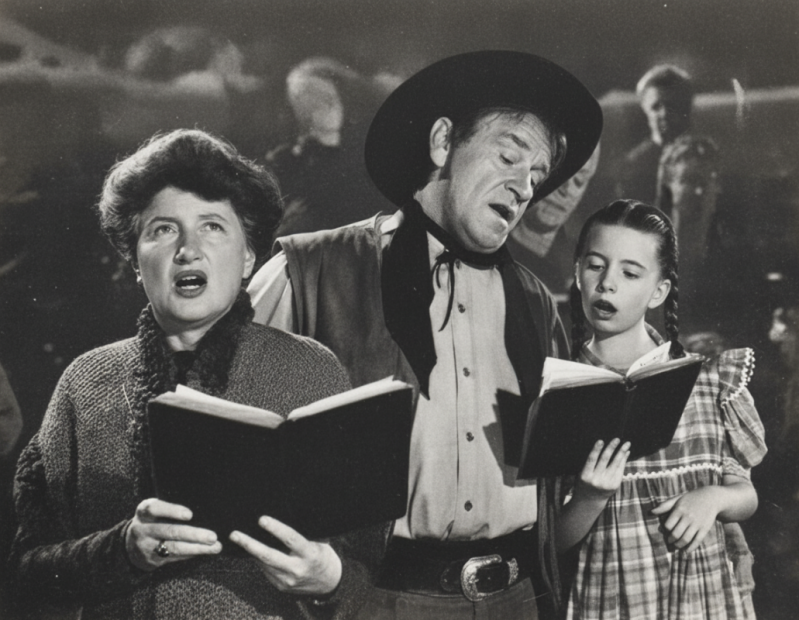
Marjorie Main, Wallace Beery and Margaret O'Brien in a scene from Bad Bascomb.
And yet O’Brien also offered one of the best explanations of why Beery remained such a powerful movie star. She acknowledged that however much she disliked him personally, he was a superb actor. Once the camera turned, he could look at her with such warmth that the audience believed he adored her. That is the remarkable contradiction at the center of Beery’s career. He could apparently make a child miserable between takes and then, moments later, create a completely convincing image of affection for that same child onscreen.
Bad Bascomb depended on the outlaw being reformed by love for the little girl, and much of the film’s appeal comes from watching Beery’s rough character gradually soften. O’Brien, meanwhile, naturally commanded attention in front of the camera, which may have been precisely what made Beery so competitive with her.
Margaret O’Brien was hardly alone. Marjorie Main, who appeared repeatedly with Beery, reportedly disliked working with him as well. Their screen chemistry was strong enough that MGM teamed them again and again, including Wyoming, Barnacle Bill, Jackass Mail, Rationing and Bad Bascomb. But their personalities clashed sharply. Main was disciplined and professional; Beery improvised, drank heavily, and had a coarse manner. The two may have disliked one another, but audiences enjoyed them together, and MGM kept exploiting that chemistry.
Mickey Rooney provides an important counterpoint. His memories of Beery were far warmer. Rooney wrote that he had tremendous fun making Stablemates with him, and the film became a major box-office success. Rooney’s account reminds us that Beery was not universally hated. Some actors plainly enjoyed him, and some children apparently did too.
That contradiction makes him more interesting than simply branding him a Hollywood monster. Beery seems to have been capable of friendliness, humor and generosity when he chose, while also being insecure, territorial and remarkably inconsiderate when he felt threatened. He may have been especially difficult when the person opposite him was a child who could steal a scene without even trying.

Mickey Rooney and Wallace Beery in Stablemates.
His screen image probably protected him. MGM sold Beery as a rough-hewn man of the people, and his offscreen hobbies fit the picture beautifully. He loved fishing, boating, and aviation and cultivated none of the polish associated with many movie stars. Audiences were encouraged to believe there was little difference between Beery the man and the gruff but tender characters he played.
The studios also controlled celebrity information far more effectively than they could today. Fan magazines depended heavily on studio access, publicity departments cultivated favorable stories, and unpleasant behavior on a closed soundstage rarely reached the public unless something spectacular happened. There was no social media, no smartphone footage, and very little incentive for an MGM employee to attack one of the studio’s most profitable stars publicly. And Beery was profitable enough that MGM had every reason to tolerate him.

His career proves how completely the studio system could separate a star’s public image from private reality. Audiences saw the shambling grin, the wounded eyes and the rough man whose goodness always emerged at precisely the right moment. Coworkers sometimes saw something else entirely: a competitive man who feared being upstaged, bullied child performers, irritated costars, and could be selfish in ways both large and absurdly small.
Margaret O’Brien understood the contradiction better than almost anyone. She could say, in effect, that she hated working with him and still admit that when the camera rolled, he could make it look as though he loved her. That may be the most revealing thing anyone ever said about Wallace Beery. He could be mean offscreen and heartbreakingly tender onscreen. And Hollywood paid him very well for making the audience believe only the second half.
Before Hollywood became the movie capital of the world, women like Mary Penman Moll helped build the community that made it possible. Discover the fascinating story of one of Hollywood's overlooked pioneers. Check back tomorrow for her remarkable story!
For readers who would like to know more about Wallace Beery and Margaret O’Brien’s experience making Bad Bascomb—and to explore Margaret O’Brien’s life and career in much greater depth—I invite you to check out my book, Margaret O’Brien: A Career Chronicle and Biography. It follows her remarkable journey from child stardom at MGM through the many chapters of her long career, with behind-the-scenes stories, film history, and personal recollections along the way.
If you enjoyed this look at Wallace Beery, both the beloved screen star and the far more complicated man his coworkers remembered, I’d love to hear your thoughts. Please leave a comment, rate the post, and share it with other classic-film fans and Hollywood history enthusiasts. Your support helps keep these stories alive on The Hollywoodland Revue.

Add comment
Comments