By Allan R. Ellenberger
Long before movie cameras arrived, before the studios, the premieres, the neon signs and the crowds along Hollywood Boulevard, the land that would become Hollywood was still largely ranches, orchards, dusty roads and scattered homes. Among the men who helped transform that landscape was Ivar Alexander Weid, a Danish immigrant whose name survives today on Ivar Avenue, even though the man himself is largely forgotten.

Weid was born Ivar Alexander Munck Hviid on October 23, 1837, at Roerslev Mølle on the island of Funen, Denmark. He came from an old Danish family and received military training before leaving his homeland for the United States. A Danish family genealogy records that he had completed his military obligation in Denmark before emigrating, and later American sources show that he was in the United States by the opening years of the Civil War.
The war quickly pulled him in. Weid became active among Scandinavian immigrants in the North and helped organize recruits for the Union cause in Chicago. A modern scholarly history of Scandinavian Civil War soldier's documents that he publicly appealed to fellow Scandinavians to defend their adopted country and later served as an officer connected with the 82nd Illinois Infantry, a regiment heavily composed of German and Scandinavian immigrants. Contemporary and family sources remembered him as Captain Ivar A. Weid, and the Danish genealogy states that he participated in several engagements and rose to captain in the infantry.
After the war, Weid continued west. Sources disagree slightly on the exact year of his arrival in Southern California, placing it around 1870 or 1871. Still, by the early 1870s he had settled in Los Angeles and begun the career that would make him one of the region’s substantial landowners. He had married Marie Sophie Elisabeth Magnus on March 7, 1868. She had been born in Fredericia, Denmark, on October 4, 1846. Their first child, Otto Johannes Munck Hviid, was born in Vallejo, California, on December 9, 1868, followed by their daughter, Ovidia Maria, born in San Francisco on April 28, 1870. Three more children followed after the family reached Los Angeles: Selma, born October 27, 1873; Victor, born August 6, 1875; and Axel Mads Johan Ivar, born much later, on July 10, 1890, in Kroghenlund, Denmark.
Weid arrived in Los Angeles at exactly the right moment. Southern California was still sparsely developed, but land was rapidly changing hands. He first turned to farming and eventually accumulated large tracts through purchase and homestead opportunities. A later history of Los Angeles described him as one of the county’s early landed proprietors and credited him with owning one tract of about 400 acres, stretching from roughly Second Street to Santa Monica Boulevard and from Western Avenue westward toward what would later become Hollywood Cemetery. Another tract of approximately 240 acres extended into the hills and became known for a time as Weid Canyon.
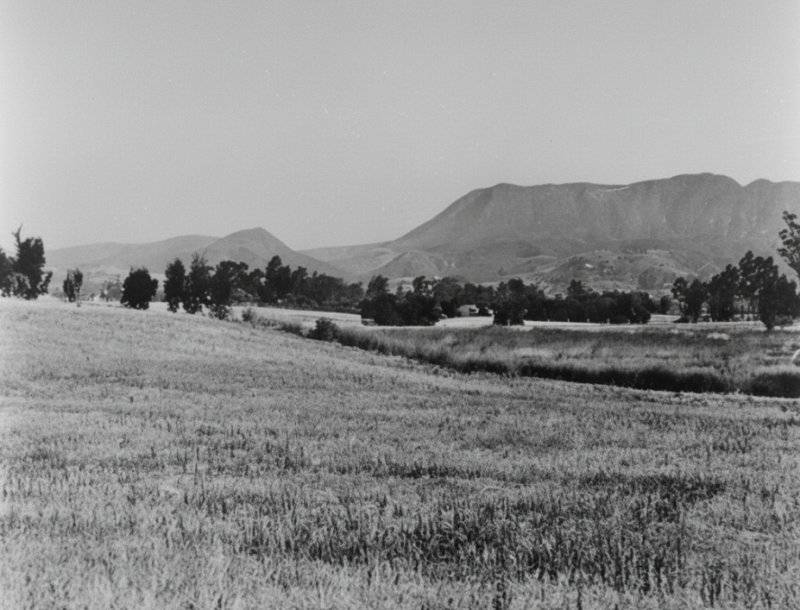
Panoramic view of Hollywood, looking across open space and a farm; Weid Canyon is seen in the distance.
Farming brought him prosperity. Wheat and fruit trees covered portions of his property, and as Los Angeles expanded, land that had once seemed remote became increasingly valuable. City historic-resource studies still identify the old I. A. Weid Tract and note that his sons continued to subdivide and develop portions of the family holdings after his death.
Weid was not simply a passive land speculator. He became a persistent advocate for the transportation links needed to connect the outlying Cahuenga Valley and Hollywood district with Los Angeles. Contemporary memorial accounts credited his energy and financial support with helping establish an early “dummy” railroad into Hollywood. Later he worked with H. J. Whitley and Griffith J. Griffith on an electric line along Prospect Boulevard, the road that would eventually become Hollywood Boulevard. That line later became part of the Los Angeles and Pacific Electric system. He was also remembered as an advocate of improved roads and as one of the promoters of Sunset Boulevard.
Those transportation projects mattered enormously. Before Hollywood could become a viable suburb—and, later, the center of the motion-picture industry—it first had to be accessible. Men like Weid were laying down the physical framework that later generations would inherit.
He also invested beyond Hollywood. Weid built the Weid Block at Eighth and Spring streets, owned additional commercial property downtown, and held land in Santa Monica. In 1875, he purchased a fifty-acre tract near the new Santa Monica settlement. He advertised lots in what was called South Santa Monica, promoting ocean-front property and villa sites to prospective buyers.
By the 1890s, he also operated a stone quarry in the Cahuenga Valley, supplying building material as Los Angeles expanded at a remarkable pace. At the same time, he held a federal position as a United States internal revenue gauger, a government official responsible for inspecting and measuring taxable commodities. His service spanned both Republican and Democratic administrations, suggesting he was valued more for experience than party allegiance.
His name became permanently attached to Hollywood's geography. Ivar Avenue was named in his honor, while nearby Selma Avenue commemorated his daughter. His hillside acreage became known as Weid Canyon before the area was absorbed into what we now call the Hollywood Hills and Hollywood Dell.
A long-standing story also connects Weid with the very name Hollywood. One version, promoted years later by his son Otto, claimed that the Wilcox family may have heard the name through Weid or through references to the holly-like plants growing in the area. Other traditions credit Daeida Wilcox with hearing “Hollywood” elsewhere while traveling. Because the competing stories cannot be conclusively reconciled, Weid’s role in naming Hollywood should be treated as part of local tradition rather than settled fact.
In 1888, after years in California, Weid returned temporarily to Denmark and purchased the estate Kroghenlund, the historic manor estate near Stenstrup on the Danish island of Funen, for 355,000 kroner. He owned it until 1900 and continued traveling between Europe and California during the later years of his life. His youngest son Axel was born there in 1890.
By the early twentieth century, Weid was financially secure and increasingly removed from day-to-day business. In Los Angeles, he lived at 138 North Bunker Hill Avenue, but travel remained part of his life. In the summer of 1903, he returned once again to Denmark, accompanied by his wife Marie, their youngest son Axel, and his friend and fellow Hollywood developer H. J. Whitley.
While in Copenhagen, Weid suddenly became ill. On August 25, 1903, he died of heart failure at the age of sixty-five. Whitley sent the news back to Los Angeles, and it was received as a genuine shock. A memorial resolution by the Pioneers of Los Angeles County described Weid as energetic, generous, temperate, and widely respected—a man with few enemies and many friends. He was also a member of the Grand Army of the Republic and the Masonic fraternity.

The chapel at Odense Cemetery. (Photo: Findagrave/Neils Brandt)
Unlike his wife and several of his children, who were later buried at Hollywood Forever Cemetery, Weid’s body was never returned to California in death. Danish genealogical records state that after he died in Copenhagen, Ivar Alexander Munck Hviid was buried at Assistens Cemetery in Odense, Denmark. That burial explains why no grave for him appears with the rest of the family at Hollywood Forever. His exact plot number and whether the original grave survives remain under investigation, but the Danish source is clear that Odense was his final resting place.
Marie survived him by fifteen years, dying in 1918. Their children remained connected with California, and the Weid family continued to hold and subdivide property long after Ivar’s death. By then Hollywood was rapidly becoming something he never lived to see—the center of a new global entertainment industry. Yet much of the landscape beneath that industry had already been shaped by men like him.
Ivar Alexander Weid died before Hollywood made its first great leap into filmmaking. But he was a Hollywood pioneer in a deeper sense: a landowner, farmer, investor, Civil War veteran, road and railway promoter, public official, and builder who helped turn an isolated agricultural district into a connected, developable community. Today thousands of people travel along Ivar Avenue without knowing the man behind the name. But long before Hollywood belonged to the movies, part of it belonged to Ivar Weid.
COMING TOMORROW TO THE HOLLYWOODLAND REVUE! With his unmistakable voice, magnetic screen presence, and extraordinary versatility, James Mason was one of cinema’s finest actors. But has Hollywood truly given him the recognition he deserves? Check in tomorrow for my review of Madeline King Porter’s new biography, James Mason: The Movie Star Hollywood Forgot — Rediscovering One of Cinema’s Finest Actors, exploring the remarkable career and complicated private life of this unforgettable star.
Discover the story of Ivar Alexander Weid, a Danish pioneer whose contributions helped shape early Hollywood. His remarkable life is another fascinating chapter in the history of our community. I'd love to hear your thoughts! Please leave a comment, rate the article, and share it with fellow Hollywood history enthusiasts. Your support helps keep these overlooked stories alive!
Add comment
Comments