

This series, The Women Who Built Hollywood Before the Movies, looks back at the remarkable women who helped shape Hollywood when it was still a quiet community of orchards, ranches, homes, and dusty roads. Long before the studios, movie palaces, premieres, and stars made Hollywood famous around the world, women were already helping build the institutions, businesses, and civic life that gave the town its identity. Among the most important was a young woman from Ohio named Daeida Hartell, who would help give the emerging community not only its name, but much of the character that defined its earliest years.
By Allan R. Ellenberger

Daeida Hartell Wilcox Beveridge was born July 22, 1861, in Hicksville, Ohio, the daughter of farmers John Emerson Hartell and Amelia Jane Ryan Hartell. She grew up in a small Midwestern community, attended a private school in Hicksville and later public school in Canton. Nothing about those beginnings suggested that she would one day become associated with one of the most famous place names on earth. Yet Daeida possessed the qualities that would serve her well in California: determination, an eye for opportunity and, perhaps most importantly, an unusually strong sense of what a community could become.
On December 6, 1882, she married Harvey Henderson Wilcox, a widowed businessman considerably older than she was. The couple lived in Kansas for a time before moving west to Southern California. By 1886, they had acquired approximately 120 acres of apricot and fig orchards in the Cahuenga Valley, paying about $150 an acre. Their tract stretched roughly from present-day Franklin Avenue south to Sunset Boulevard and from Whitley Avenue east to Gower Street. At the time, it was countryside.
Los Angeles lay several miles away, and the idea that this quiet agricultural property would someday sit at the center of the world's entertainment industry would have sounded absurd.
The Wilcoxes began subdividing the property during Southern California's frenzied real-estate boom of the 1880s. They laid out streets, planted pepper trees, and offered lots for sale. Daeida took an active interest in the tract's appearance and character rather than leaving everything to her husband. The development was intended to be respectable, orderly and family-oriented, reflecting the Wilcoxes' strong temperance and religious sympathies. Churches were encouraged; saloons and gambling establishments were decidedly not.
Then came the name. According to the traditional account, Daeida was traveling by train when she met a woman who spoke of a home or estate near Chicago called Hollywood. Daeida liked the sound of it and brought the name back to California. Harvey subsequently used “Hollywood” on the subdivision map filed with Los Angeles County in February 1887. Hollywood Heritage identifies the fellow traveler as Laura Rockefeller, although versions of the story have differed over the years. What is clear is that Daeida became closely associated with selecting the name and that Harvey officially placed it on the map.

Daeida's first husband, Harvey Henderson Wilcox.
The romantic story that Hollywood was named for native “California holly” or toyon is attractive, but there is little evidence for it. The stronger historical tradition points to Daeida's train conversation. Even in a town that would later become famous for rewriting its own history, the woman who chose the name deserves to remain at the center of the story.
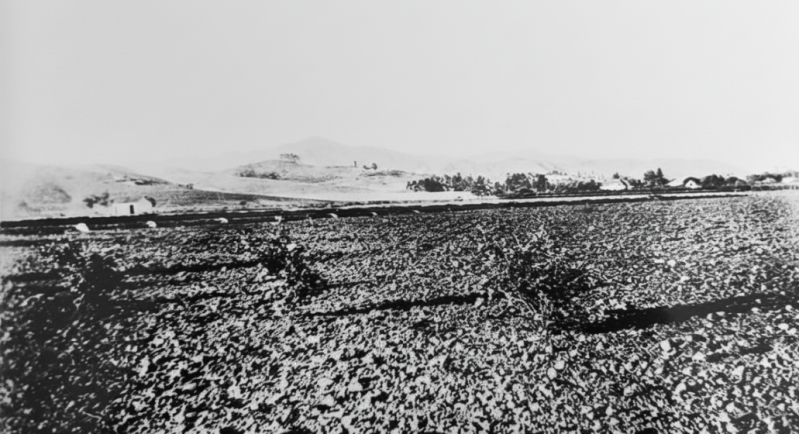
Hollywood as it appeared around the time Harvey and Daeida Wilcox purchased their land, when the future movie capital was still largely open countryside, orchards, and scattered homes.
The Wilcoxes' happiness was tempered by personal tragedy. Their son Harry Wilcox, born in 1885, died in infancy. Then Harvey himself died in 1891, leaving Daeida a widow while still a young woman. Contrary to versions of the Hollywood story that portray Harvey as dying impoverished, contemporary evidence indicates that he left substantial property. More importantly, Daeida did not simply inherit land and retreat from public life. She took control of the family's real-estate interests and continued developing Hollywood herself. Later historian Edwin O. Palmer described her as managing those holdings with “rare judgment.” That period is what makes Daeida much more than simply “the woman who named Hollywood.” She helped transform a subdivision into a community.

Above is Philo Judson Beveridge, the second husband of Daeida Wilcox.
In 1894, she married Philo Judson Beveridge, a businessman and real-estate operator whose father, John Lourie Beveridge, had served as governor of Illinois. They married on March 27, 1894, and Philo became an active participant in Hollywood's growth. The couple had four children: Marian, born in 1895; Daeida, born in 1896 and lost tragically in childhood in 1900; Phyllis, born in 1898; and a son, Philo, who died in infancy in 1906. Only Marian and Phyllis survived to adulthood.
Daeida's civic ambitions continued alongside those personal losses. She donated land for three churches, helping ensure that religious institutions would be part of Hollywood from the beginning. In 1903 she gave property at what was then Prospect and Weyse avenues—today Hollywood Boulevard and Vine Street—to the German Methodist congregation. A church rose on the southeast corner, decades before that intersection became synonymous with radio, restaurants, movie stars and Hollywood glamour. She also understood that a town needed more than houses and churches. She helped develop Hollywood's early commercial district, including banks, a post office, civic buildings, and sidewalks.
Wilcox Hall, at Hollywood Boulevard and Cahuenga, became an early civic center, housing public and social activities. Upstairs was the Hollywood Club, while the surrounding area gradually evolved from orchards into a recognizable town center. Contemporary and later accounts credit Daeida with helping establish the Hollywood National Bank and Citizens Savings Bank and with providing property for public purposes.
One of her most inspired decisions involved French-born flower painter Paul de Longpré. Impressed with his work, Daeida gave him three lots at Prospect Avenue and Cahuenga Boulevard, realizing that the renowned flower painter could add a cultural element and attract visitors to the new community. There he built an elaborate residence, studio, and magnificent flower gardens that became one of Hollywood's earliest tourist attractions. A year later, when de Longpré wished to extend his gardens, he bought additional adjacent land from her by giving her three of his paintings, which were said to be worth approximately $3,000.
Visitors came by excursion car to wander through the grounds, admire the flowers and purchase De Longpré's paintings. Long before tourists arrived hoping to glimpse movie stars, they were already coming to Hollywood because of a destination Daeida had helped create.

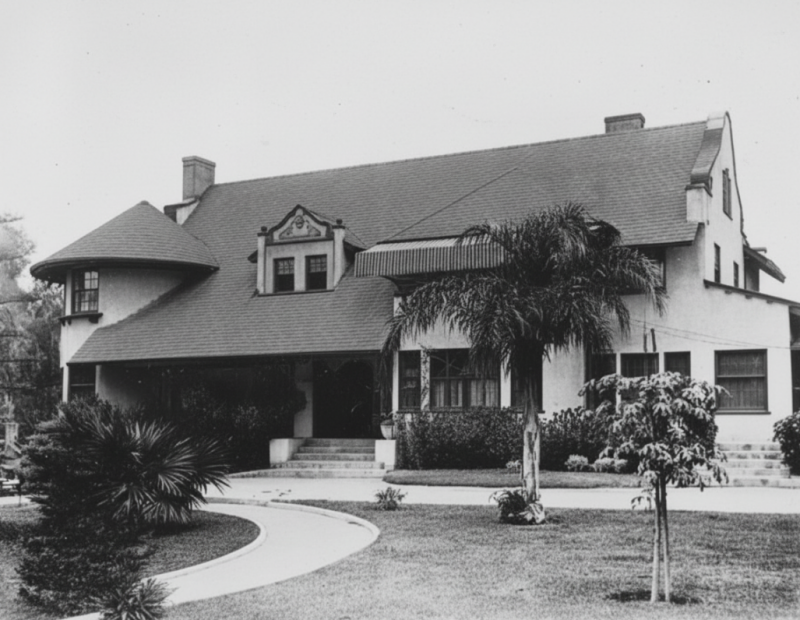
The home of Daeida Wilcox Beveridge once stood at the northeast corner of Hollywood Boulevard and Wilcox Avenue. The site was later occupied by the Warner Bros. Theatre, and later the Hollywood Pacific Theatre.
Education and culture mattered to her, too. When Hollywood's Woman's Club established a small public library in rented rooms in 1906, and Andrew Carnegie later offered $10,000 toward a permanent building, Daeida donated the land at Prospect Avenue and Ivar Avenue on which the Carnegie library was built. The building became one of the young town's most important civic institutions. That gift is particularly telling: she was not merely selling property as its value rose but deliberately reserving valuable land for uses she believed would improve the community.
Daeida did not always agree with Hollywood's direction. When residents debated incorporating Hollywood as an independent city in 1903, she opposed the proposal. Incorporation nevertheless passed narrowly, 88 votes to 77. Hollywood became an independent municipality, although only briefly; in 1910 its residents voted to annex to Los Angeles, largely because the growing community needed reliable access to the city's water system. Prospect Avenue then became Hollywood Boulevard.
By then another transformation had begun. Motion-picture companies were creeping westward from Los Angeles. In 1910, D. W. Griffith's Biograph company photographed scenes in Hollywood, including work at Paul de Longpré's gardens. Within a few years, studios arrived in earnest. Daeida lived long enough to witness the first faint signs of what Hollywood would become, although she could hardly have imagined the scale of the revolution ahead.
Her health failed in the summer of 1914. After returning from an extended trip to Asia with Philo the previous year, she remained socially active into July, but cancer was advancing. Daeida died at Good Samaritan Hospital in Los Angeles on August 7, 1914, at the age of fifty-three. Her death certificate gave cancer of the liver and stomach as the cause. Contemporary tributes remembered her as forceful but kind, reliable, progressive, and possessing unusually sound judgment.
Her funeral was followed by burial in the Wilcox family vault at Rosedale Cemetery in Los Angeles, where Harvey and their infant son Harry already rested. Her second husband, Philo Beveridge, died in 1921. Then, on November 13, 1922, the remains of Daeida, Harvey, Harry, and Philo were removed from Rosedale and transferred to the Hollywood Mausoleum at Hollywood Cemetery. Daeida now rests there with the two men with whom she built her life: Harvey is interred below her, while Philo rests beside her.
There is something wonderfully appropriate about that final resting place. Hollywood Forever did not exist when Daeida and Harvey first laid out their little subdivision. Today she lies in the heart of the community she helped create, surrounded by the pioneers, filmmakers and stars who followed.
Calling Daeida Wilcox Beveridge the “Mother of Hollywood” is not sentimental exaggeration. She helped give Hollywood its name, nurtured its growth after her first husband's death, donated land for churches and a library, encouraged culture and commerce, supported public improvements, and understood that streets and houses alone do not make a community. The movies came later. By the time they arrived, Daeida had already helped build Hollywood.

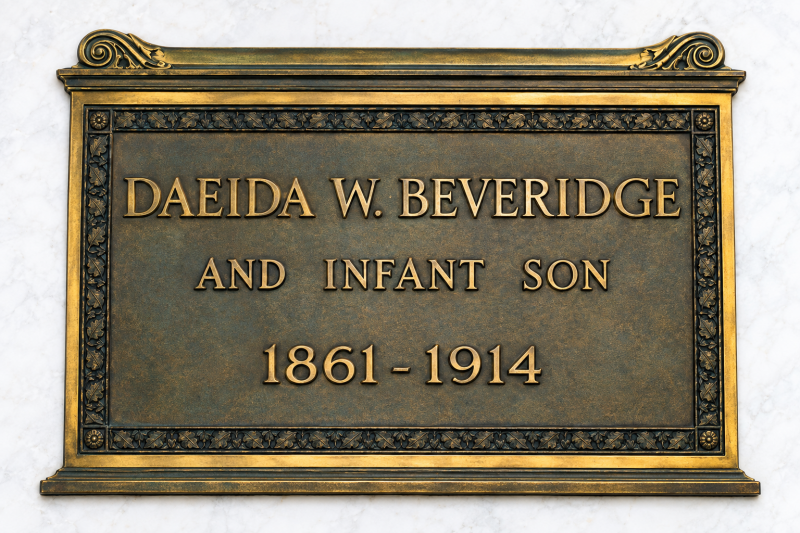
Above is the original Wilcox family vault at Rosedale Cemetery. Below is Daeida Wilcox Beveridge’s crypt at Hollywood Forever, where her remains were transferred in November 1922.
If you enjoyed my look at Hollywood pioneer Daeida Wilcox Beveridge, I’d love to hear your thoughts. Please leave a comment, rate the article, and share it with anyone interested in the early history of Hollywood and the remarkable women who helped build it before the movies arrived. Your comments, ratings, and shares help The Hollywoodland Revue reach new readers and keep these forgotten stories alive.
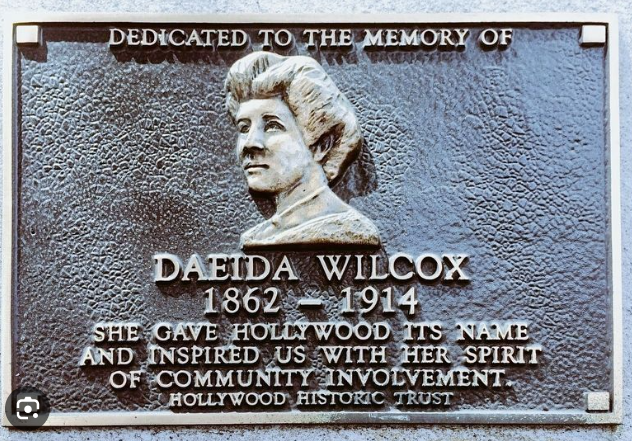
Tribute to Daeida Wilcox Beveridge located at 6381 Hollywood Boulevard,
Add comment
Comments