

Long before Hollywood mail arrived in sackfuls addressed to movie stars, fan clubs, and motion-picture studios, it was sorted inside a little wooden hotel at the corner of a dirt road. The woman behind that early postal counter was Mary Maria Sackett, a pioneer who arrived in Hollywood before there was much of a Hollywood at all and lived long enough to tell Groucho Marx about it on national television.
By Allan R. Ellenberger

Mary was born July 8, 1875, in Suffield, Connecticut, the eldest daughter of Horace David Sackett and Ellen Minerva Lyman Sackett. The Hartford Daily Courant announced her birth, and the Sackett family had deep New England roots. Horace was born in Blandford, Massachusetts, on December 29, 1843, to Leverett and Mary Culver Sackett. As a young man, he settled in Suffield, where he combined farming with a successful general merchandise business. Mary therefore grew up in a household where commerce, hard work and self-reliance were part of daily life.
Horace and Ellen had five children: Mary, William, Warren, Zella and Emily. In 1887, with approximately $10,000 in capital, Horace decided to leave New England and try his fortune in Southern California. The family arrived in the Los Angeles area the following year and settled in the sparsely populated Cahuenga Valley, where Harvey and Daeida Wilcox were subdividing land they called Hollywood. Mary later remembered that the two families arrived at almost the same moment, when the future movie capital had no paved streets, electric lights, or telephones and only a scattering of houses and farms.
Harvey Wilcox reportedly offered Horace Sackett three lots at the southwest corner of Prospect Avenue and Cahuenga Boulevard if he would improve the property before the new dummy railroad began service. Sackett accepted the challenge. By 1888, he had erected a three-story wooden hotel crowned by a mansard roof—the first hotel in the Cahuenga Valley. Downstairs were a general store, lobby, parlor, and kitchen; upstairs were eighteen guest rooms sharing a single bathroom. Behind the building stood a barn and corral, while pepper trees Daeida Wilcox planted helped soften what was still very much a frontier landscape.
For teenage Mary, the Sackett Hotel was not merely her father’s business. It was the center of her world. Travelers came through looking for land. Farmers arrived to buy boots, overalls, canned goods, ribbons, butter, and eggs. Young, unmarried men working in the settlement found lodging there, and professionals newly arrived in California rented rooms. One of them was Dr. Edwin O. Palmer, who later became one of Hollywood’s important early historians. The Sacketts grew produce and sold it through their store, kept horses for travelers, and watched a collection of rural properties slowly begin to resemble a town.
Mary and her siblings attended the Temple Street School, but daily travel into Los Angeles made advanced schooling difficult. Still, Mary later pursued further education. A Hiram College alum directory lists Mary Maria Sackett among students attending during the 1907–1908 academic year, demonstrating that she continued her education well into adulthood.
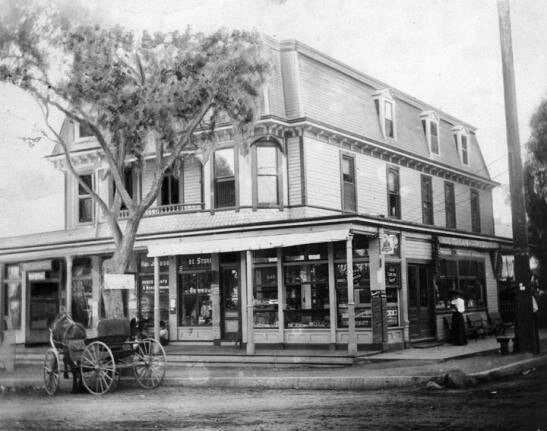
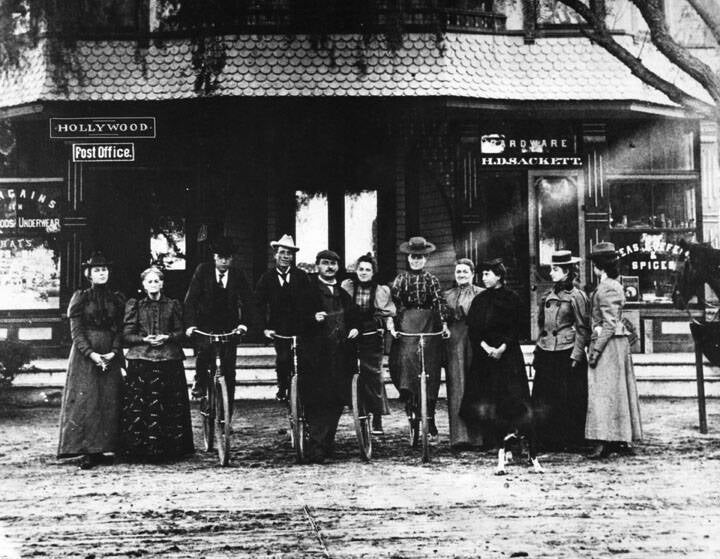
Above is the original Sackett Hotel, which stood at the southwest corner of Prospect Avenue (now Hollywood Boulevard) and Cahuenga Boulevard. At right, members of the Sackett family pose in front of the hotel.
Her most important contribution to early Hollywood came through something far more ordinary than land speculation or grand architecture: the mail. When Hollywood received postal service, Horace carved out a small corner of the hotel for a post office. Surviving accounts vary on the exact year—some place its beginnings in the early 1890s, while stronger local research favors 1897—but Mary became closely associated with its daily operation. Official records indicate that Lineaus Matthews served as Hollywood’s first postmaster, followed later by Philo Beveridge and Harvey Friend, while Mary worked as the postal assistant. Nevertheless, generations of Hollywood histories have remembered her as Hollywood’s first postmistress, and there is little doubt that she was the familiar face actually handling much of the community’s mail. She presided over a modest rack of boxes and earned as much as five dollars a month.
It is worth imagining that scene for a moment. Prospect Avenue was still unpaved. Horses waited outside. Inside the hotel, someone might be buying canned peaches while another guest registered for a room and a neighbor asked Mary whether a letter had arrived from relatives back East. Decades before Hollywood became synonymous with communications and entertainment, Mary Sackett was already helping connect it with the outside world.
By the early twentieth century, Hollywood was changing quickly. The larger Hollywood Hotel at Prospect and Highland began drawing customers away from the Sackett establishment, and in 1905 Horace closed the hotel and sold the property. The old building stood for several years before developer J. P. Creque purchased the site in 1910 for $28,000, demolished the wooden hotel, and replaced it with a substantial commercial building. The corner where Mary had once sorted mail was becoming prime Hollywood real estate.
In 1907, Horace built the family a large residence at 1642 Wilcox Avenue. The two-story Craftsman-style house became another gathering place for early Hollywood. That same year, Mary’s sister Zella Sackett married George H. Dunlop, who became the last mayor of the independent City of Hollywood before its annexation to Los Angeles in 1910. Mary, however, never married.
Her father died at the Wilcox Avenue house in 1918. Ellen remained there with Mary and other family members as Hollywood Boulevard and its surrounding streets became increasingly commercial. Eventually the property grew too valuable and busy for the quiet domestic life the Sacketts preferred. Rather than allow the family home to be demolished, Mary helped save it.

Above, the J. P. Creque Building rises at the southwest corner of Hollywood and Cahuenga Boulevards on the former site of the Sackett Hotel. Below, the same building as it appears today at 6400 Hollywood Boulevard.

On January 2, 1929, they obtained a permit to move the entire house about ten miles to 10739 Kling Street in North Hollywood. The job was extraordinary. Mary later recalled that workers removed the roof so the enormous house could pass beneath trees, then slowly rolled the structure through the Cahuenga Pass. It took a full day to reach Dark Canyon—today’s Barham Boulevard—and another night to maneuver the house along Kling Street. Looking at the dismantled building, Mary feared it could never be reassembled. Yet, she remembered, the movers managed the feat without even breaking a dish left in a kitchen cupboard.
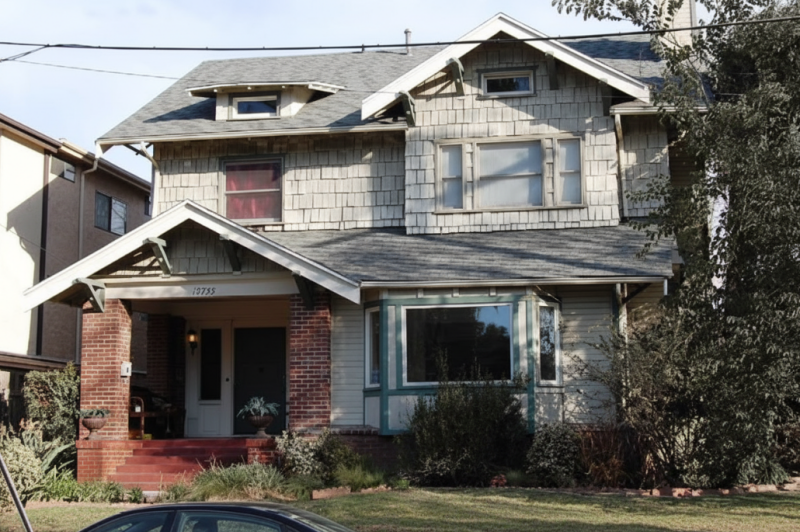
In 1929, Mary Sackett had her family home at 1642 Wilcox Avenue in Hollywood moved to 10739 Kling Street in North Hollywood. Above is the house as seen from the street; below is a view of the rear. The house was demolished in 2022.
This was no little cottage. Mary described a two-story house with an attic and basement, eight bedrooms, two sleeping porches, a sunroom and several additional porches. Six months after the move, her mother Ellen died there on June 21, 1929. Mary and her brother Warren continued living in the house for decades, sometimes taking in tenants.
Then, in 1954, Mary stepped briefly into the new Hollywood she had watched grow around her. At seventy-eight, she appeared as a contestant on Groucho Marx’s You Bet Your Life. The episode aired February 18, 1954, and introduced her as a Hollywood pioneer. Groucho mistakenly called her “Mrs. Sackett.”
“Miss Sackett, if you please,” Mary corrected him.
When Groucho apologized, she immediately replied, “You may be sorry, but I’m not.”
Mary was more than capable of holding her own against one of America’s quickest comedians. She told the audience about arriving in California in 1887, working in the general store and post office, and serving as a ticket agent in early Hollywood. A lifelong abstainer from alcohol, tea, and coffee, she also disapproved of Groucho’s ever-present cigar and calmly asked him to dispose of it. He complied.


Mary Sackett chats with Groucho Marx during her 1954 appearance on You Bet Your Life, where the longtime Hollywood pioneer more than held her own against the legendary comedian.
Mary described herself as “an old maid and proud of it.” She had never been kissed but received marriage proposals. She preferred independence and joked that by then she was far too set in her ways to have a man cluttering up her house.

Mary Sackett takes part in the opening ceremonies for the Wilcox Post Office station. Sackett, long remembered as Hollywood’s first postmistress, served the community’s early postal operations from 1898 to 1906.
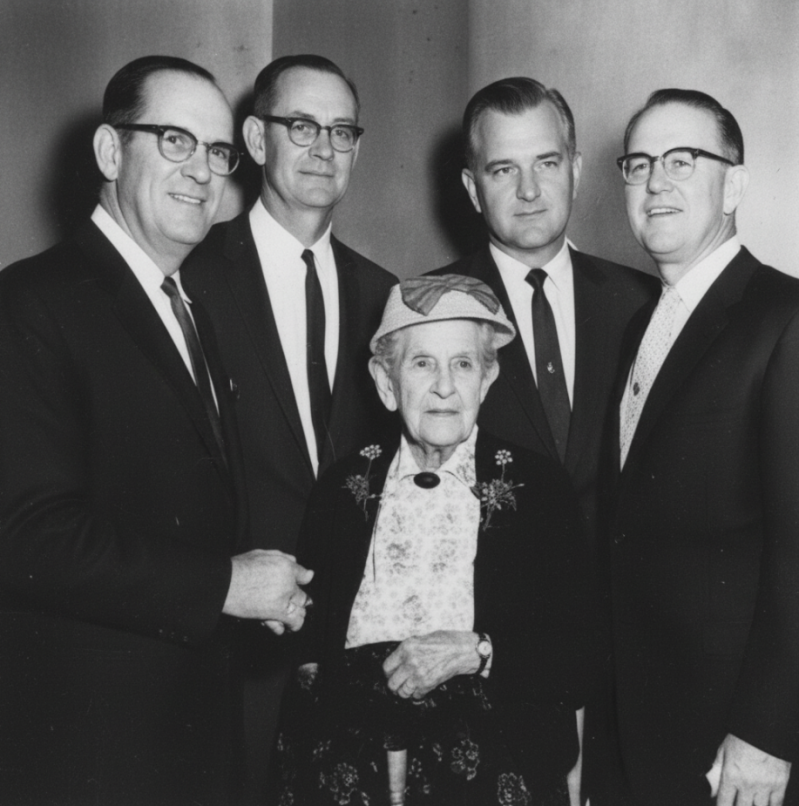
Mary Sackett, center, the oldest active member of the First Christian Church of North Hollywood, joins in the celebration of the church’s 40th anniversary in 1965.
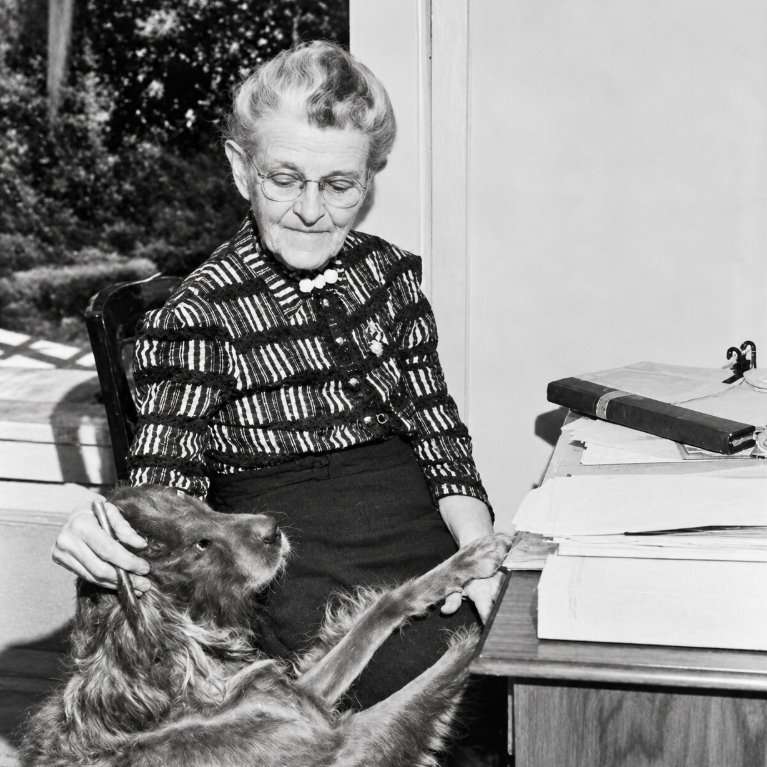
Mary Sackett at her Kling Street home in North Hollywood in 1949, accompanied by her dog.
Mary Sackett lived to the age of 94, carrying vivid memories of pioneer Hollywood into an era she could scarcely have imagined as a young woman. She died on January 31, 1969, while a resident of the California Christian Home in Rosemead, California. A longtime member of Beverly Christian Church, she was survived by her sister, Emily Arnett of Phoenix, Arizona, and several nieces and nephews. Mary was laid to rest in the Sackett family plot at Rosedale Cemetery, reunited with the family whose journey west had helped place them among Hollywood’s earliest pioneers.


Remarkably, the Sackett house outlived her by more than half a century. It remained at 10739 Kling Street, retaining original woodwork, floors and other details, until redevelopment finally caught up with it. Despite surviving its extraordinary 1929 journey from Hollywood to the San Fernando Valley, the approximately 115-year-old house was demolished in 2022 to make way for new construction.
Mary Sackett never became famous in the conventional Hollywood sense. No star bears her name on Hollywood Boulevard. She knew Hollywood when mail was sorted inside her family’s wooden hotel, when Prospect Avenue was still dirt and when reaching Los Angeles, itself could be an expedition. She watched that rural settlement become a municipality, then a neighborhood, then the center of the motion-picture world.
And nearly seventy years after she first stood behind that little postal counter, Mary Sackett sat across from Groucho Marx on television and reminded modern Hollywood that she had been there almost from the beginning.
To the left is the tombstone of the Sackett family, including Mary Sackett, at Angelus Rosedale Cemetery (Section G).
Check back next Friday for the next installment of The Women Who Built Hollywood Before the Movies, when I’ll profile Mary Penman Moll—a pioneering schoolteacher, landowner, and businesswoman who helped shape early Hollywood and the area around Hollywood and Highland long before the movie studios arrived.
Below is a clip of Mary Sackett with Groucho Marx
If you enjoyed my look at Mary Sackett, one of the pioneering women who helped shape Hollywood before the movies, I’d love to hear your thoughts. Please leave a comment, rate the article, and share it with anyone interested in early Hollywood history. Your comments, ratings, and shares help The Hollywoodland Revue reach new readers and keep these remarkable stories alive.
Add comment
Comments