

More than a hundred years after Andrew and Abby Borden were brutally murdered in their house in Fall River, almost every part of Lizzie Borden's life has been examined, explored in detail, and given a dramatic portrayal. The most interesting incident occurred many years after her acquittal in 1893, when she established a close friendship with Nance O’Neil, who was one of the most well-known actresses on the American stage. Even though this friendship only continued for a few years, it caused speculation at the time and has since become a major aspect of the debate about Lizzie's private life and sexuality.
By Allan R. Ellenberger
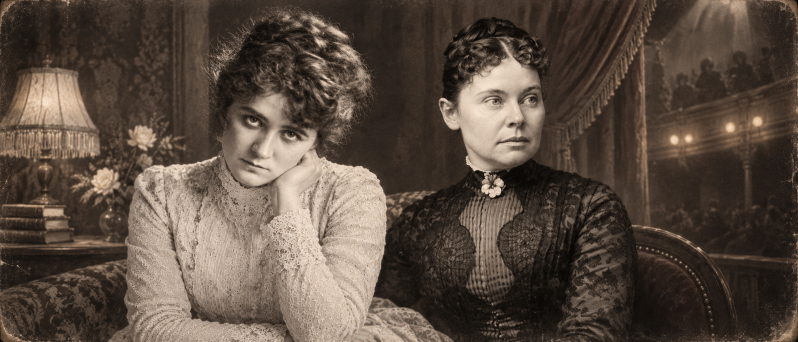
In view of Netflix's Monster: The Lizzie Borden Story, in which Jessica Barden plays O’Neil opposite Ella Beatty as Lizzie, the friendship has become more important. The program features Nance in the account of Lizzie's murder trial and makes use of her in a way that is rather like that of a theatrical advisor. Although this is a dramatic device, it is not based on historical fact; Lizzie and Nance did not meet until 1904, which was more than ten years after Lizzie had been acquitted.
When Lizzie was forty-four she lived at Maplecroft, the pleasant house at 306 French Street which she and her sister Emma had purchased after inheriting their father's estate. Lizzie was starting to refer to herself as "Lizbeth." She was wealthy and went on trips, attended concerts and theatrical performances, and valued the comforts that had mostly been denied to her in her father's tight-fisted household. She had not yet achieved full social acceptance; even though the jury had acquitted her, Fall River had never entirely stopped viewing her as the woman who had been suspected of having killed both her father and her stepmother.
Nance O’Neil came from a wholly different sphere; she was born Gertrude Lamson in Oakland, California on October 8, 1874, and gained a highly impressive reputation as a tragedienne thanks to her height, deep voice, and strong emotional intensity, characteristics that made her especially suitable for taking on roles such as Lady Macbeth, Hedda Gabler, Camille, and other powerful women in the classical and European repertoires. By the 1900s she had carried out extensive tours and had built up a solid reputation in theatre.
It is probable that Lizzie saw O’Neil give a performance in Boston in 1904, since the actress was in the city as part of her engagement in Hermann Sudermann’s Magda. Although the version of the story according to which they first met after a performance of Macbeth is less certain, it is well known what O’Neil said about the incident after Lizzie died in 1927. She had sent the actress a note in which she expressed her admiration for her performance and requested permission to call on her; the note was accompanied by a bouquet.
O’Neil took Lizzie into the backstage section of the Boston Tremont Theatre, just as she did with all the other admirers who visited her dressing room. At first, she had no idea that this quiet visitor was Lizzie Borden; it was only afterwards that someone told her that the woman she had just met was the one who had been on trial for the murder of Andrew and Abby Borden. O’Neil said that it made "not the slightest difference" to her.

Above is Boston’s Tremont Theatre, now demolished, where Lizzie Borden first met actress Nance O’Neil after attending one of her performances.
Her memories are so valuable since they show Lizzie as she really knew her, rather than the wicked figure of folklore, and O’Neil remembered her as a "quiet, reserved, frail little old-fashioned gentlewoman." She remembered her gray eyes, her gray hair, her clear refinement and intelligence, and the fact that Lizzie was well read, enjoyed literature, and had interesting things to say about her trips abroad. O’Neil also recalled her great love of animals and noted that she was a life member of the Boston Animal Rescue League.
The thing that struck O’Neil most was her perception of Lizzie's loneliness. Even though she was wealthy and therefore could have many amusements, the actress believed that Lizzie had always been affected by what occurred in 1892 and appeared to be "always so alone," living a life that was constantly in the shadow of tragedy. Nevertheless, as Nance said, the murders were never mentioned, not even referred to in an indirect way. "I simply felt a great sympathy for her," O’Neil recalled, "and a great deal of admiration for the way she carried on."

Above is Nance O’Neil’s country house in Tyngsboro, Massachusetts, where Lizzie visited for a number of days.
Their friendship soon went beyond the dressing room. Lizzie frequently travelled to Boston to attend plays and concerts and to spend time with a small number of friends. O’Neil said that they met at each other's homes, but her later memories are a bit contradictory regarding the precise places of those visits. It is nevertheless certain that Lizzie went to O’Neil’s country house in Tyngsboro, Massachusetts, close to Lowell, and remained there for a number of days.
Lizzie had always been deeply interested in the theatre. In the company of the actors, writers and all the other unusual people there was a kind of companionship which Fall River had not offered: she could be regarded as a hostess, a patron and a theatre enthusiast rather than merely a well-known former defendant. Nance and her associates led a more liberal and cosmopolitan way of life.
The friendship then became connected to another long-standing mystery in Lizzie's life, as it was in 1905 that Emma Borden had suddenly left Maplecroft and had never lived with her sister again. At that time, the newspaper reports attributed the sisters' separation to Lizzie's association with Nance O'Neil and with people in the theatrical world, and many subsequent writers believed that Nance's presence had in some way caused the break.

Above is Maplecroft, Lizzie Borden’s home at 306 French Street in Fall River, where she entertained Nance O’Neil and members of the actress’s theatrical circle during their friendship.
The evidence, on the other hand, is by no means conclusive. Emma never provided a public reason for the way in which she had left. Although she acknowledged that the circumstances had made it impossible for her to live with Lizzie, she gave no further details. O’Neil later denied having met Emma and argued that she had not spent a great deal of time at the Borden house; yet this denial is at variance with the fact that Lizzie had entertained O’Neil’s theatrical circle and with Nance’s own statement that she and Lizzie had met at each other’s homes.
Speculation has arisen that Lizzie and Nance were romantically involved. Still, no evidence survives—no love letters, no diaries, and no reliable eyewitness accounts—to show the relationship had a sexual aspect. Although they were clearly close and romance is possible, the exact nature of their relationship remains unknown.
Lizzie never got married and instead built close relationships with women, whereas Nance married the actor Alfred Hickman in 1916 and stayed with him until he died in 1931. Yet this information alone is not sufficient to determine with certainty the sexual orientation of either woman.
It appeared that by 1906 the most intense period of their friendship had come to an end, after which O’Neil began touring and the two women became more and more distant. Nance later admitted that they had not written a single letter in the nearly twenty-five years following their parting, and she explained her own incompetence as a correspondent, giving one of the most touching descriptions of their relationship: "We were like ships that pass in the night."
Lizzie remained at Maplecroft until her death, which occurred on June 1, 1927, when she was sixty-six years old, the immediate cause of death being pneumonia; after her health had deteriorated and she had undergone surgery for her gallbladder troubles, Emma died nine days later. The two sisters never reconciled.
After Lizzie had died, whenever the reporters got in touch with O’Neil she answered in a friendly yet careful way. When asked if she could believe that her former friend was capable of committing the Borden murders, she made it very clear that she could not see any link between that act and the person whom she had known. She recalled her as a refined, intelligent and lonely woman, not the monster that the popular legends had depicted her as.
Nance lived for almost thirty-eight more years and kept on with her work in both stage and film, including appearances in movies like Ladies of Leisure and Cimarron. In her later years she resided at the Actors Fund Home in Englewood, New Jersey, and passed away there on February 7, 1965, at the age of ninety; ultimately, her cremated remains were put beside those of her husband, Alfred Hickman, at Forest Lawn Memorial Park in Glendale, California.

Above, Lizzie Borden at Maplecroft shortly before her death in 1927.
The Monster series takes the real friendship between Lizzie Borden and actress Nance O’Neil and reshapes it for drama, placing Nance at the 1893 trial. Historically, however, the two women did not meet until about eleven years later, so Nance had no role in the murders, investigation, or trial.
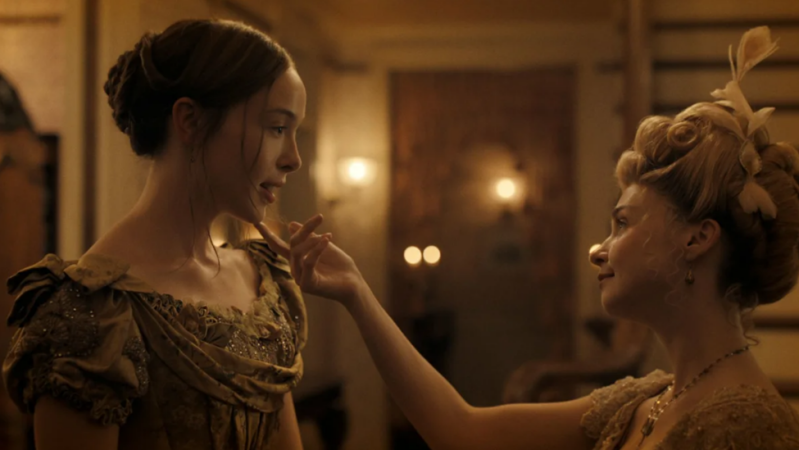
Above is a scene from Ryan Murphy’s Monster: The Lizzie Borden Story, featuring Ella Beatty, left, as Lizzie Borden and Jessica Barden as Nance O’Neil.
Their relationship was clearly close, but its exact nature remains uncertain. Lizzie admired Nance, they visited one another, and Nance later spoke of her with sympathy and affection. Beyond that, the evidence does not allow us to say with confidence whether the friendship was romantic.
Perhaps that uncertainty is what has kept the story alive. Nance knew Lizzie after the trial, after the headlines, and after the public spectacle had faded. Whether she was a lover or simply one of the most important friends of Lizzie’s later life may never be known. What does seem clear is that, for a brief time, she gave Lizzie something rare: companionship without judgment.
Check in tomorrow on The Hollywoodland Revue for my latest commentary, “From Box-Office Bomb to Classic: Could Digger Have the Last Laugh?” Tom Cruise’s Digger may have stumbled badly at the box office, but Hollywood history is filled with films that were dismissed, panned, or ignored on release—only to be rediscovered years later as cult favorites or even classics. Could Digger someday join them?
If you enjoyed my look at Lizzie Borden and Nance O’Neil, I’d love to hear your thoughts. Please leave a comment, rate the article, and share it with anyone interested in true crime, theater history, and the enduring mysteries surrounding Lizzie Borden. Your comments, ratings, and shares help The Hollywoodland Revue reach more readers and keep these fascinating stories alive.

Add comment
Comments