

I have never forgotten seeing The Omen when it was released in the summer of 1976. I was in art school in Pittsburgh and went back to the theater several times. What stayed with me most was not simply the violence or the shocks, but the control Richard Donner brought to the film and the extraordinary music by Jerry Goldsmith. Even after you knew what was coming, The Omen remained unsettling. Nearly fifty years later, it still does, because Donner resisted the temptation to make a conventional monster movie. He treated an implausible story with absolute seriousness, and that made it frightening.
Reviewed by Allan R. Ellenberger
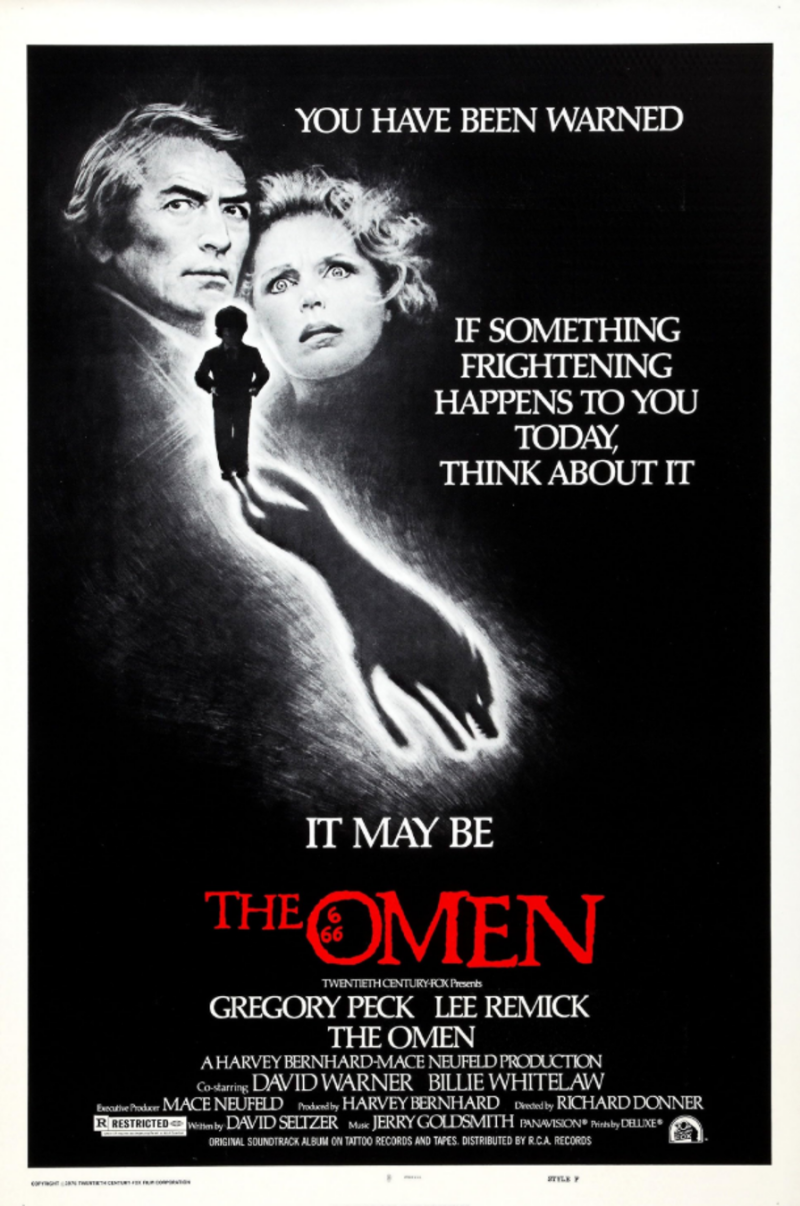
The idea originated with producer Harvey Bernhard, who recalled discussing biblical prophecy and the Antichrist over lunch with a religious friend. Bernhard eventually brought in screenwriter David Seltzer, who fashioned the story into an original screenplay. Seltzer later admitted that he was neither particularly religious nor personally fascinated by the Devil; he approached the assignment professionally and commercially. Early titles included The Anti-Christ and Birthmark, before the much simpler and more ominous The Omen was chosen. The screenplay initially languished at Warner Bros., but Alan Ladd Jr., then at 20th Century-Fox, saw its possibilities and picked it up.
Richard Donner was not yet the major feature-film director he would become with Superman and the Lethal Weapon series. He had spent years working extensively in television and immediately recognized the danger in treating Seltzer’s material too literally. Donner later said he wanted to remove the more obvious devil imagery and approach the story as a mystery and suspense thriller. The deaths and coincidences could suggest supernatural intervention, but the characters behave as if they're trapped in a terrifying real-world situation. That decision gave the picture much of its enduring power.
The plot is deceptively simple. American diplomat Robert Thorn learns that his newborn son has died shortly after birth in Rome. Without telling his wife, Katherine, he agrees to substitute another infant whose mother supposedly died in childbirth. The child is named Damien. Five years later, Robert is U.S. ambassador to Britain, and the family appears idyllic until increasingly disturbing events surround the boy. Damien’s nanny hangs herself during his birthday party, screaming that everything is for him. A sinister replacement nanny, Mrs. Baylock, arrives. Animals react violently to Damien. A priest warns Robert that the child is the Antichrist, and photographer Keith Jennings discovers strange marks in photographs that seem to predict violent deaths. Eventually Robert is forced to confront the possibility that the child he loves may not be human at all.
Casting Gregory Peck as Robert Thorn gave the film instant credibility. Fox initially worried that audiences would not accept one of Hollywood’s most honorable screen figures as a man who might ultimately attempt to kill a child. Roy Scheider was considered, and other accounts mention William Holden, Charlton Heston, Charles Bronson, and Dick Van Dyke as possibilities. Peck, however, was perfect because audiences trusted him. When Robert begins to believe the unbelievable, Peck’s dignity keeps the character grounded rather than hysterical. Lee Remick brought warmth and vulnerability to Katherine, while David Warner gave photographer Jennings an intelligence and understated humor that made his eventual fate especially shocking.
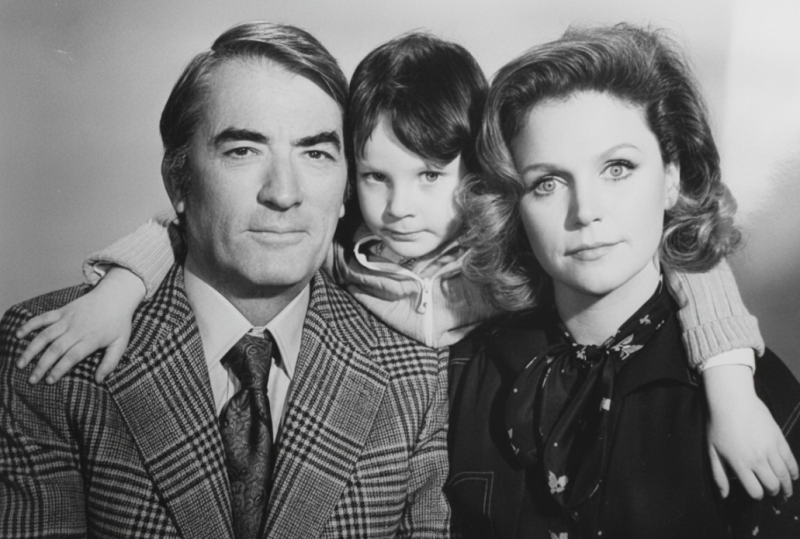
Gregory Peck as U.S. Ambassador to Britain Robert Thorn, Harvey Stephens as his son Damien, and Lee Remick as Robert’s wife, Katherine Thorn, in The Omen (1976).
Perhaps the most inspired casting was Billie Whitelaw as Mrs. Baylock. The character had originally been conceived differently, but Whitelaw’s audition made her colder, darker and more threatening, and Donner reshaped the role around what she brought to it. Five-year-old Harvey Stephens, meanwhile, won the role of Damien after Donner asked prospective child actors to attack him. Stephens reportedly went at the director with such enthusiasm that he got the part; his naturally blond hair was dyed dark for the film. He achieved it by doing very little. Damien rarely behaves like a conventional horror-film child. He watches. He smiles. He remains strangely detached.
Principal photography began in October 1975, with an eleven-week schedule centered at Shepperton Studios and locations around England. The production used Guildford Cathedral, Windsor Safari Park, London’s Grosvenor Square and Bishops Park, Brookwood Cemetery and several Surrey locations, while additional material was filmed in Rome and Jerusalem. The Thorn residence was represented by an imposing English estate, lending the movie the polished appearance of an upper-class political drama rather than a cheap horror picture.
Donner’s direction is particularly effective because he does not rush the supernatural material. He lets dread develop inside ordinary surroundings. One of the best examples is the safari-park sequence, when seemingly harmless animals become terrified of Damien before a troop of baboons attacks Katherine’s car. The sequence was filmed at Windsor Safari Park, and Donner later recalled that Remick’s panic was quite genuine as the animals swarmed around the vehicle. No monster is visible, yet the scene becomes almost unbearably tense.
The deaths are equally memorable because Donner stages them with brutal precision. Father Brennan is impaled by a falling lightning rod after desperately seeking refuge at a church. Katherine plunges from an upper floor after Damien knocks into her. Most unforgettable is Jennings’ decapitation by a sheet of glass sliding from a runaway truck. The scene is elaborate and horrifying, yet Donner allows the buildup to do as much work as the effect itself. The film’s violence arrives suddenly, almost mechanically, as though fate itself has arranged the circumstances.
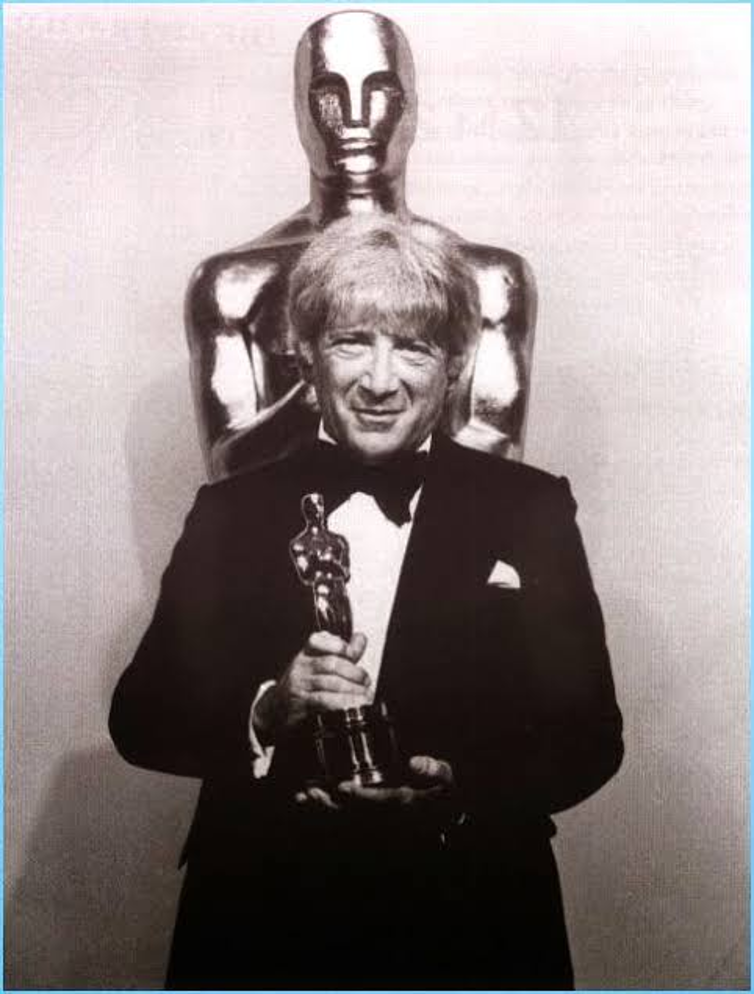
And then there is Jerry Goldsmith’s music. For me, it remains one of the great horror scores. Instead of relying on conventional spooky music, Goldsmith created a satanic choral sound built around the Latin-styled chant “Ave Satani.” The music does not merely accompany the evil; it announces it. The score was nominated for two Academy Awards —Original Score and Original Song —and Goldsmith won the Oscar for his score, the only competitive Academy Award of his long career.
The Omen opened on June 25, 1976, and became a major commercial success. Produced for approximately $2.8 million, it earned about $60.9 million domestically and roughly $78.7 million worldwide according to current box-office tallies. Its opening weekend alone brought in more than $4.2 million from 515 theaters.

Above, director Richard Donner, whose restrained approach gave The Omen much of its power. Below, Jerry Goldsmith accepts the Academy Award for Best Original Score for his unforgettable music for the film.
Critical reaction was mixed but fascinated. Variety praised Donner’s taut direction and strong performances. Roger Ebert gave the film two and a half stars, noting how seriously it treated its supernatural premise. At the same time, The New York Times found it silly but admitted that it moved effectively and sustained curiosity. The public responded far more enthusiastically than some critics. The Omen became one of the defining horror films of the 1970s.

Scott-Taylor as the adolescent Damien and William Holden and Lee Grant heading the cast. It earned about $26.5 million domestically, respectable but far below the original. The Final Conflict followed in 1981, with Sam Neill portraying an adult Damien; its American theatrical return was much smaller. Later came the television movie Omen IV: The Awakening, a 2006 remake and, decades later, the prequel The First Omen. None duplicated the particular combination of restraint, craftsmanship and discovery that made the first film so effective.
What still distinguishes The Omen is how confidently it refuses to wink at its own premise. Donner directs it as tragedy, Peck and Remick play it as tragedy, and Goldsmith scores it like an approaching apocalypse. That seriousness is precisely what frightened me in that Pittsburgh theater in 1976, and it is why I kept going back.
The shocks were memorable, certainly. But the feeling behind them—the growing sense that something terrible had already been set in motion and could no longer be stopped—made The Omen unforgettable.
If you enjoyed my review of the 1976 horror classic The Omen, I’d love to hear your thoughts. Please leave a comment, rate the article, and share it with fellow classic-film and horror fans. Your comments, ratings, and shares help The Hollywoodland Revue reach more readers and keep these great films alive for new generations.
Add comment
Comments