

Long before Elvira, long before the televised horror host became a genre in itself there was Vampira. She was pale, impossibly thin, black-haired and utterly unlike anything that had ever been seen on television. Behind the character was Maila Nurmi, a very intelligent, very eccentric and fiercely independent woman who created one of the most enduring of all television icons of the 1950s and then spent the rest of her life both in the shadow of and defending that icon.
By Allan R. Ellenberger

Maila Elizabeth Syrjäniemi was born December 11, 1922. For many years she stated she was born in Petsamo, Finland and that is the information which appears in most of the contemporary obituaries. Subsequent research (including work by her niece and biographer Sandra Niemi) has established that she was in fact born in Gloucester, Massachusetts to Finnish immigrant parents. Her father Onni Syrjäniemi was a journalist and occasional evangelist, and her mother Sophie was a journalist and translator. The family eventually settled in Astoria, Oregon where Maila completed her high school education in 1940.
Her childhood wasn't exactly easy. The money was always iffy, her dad was frequently away, and her mother had a serious problem with alcohol. Maila worked wherever she could, in a salmon cannery and with a travelling carnival. By 18 she was determined to get out of the small-town life. She headed off to Los Angeles with her striking looks, a real instinct for self-creation and a talent for making her own clothes out of whatever she could lay her hands on.
Hollywood saw her beauty way before they knew what to do with her. She modelled, she sold cigarettes in nightclubs, and she was a hat check girl. She also posed for a number of photographers including Alberto Vargas, Bernard of Hollywood and Man Ray. In New York she was in various productions associated with Mike Todd (Spook Scandals amongst them) and she was in Mae West's Catherine Was Great. Nurmi later recalled that Mae West got rid of her for copying her famous walk a little too well. Director Howard Hawks did in fact consider her as a potential new screen find at one stage but Maila, never one to be shaped by anyone, turned it down.
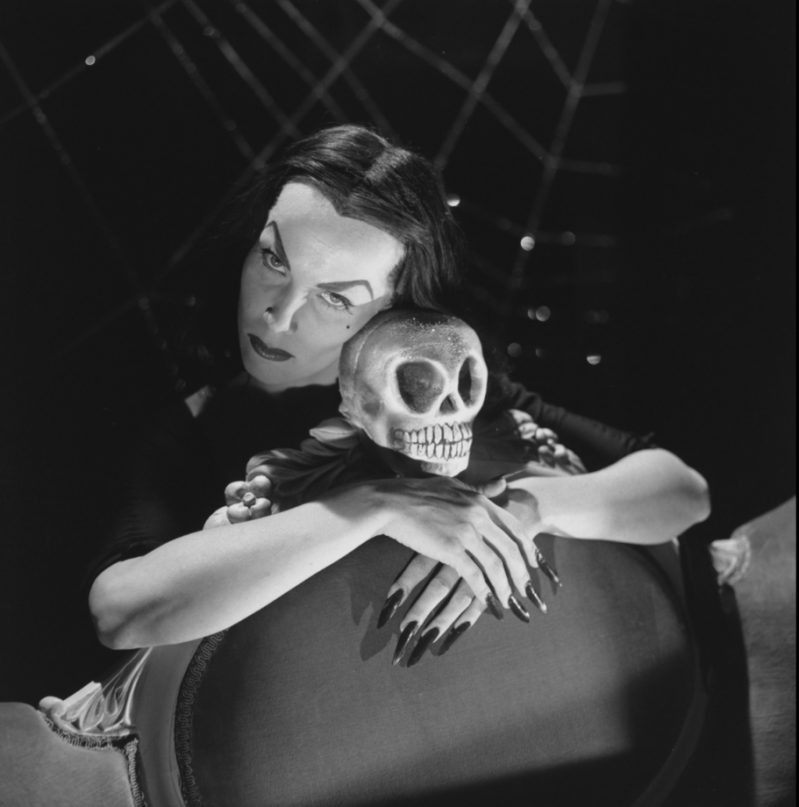
The pivotal moment was 1953 when Nurmi went to a Hollywood masquerade as the anonymous ghastly woman from Charles Addams' New Yorker cartoons. That character would eventually become Morticia Addams. Nurmi took the concept and ran with it, creating a very much more risqué version of the character: a skintight black dress, very deep neckline, long fingernails, corpse white make up, arched eyebrows and a waist cinched to a ridiculous degree. Television producer Hunt Stromberg Jr. reportedly saw photos of the costume and spent months trying to track down the mysterious woman.
When he finally did, Nurmi turned the costume into a full-blown character. She drew on Addams, Norma Desmond, the comic strip femmes fatales, fairy tale witches and her own brand of dark humor. Vampira was the name that completed the picture. On April 30, 1954, she started presenting horror films on Los Angeles station KABC-TV, gliding in through the fog before unleashing her unforgettable scream. She would introduce the old horror films, give macabre recipes, have her pet tarantula and drop a whole load of double entendres which were able to get past the censors as the whole thing was so absurd.
The effect was instant. The Vampira Show became a local phenomenon and then a national curiosity. Life magazine did a photo of her; fan clubs sprang up and Nurmi was on network shows and various promotional appearances. In a time when the average television viewer was a neatly dressed homemaker and the social mores were extremely rigid, Vampira was incredibly sexual, very odd and self-conscious. Nurmi later said that the audience in that day needed something 'outlandish' and she felt that society in general was extremely repressed. She had in fact created the television horror host as a personality in his own right, distinct from the films that were being shown.

Her personal life was just as eccentric. She was married to screenwriter Dean Riesner (later known for Dirty Harry and Play Misty For Me) though that marriage ended in divorce. She had various relationships and friendships with some of the most interesting men in Hollywood including Anthony Perkins, Marlon Brando and James Dean. Her friendship with Dean in particular was very close. They would go to the coffee shops, they'd wander through the cemeteries, and they'd just go out late at night in Los Angeles. After Dean died in 1955, she was very much in his shadow and actually went to séances in an attempt to get in touch with him.
Vampira's television success was actually quite short lived. KABC cancelled the show in 1955 and although Nurmi did manage to rework the character in other places it didn't last. She was in a very difficult financial position as a result and that decline eventually saw her come to Edward D. Wood Jr. (whom she had previously looked down upon). Wood offered her $200 to appear in his rather odd sci-fi film Plan 9 from Outer Space and she took the job as she was desperate for the money. Nurmi was adamant about playing the part without speaking any of the dialogue which she found distasteful.

Released in 1959, Plan 9 from Outer Space went on to become one of the most infamous examples of bad filmmaking. Ironically, the film which Nurmi had feared would utterly destroy her career became the film which ultimately ensured her place in history. Dressed as Vampira she simply wandered through a cemetery with her arms outstretched and thus became inextricably linked with the bizarre world of Ed Wood. She appeared in a number of other films (The Beat Generation, and Sex Kittens Go to College to name but two) but any real acting work pretty much evaporated.
The glamorous years gave way to a far more precarious existence. Nurmi did linoleum laying, carpentry, made drapes, refinished furniture and cleaned houses. She ran a small antique shop and later sold artwork, jewelry and Vampira memorabilia. She never gave up on the character though. When Cassandra Peterson's Elvira became a huge hit in the 1980s Nurmi claimed the character was just too much in the Vampira mold and she took legal action. The courts were not in her camp, but she was absolutely convinced that her character had been copied.
Her reputation was certainly resurrected in the 1990s, particularly with the release of Tim Burton's Ed Wood (1994) which introduced a whole new generation to the wonderfully odd world of Wood and Vampira. Lisa Marie played Nurmi in the film and interest in the actual woman behind the character grew exponentially. By that stage goth had adopted an aesthetic which was pretty much the same as what Nurmi had created all those years previously. People who knew her and people who didn't were increasingly coming to see her as a real cultural original rather than just some obscure television personality.
Maila Nurmi died on January 10, 2008, at her home in Hollywood. She was 85. She had no children and had lived very modestly all her life, but she left behind exactly what she had always said was important to her: Vampira. Vampira had survived.
Nurmi was buried at Hollywood Forever Cemetery (Griffith Lawn) with a black stone bearing her name and the word 'Vampira' and the appropriate epitaph 'Hollywood Legend'. Hollywood Forever continues to pay tribute to her, hosting a gathering at her grave in 2022 to mark what would have been her 100th birthday.
Vampira's television show is essentially lost and her notoriety at the height of it was very brief. The image she created though has survived for over seventy years. Maila Nurmi took all the elements of horror, glamour, comedy and sexuality and put them together to create something that television had never seen. She got a very brief moment in the limelight from Hollywood. She made herself immortal in the process.

Maila Nurmi's tombstone before being vandalized with numerous lipstick marks. Griffith Lawn, Sect. 7, Lot 203, Space 1-Cr. (Photo: Findagrave/Scott Michaels).
Check in tomorrow on The Hollywoodland Revue as Halloween Week continues with my look at the making of The Exorcist. Behind one of the most terrifying films ever made were difficult casting decisions, dangerous practical effects, injuries, a devastating set fire, real-life deaths, and the stories that helped create the legend of an “Exorcist curse.” Tomorrow, I separate the documented facts from the mythology behind this horror classic.
If you enjoyed my look at Vampira at Hollywood Forever, I’d love to hear your thoughts. Please leave a comment, rate the article, and share it with anyone interested in classic horror, old Hollywood, and the unforgettable Maila Nurmi. Your comments, ratings, and shares help The Hollywoodland Revue reach new readers and keep these remarkable Hollywood stories alive.
Add comment
Comments