

Hollywood in the 1920s was a place where almost anything seemed possible. Fortunes appeared overnight, unknown actors became international idols, orange groves became movie studios, and painted scenery could turn Southern California into ancient Rome before lunch. Perhaps it was inevitable that a town devoted to creating illusions would also become fascinated by another invisible world—the realm of spirits, séances, astrologers, clairvoyants, reincarnation and messages from the dead.
By Allan R. Ellenberger
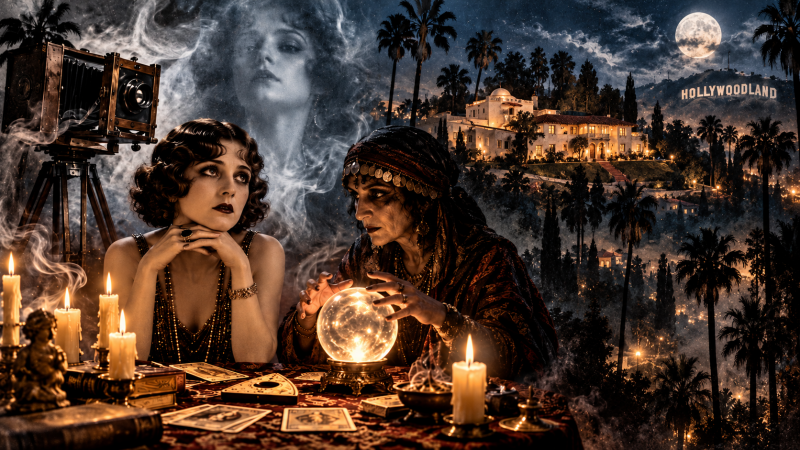
The occult did not arrive in Hollywood with the movies. Spiritualism had flourished in America since the nineteenth century, while Theosophy, astrology and other esoteric movements already had devoted followers. But the years surrounding World War I and the influenza pandemic of 1918 gave belief in communication with the dead a terrible new urgency. Millions of families had lost sons, husbands, wives and children. For many of the bereaved, a séance was not parlor entertainment. It offered the possibility that death had not completely severed the conversation. The silent-film era, which roughly coincided with this revival, absorbed that fascination almost immediately.
Los Angeles proved particularly fertile ground. During the 1920s, the city filled with mystics, alternative religions, spiritual teachers and people promising access to hidden knowledge. Newspapers carried advertisements for clairvoyants, palm readers, astrologers and mediums offering advice about love, money and the future. City authorities periodically tried to regulate the business, especially when fortune-telling shaded into fraud, but the clientele remained plentiful. The same city attracting thousands of ambitious newcomers hoping to become movie stars also offered an extraordinary assortment of people willing to tell them whether the stars—celestial rather than cinematic—favored their chances.
Hollywood even had an organized center of esoteric study in its hills. The Theosophical Society established the Krotona community in Hollywood in 1912 on property near what is now Vista Del Mar Avenue. Its members studied comparative religion, philosophy, and what they described as the unexplained laws of nature and humanity's latent powers. Krotona included residences, classrooms, and the Grand Temple of the Rosy Cross, all within walking distance of the rapidly expanding movie colony below. The American Theosophical Society maintained its headquarters there until 1920, and the Hollywood community continued until its activities shifted to Ojai during the 1920s.

The Krotona colony of Theosophists, established in Hollywood in 1912, served as the national headquarters of the Esoteric Section of the American Theosophical Society and, for a time, as headquarters of the Society itself.
The surviving Krotona buildings remain an extraordinary physical reminder that metaphysical Hollywood was not simply a newspaper invention.
By the middle of the decade, occultism had become such a Los Angeles institution that it could support its own publications. The Occultist, founded in Los Angeles in 1926, described itself as devoted to “Occult Science and Philosophy.” Its editor, George Hayes Beasley, was both a Hollywood screenwriter and astrologer. The magazine became a print gathering place for the smaller figures in Southern California’s metaphysical world, where entertainment, astrology, and esoteric philosophy could easily overlap.
Hollywood’s movies reflected the same curiosity. Séances, fortune tellers and clairvoyants appeared repeatedly in silent films, sometimes treated seriously and sometimes as comic frauds. As early as 1911, Billy’s Séance turned table-rapping and occult tricks into a comedy. In The Fortune Teller (1920), the profession became a central dramatic device. Movies were uniquely equipped to visualize ghosts because the camera itself seemed magical. Double exposures, superimpositions, and other photographic tricks could make a transparent figure materialize beside the living, walk through a wall, or disappear before an audience’s eyes.

That same technology helped create one of the strangest branches of the occult craze: spirit photography. Photographic mediums claimed that the camera could record what the eye could not see. A sitter might pose for an ordinary portrait only to discover, when the plate was developed, a misty face hovering behind a shoulder. Believers saw it as evidence that the dead remained nearby. To skeptics, it was proof only that photographers understood double exposure, prepared plates and darkroom manipulation.
The argument became international. In 1923, Scientific American offered substantial cash prizes for convincing demonstrations of psychic phenomena, including authentic spirit photography, under controlled conditions. Among the investigators was Harry Houdini, the world’s most famous magician and increasingly the most relentless enemy of fraudulent mediums. Houdini knew too much about illusion to be easily impressed by floating trumpets, mysterious knocks and messages appearing on slates. He could reproduce many supposed miracles himself, and he believed dishonest mediums were exploiting grief for profit.
Hollywood became one of the battlegrounds in that debate. Houdini appeared in Los Angeles in April 1923 lecturing against fraudulent mediums and “miracle mongers.” Almost simultaneously, one of Spiritualism’s most famous defenders arrived in the city. Sir Arthur Conan Doyle, creator of the relentlessly logical Sherlock Holmes, had become an ardent believer in communication with the dead. At Trinity Auditorium in Los Angeles, he delivered a series of lectures—“The Life Beyond,” “Personal Psychic Experiences,” and “Recent Psychic Evidence.” The juxtaposition was irresistible: the creator of fiction’s greatest detective championing spirits while the world’s greatest illusionist demanded proof.
The fascination reached directly into the movie colony. Rudolph Valentino and his second wife, Natacha Rambova, became associated with Spiritualism, an interest that grew particularly prominent in accounts published after Valentino’s death on August 23, 1926. Rambova’s later memoir included purported communications from Valentino obtained through séances. His sudden death at thirty-one then created exactly the kind of emotional atmosphere in which Spiritualism flourished. Admirers wanted desperately to believe that the Great Lover had not vanished altogether, and mediums began claiming communications with him. His crypt at Hollywood Cemetery eventually attracted stories of supernatural experiences, séances, and visitors convinced that Valentino’s presence remained nearby.
Even behind the cameras, mysticism had adherents. June Mathis, the powerful screenwriter and executive instrumental in making Valentino a star in The Four Horsemen of the Apocalypse (1921), was widely described as having strong spiritual and metaphysical beliefs. Such interests were hardly incompatible with success in Hollywood. In a business where executives routinely tried to predict public taste and actors lived with the terrifying uncertainty of their next contract, astrology and fortune-telling must sometimes have seemed no less rational than the studio system itself.
However, the craze had another side. Los Angeles authorities repeatedly encountered fortune tellers and supposed mediums accused of fraud, extortion and other abuses. Newspapers alternated between fascination and ridicule. For every sincere Spiritualist seeking consolation after a death, someone was willing to manufacture a ghost for money. Hollywood understood that contradiction particularly well. The same town that believed in magic also employed thousands of people whose job was to manufacture it.
The silent era ended, but Hollywood’s conversation with the supernatural did not. Its most spectacular epilogue came on Halloween night, October 31, 1936, ten years after Houdini’s death. On the roof of Hollywood’s Knickerbocker Hotel, Houdini’s widow, Bess, made her final highly publicized attempt to contact him.

Natacha Rambova (above) and screenwriter June Mathis (below) were among the Hollywood figures drawn to spiritualism and metaphysical ideas during the silent era. Rambova became especially associated with séances and attempts to communicate with Rudolph Valentino after his death, while Mathis was known for her interest in spiritual and occult beliefs.

About 300 invited spectators gathered around a table holding objects associated with the magician. At the same time, Bess and her associates waited for the secret message Houdini had promised to send if communication from beyond the grave proved possible. Nothing came. After ten years, Bess finally extinguished the light she had kept burning for him.
There could hardly have been a more appropriate setting. Below them was Hollywood, the city that had spent a generation making dead images move, making invisible things visible and convincing audiences that shadows projected on a wall were alive. Spiritualists and filmmakers had, in their own very different ways, promised much the same miracle.
For a brief, strange period in early Hollywood, the distance between a darkened movie theater and a darkened séance room could seem remarkably small. In both places, people sat quietly while the lights went down and waited for ghosts to appear.
Check in tomorrow for a new post about the haunted second floor of Chuck Lorre Productions and the ghosts of Warner Bros. Above the laughter, writers’ rooms, and hit sitcoms, strange stories have lingered for years. Who—or what—may still be roaming the halls? Come back for one of Hollywood’s eerier behind-the-scenes tales.
Did you enjoy “The Silent-Era Occult Craze”? Please take a moment to comment, rate, and share the post. Your feedback and shares help The Hollywoodland Revue reach more readers who love Hollywood history, strange stories, and the forgotten corners of the film industry.

Add comment
Comments