

Hollywood has a habit of erasing its own history. A house where a silent film star once lived becomes an apartment building. A studio disappears beneath a shopping center. Even surviving buildings lose their stories as generations pass and neighborhoods change. Before long, nobody remembers who lived there or why the place mattered. E. J. Fleming understood that better than most. For decades, he collected the addresses of the people and places that made Hollywood what it was, from legendary stars and notorious scandals to forgotten character actors, technicians, and ordinary people who worked in the motion-picture industry. His Movieland Directory became an invaluable resource for researchers who believe Hollywood history isn't confined to studio archives. Much of it still exists on the streets where these people lived.
By Allan R. Ellenberger
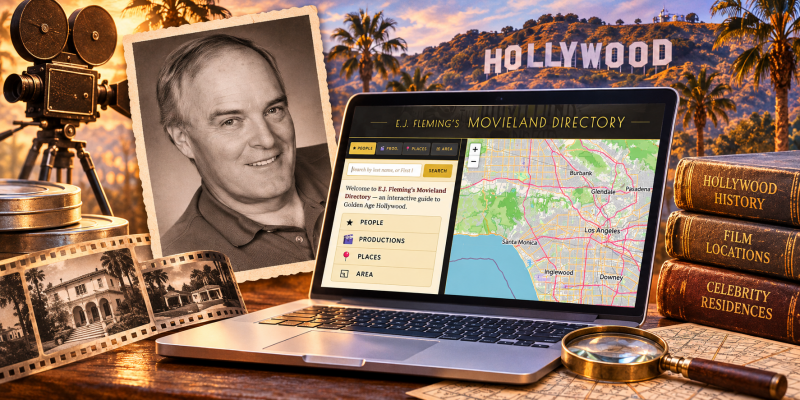
When Fleming died unexpectedly in 2020, his remarkable collection faced an uncertain future. The original website had disappeared, leaving researchers without one of their most useful tools.
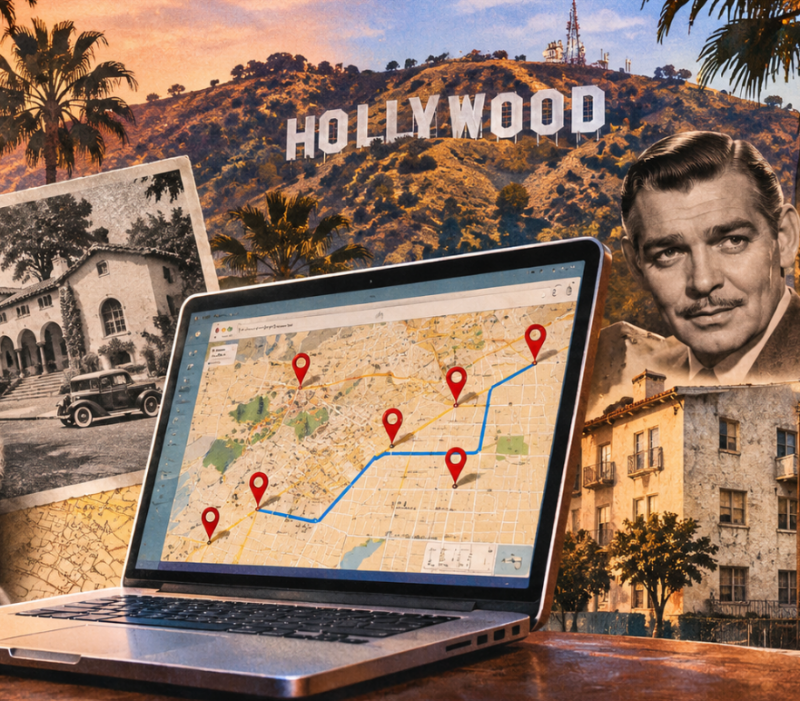
Now comes some welcome news. E. J. Fleming's Movieland Directory is back online, rebuilt by his brother Tony Fleming, who helped create the original website nearly twenty years ago. The redesigned version, available at https://diypoi.com/movieland/, preserves E. J.'s research while offering interactive maps, neighborhood searches, and customized driving tours. For those of us who spend our time digging into Hollywood's past, this is more than a website's return. It preserves a fellow historian's life's work.
Edward Joseph Fleming IV was born on October 10, 1954, in South Bend, Indiana, and grew up in East Longmeadow, Massachusetts. He was an avid reader, enthusiastic traveler, and an intensely curious man whose interests extended far beyond Hollywood. Civil War battlefields, New England history, and difficult subjects that others preferred to avoid all attracted his attention.
His fascination with Hollywood began during early trips to Los Angeles. Tony recalls that his brother took Scott Michaels' Grave Line Tours and explored the city using celebrity star maps purchased along Sunset Boulevard.
“He loved it all,” Tony said, recalling how E. J. returned with photographs of Jimmy Stewart's house, Ray Bolger's former residence, and the location of Sharon Tate's murder. “He saved it all. And started typing.”
That last observation explains a great deal about Fleming. Most tourists returned home with photographs and memories. E. J. returned with research material. One address led to another. Biographies supplied new leads, as did voter registrations, ship manifests, census records, and other documents most people would never consider recreational reading. According to Tony, his brother even read census records to pass the time.
“In a sense, I suppose the sheer size of the endeavor speaks to E. J.'s obsessive personality,” Tony explained. “Wholly apart from Hollywood history, if there was a subject which interested E. J., he immersed himself in it.”
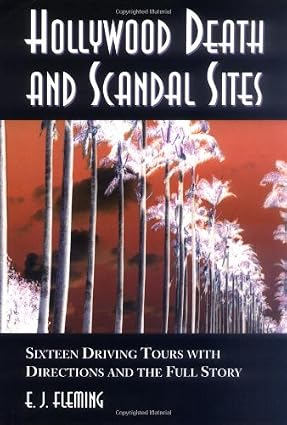
That determination produced several important Hollywood-history books, including Hollywood Death and Scandal Sites, The Fixers: Eddie Mannix, Howard Strickling and the MGM Publicity Machine, and biographies of Wallace Reid, Paul Bern, and Carole Landis.
Fleming was particularly interested in troubled personalities and uncomfortable stories that exposed the machinery behind Hollywood's carefully manufactured image.
But the directory was something different. Fleming wanted to know who had lived where, when they lived there, and how those addresses connected to the industry's larger history.
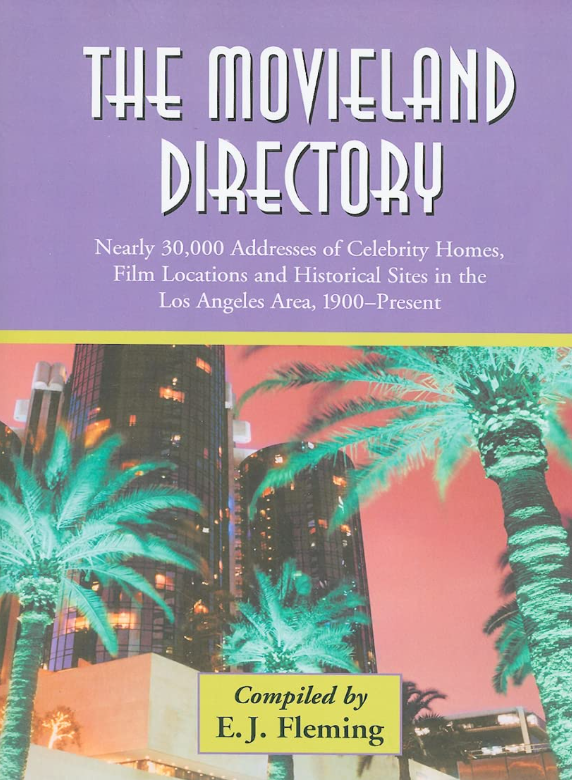
In 2004, McFarland published The Movieland Directory: Nearly 30,000 Addresses of Celebrity Homes, Film Locations and Historical Sites in the Los Angeles Area, 1900–Present. An updated edition followed in 2010. Yet the printed volumes represented only part of his research. His electronic database continued to grow.
One of my favorite examples of Fleming's detective work appeared in a 2008 post on the original Movieland Directory blog. While examining 1926 voter registrations, he found an address for a struggling young actor named William C. Gable, living with his wife, Josephine, at 5832 Carlton Way. The future Clark Gable had not yet become a star. He was another hopeful actor trying to establish himself in Hollywood. Fleming's discovery documented a largely forgotten chapter of his early career.
That is precisely why this kind of research matters. A famous actor's mansion is relatively easy to locate. The modest residence where he lived before anyone knew his name is another matter. Fleming was interested in both.
He also recorded the addresses of stunt performers, character actors, and technicians whose contributions rarely attracted public attention. Hollywood was built by far more people than those whose names appeared above theater marquees, and Fleming understood that their stories deserved preservation.
Tony Fleming played an essential role in making this information accessible. Although he did not share his brother's consuming interest in movies, he possessed the technical and database skills necessary to organize the growing collection.
“E. J. and I talked and exchanged emails three to five workdays a week,” Tony recalled. He sometimes accompanied his brother on research excursions through Whitley Heights, Benedict Canyon, Laurel Canyon, and Topanga Canyon. E. J.'s storytelling, combined with the architecture and scenery, made the outings enjoyable even for someone without a particular interest in Hollywood history.
Initially, E. J. maintained his addresses in a word-processing program. Tony helped transfer the information into Excel, making it easier to organize and search. The brothers even considered distributing an interactive version on CD-ROM before deciding to develop a website.


With help from a programmer, Tony knew through work, the original Movieland Directory website appeared in 2006. Visitors could search for Hollywood personalities, discover their associated addresses, and follow connections between people and properties.
“The database and the first website was a team effort between E. J. and me,” Tony explained. The site remained largely unchanged for years, apart from a major database update in 2012.
By then, the collection had grown to approximately 97,000 records covering more than 53,000 unique addresses. The figures were astonishing, but Tony offered a wonderfully realistic explanation of what they represented. “The practical impact is that a human has to build all those records one at a time. Over many years,” he said. “E. J. spent a lot of time smoking cigars, reading and typing.”
Then life intervened. E. J. continued writing books, while Tony pursued his career and family responsibilities. The website remained largely unattended after 2012, and the brothers eventually lost control of the original domain name.
On August 31, 2020, Fleming died unexpectedly at his Connecticut home at the age of 65. His passing raised a question familiar to anyone who has spent years collecting historical material: What happens to the research when its creator is gone? Much of E. J.'s digital work was difficult for his family to access, but fortunately Tony had retained the address database. “Despite the loss of E. J.'s digital life, I always had the address data,” Tony told me. “I was ‘the data guy’. Like E. J., I didn't throw away anything.”
After retiring from AT&T in December 2022, Tony eventually found the time to revisit the project. His career had given him considerable experience with databases, digital mapping, and software development. By early 2026, he was ready to bring the directory back.
The rebuilding process was remarkably different from the original undertaking. Instead of working with a human programmer, Tony used Claude, an artificial-intelligence coding assistant, to help develop the new site. His technical experience let him direct the work and evaluate the results.
The first working version appeared on his computer in February 2026. The web-based version followed in March, and he has continued refining it ever since. The redesigned directory is a far more versatile research tool. Visitors can search for people, addresses, and filming locations, then explore their connections on an interactive map. Search for Jean Harlow, for example, and her associated addresses appear. Select a property and the directory can reveal other entertainment-industry people connected with that location.
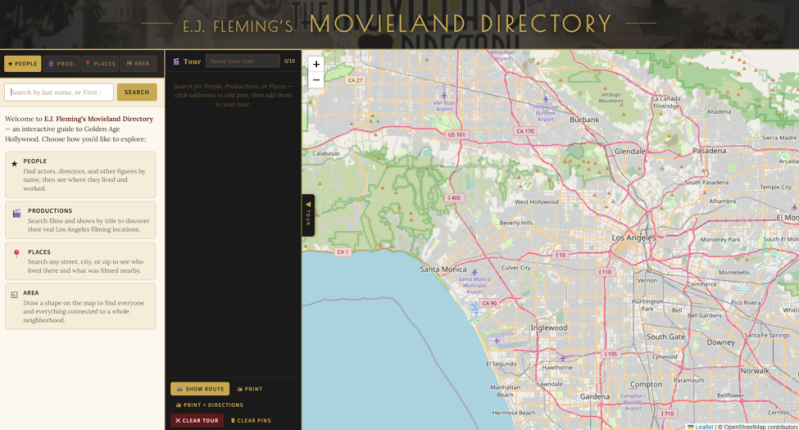
One particularly useful feature allows researchers to draw a boundary around a neighborhood and discover the Hollywood personalities associated with that area. Another lets visitors assemble customized driving tours, rearrange stops, and generate directions.
These improvements are especially valuable because Hollywood history is geographical. Streets, apartment buildings, former studio lots, and hillside residences provide the physical settings for stories that otherwise survive only in photographs and newspaper clippings.
Tony has deliberately preserved E. J.'s original address database rather than turning it into an endlessly updated record of contemporary celebrity residences. The collection contains no new address entries after 2012, which researchers should keep in mind when using it.
He still wants to make improvements, including a version better suited to smartphones and ways to incorporate additional historical stories. Tony also mentioned my work and Scott Michaels's as examples of location-based research that might eventually connect to the directory.
That possibility particularly interests me. Imagine researching a Hollywood address and finding not only the names of former residents but photographs, newspaper accounts, and detailed histories explaining what happened there.
Of course, an address directory should never replace original research. Buildings disappear, street numbers change, and historical records sometimes contradict one another. Significant discoveries still deserve verification through contemporary documents. But Fleming's collection offers starting points researchers might never otherwise find.
What I particularly admire about this revival is that Tony has not attempted to reinvent his brother's work. He has preserved the original research and given it a better way to reach people. Tony recalled that some users of the directory discovered connections to relatives who worked in the movie industry without ever becoming celebrities. Those discoveries delighted both brothers. They appreciated the forgotten names and unexpected connections that make historical research so rewarding.
Asked what E. J. would think if he could see the new website, Tony responded immediately. “He'd love it. And he'd have ideas for improvements.” I suspect he would. Anyone who spent decades collecting tens of thousands of addresses was unlikely to consider the job finished.
Too much Hollywood history has already been lost through demolition, neglect, and indifference. Fleming's directory cannot save an endangered building or restore a vanished neighborhood, but it can preserve the knowledge that something important once happened there.
Thanks to Tony Fleming, his brother's remarkable research is once again available to historians and anyone curious enough to turn down an unfamiliar Hollywood street and wonder who might have lived there. E. J. Fleming's Movieland Directory has returned, and Hollywood's past is a little easier to find because of it.
Special thanks to Tony Fleming for his valuable assistance in researching this article. Visit the revived website at The Movieland Directory
E. J. FLEMING’S MOVIELAND DIRECTORY IS BACK! Discover how Tony Fleming revived his late brother’s remarkable Hollywood history website in my latest remembrance, featuring Tony’s personal recollections. Please read, comment, rate, and share! Help keep Hollywood history alive!
Profiles & Remembrances is an ongoing series at The Hollywoodland Revue devoted to writers, historians, archivists, collectors, and cultural stewards whose work has helped preserve and interpret Hollywood’s past. These profiles are independently researched and written to document contributions, context, and legacy—ensuring that the people who keep Hollywood’s history alive are not forgotten.
Add comment
Comments