

How many readers remember Tiny Naylor’s Drive-In? Motorists coming up to the northwest corner of Sunset and La Brea used to have one of Hollywood's most unique sights. There was a vast winged roof under which cars would gather around a restaurant that was brilliantly lit. Carhops in uniform would come out and serve you your meal. You could eat in your car, movie stars would come in and have their meal in their car, the teens would drive past hoping to see a celebrity and the hungry night owls would know they could have a meal at any time of the night. That was Tiny Naylor's Restaurant and Drive-In at 7101 Sunset Boulevard. It was one of the landmarks of Hollywood, as much a part of the Hollywood scene as the studios, the theatres and the nightclubs.
By Allan R. Ellenberger

For over thirty years Tiny Naylor's was the very definition of a Southern California establishment in terms of its cars, its architecture, its food and its showmanship. It was a very early example of the Googie style of architecture, and its founder William Wallace "Tiny" Naylor was one of the most successful restaurateurs in the area. It ultimately did fall victim to redevelopment and there was an unsuccessful campaign to preserve it.
The site had a history of serving motorists prior to Naylor's arrival. In the 1930s, McDonnell's Drive-In was on the site as part of a chain of restaurants founded by Melvin "Rusty" McDonnell. It was a circular building with parking spaces for cars all around it, enabling the customer to have their meal without having to get out of their car. By 1938, McDonnell's had eight conventional restaurants and six drive-ins (the Sunset and La Brea restaurant being one of them). The ads were full of promise with respect to sandwiches and complete meals served in the car. It was a very attractive proposition in a city which was increasingly organized around the motorcar.
In 1948, Naylor took over about a dozen of McDonnell's locations (including the Sunset Blvd. one) and started the business under his own name. Naylor was born July 12, 1898, in Keswick, Iowa. He came from humble beginnings and made himself quite a bit of money in the restaurant business. A very large man (6'4" and over 300 lbs.) he was given the nickname "Tiny" which he adopted as his business name. His early ventures were in the Tiny's Waffle Shops in Central California, and he went on to build up a substantial restaurant empire. In 1948, he opened Biff's Coffee Shop at Cahuenga Blvd. and Yucca Street in Hollywood (named for his son).
Naylor engaged architect Douglas Honnold to turn the former McDonnell's into a restaurant of a totally different kind on Sunset. It's often dated to 1949 but building permit records show that the permit for the remodel was actually obtained in February 1950. The design was very much in keeping with the spirit of the postwar period when aircraft, cars and the prospect of space travel were all the rage in commercial architecture. The cantilevered roof was obviously intended to suggest the wings of an aircraft about to take off. There was also a very prominent glass wall, lots of illuminated signage and a large car service area which made it a very impressive looking establishment at night.

Pictured above is McDonnell’s Drive-In, the original restaurant at the northwest corner of Sunset Boulevard and La Brea Avenue, before it was replaced by Tiny Naylor’s.

Above, William Wallace “Tiny” Naylor, founder of Tiny Naylor’s Drive-In, and his wife, Milla, enjoy an outing at the Turf Club at Santa Anita Park.

A nighttime view of Tiny Naylor’s Drive-In at the northwest corner of Sunset Boulevard and La Brea Avenue, its distinctive architecture and illuminated signage lighting up the Hollywood intersection.
Honnold was already well known in the world of adventurous commercial architecture having worked with John Lautner on the Coffee Dan's restaurants in Hollywood. At Tiny Naylor's the architecture was very much a part of the business. It provided a functional canopy over the customers and carhops, but it also made the restaurant virtually impossible to miss. The building in itself was the most effective advertisement.
Inside and out, Tiny Naylor catered to different types of customers. The dining room was for those who wanted the full restaurant experience, the carhop service was for the people who just wanted to sit in their car and have the food brought to them. It was open twenty-four hours a day and drew in studio people finishing their shifts, night-clubbers, families and the young folk who treated Sunset Boulevard as their playground. The Hollywood types were known to like the relative anonymity of eating in your car, particularly if you didn't want to be seen.

Above, is the menu cover for Tiny Naylor's Drive-In. Below, the crypt of founder William Wallace “Tiny” Naylor and his wife, Milla, at Forest Lawn Memorial Park in Glendale. (Photo: Findagrave).


The menu was far more substantial than the standard drive-in fare of hamburgers, French fries and milkshakes. They had steaks, ribs, baked potatoes and corn on the cob. The emphasis was on good quality food, prepared fresh and served in a relaxed, informal way. In 1953, Naylor applied for a liquor license.
In the 50s and 60s, Sunset was a very popular cruising route with the drive-ins being the place where the kids would go to look at the cars, meet up with their mates and just watch the parade as it passed. Tiny Naylor's was right at the intersection which became the famous 'Dead Man's Curve' in Jan and Dean's 1964 recording of that song. The restaurant itself wasn't mentioned in the lyrics, but it was in the very heart of that world of teenage car culture.
Naylor's own life ended suddenly on August 17, 1959. He was at a horse auction at the Del Mar racetrack and suffered a fatal heart attack just after he'd placed the highest bid of $18,500 on a broodmare. He was in the process of signing the sales slip when he collapsed and was taken straight to Scripps Hospital in La Jolla where he was declared dead. He was 61.
By that stage, Naylor had over thirty restaurants in Southern California, including the Tiny Naylor's chain. He also owned Eddie Arcaro's on the La Cienega Strip with jockey Eddie Arcaro and had a part interest in the Riviera Hotel in Las Vegas. A keen thoroughbred man, he had a large horse breeding operation in Riverside and lived at 362 Copa de Oro Road in Bel-Air.
Naylor had been married twice, first to Pearl Catharine Klein in 1921 and then to Hattie Camilla "Milla" Oranges in 1938. He was buried at Forest Lawn Memorial Park in Glendale in the Freedom Mausoleum. Milla was buried beside him after her death in 1984.
His death didn't in any way put an end to the business that bore his name. Tiny Naylor's remained a Hollywood institution right through the 1960s and 70s with carhops serving up families and motorists under its huge canopy. In 1977, the exterior of the place was used in Deadman's Curve (the television movie about Jan Berry and Dean Torrence, released 1978). It was one of the things that helped to recreate 1950s Los Angeles at night, and it was on film before it was ultimately destroyed.
By the early 1980s, the car-based dining culture which had underpinned Tiny Naylor's was in terminal decline. The pressures of rising property values and redevelopment were increasingly going to impact the drive-ins of Los Angeles. Some published histories get this wrong and state that Tiny Naylor's closed in 1980. The Sunset and La Brea site was still going in November 1982. It finally closed in March 1984 when plans were put in place to replace the landmark with a commercial development.

In 1984, Tiny Naylor’s president Michael Guarnieri turned back the clock, offering 1961 menu prices as the landmark Hollywood drive-in prepared to close its doors for good.
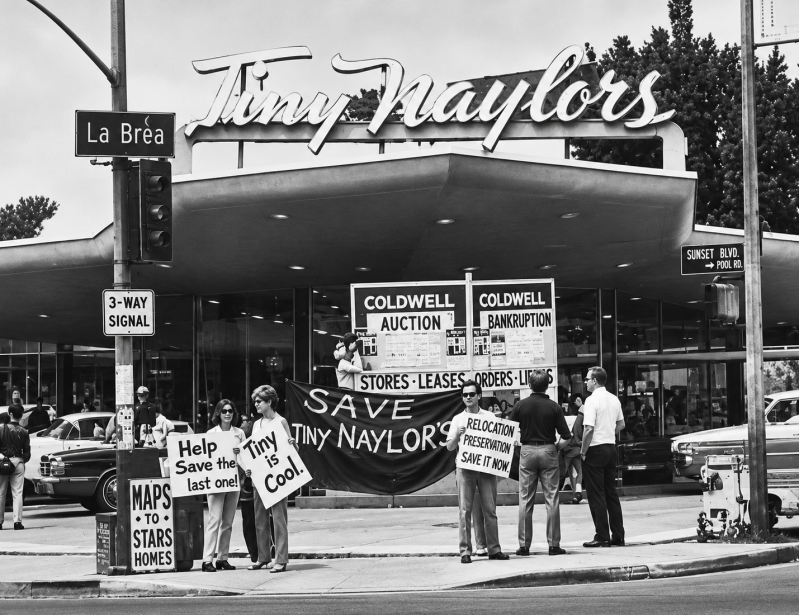
Protesters gather outside Tiny Naylor’s Drive-In in a last-ditch effort to save the Hollywood landmark from demolition in 1984.
The announcement was a real shock to the architectural preservation world who were all aware of the significance of Honnold's design. The Los Angeles Conservancy was scrambling to find a property owner who would take the building on and move it. Developers had agreed to donate the building to the Conservancy, who in turn were looking for a property owner with a vacant site and use it as a coffee shop or for some other purpose. The plane silhouette and the cantilevered roof were the features specifically highlighted as being of considerable architectural merit from the 1950s.
Unfortunately, no rescue was successful. The Los Angeles Times ran an ad for a public auction which was to take place on March 13, 1984. It was under the heading "Hollywood's Historical Landmark" that the ad announced the sale of the restaurant's fixtures, seating and kitchen equipment. The ad invited the public to come and buy a piece of Hollywood history as the famous drive-in went under the hammer.
Tiny Naylor's went down in June 1984. The loss of that along with the loss of Ship's in Westwood that same year was a major catalyst for the formation of the Fifties Task Force of the Los Angeles Conservancy (which eventually became the Modern Committee). The loss of those two buildings became the very thing that galvanized the preservation movement to go out and save other examples of 1950s architecture.
The property was subsequently redeveloped for commercial use (the restaurant's sweeping canopy, glass walled dining room and the familiar auto service areas all gone). Nothing of Honnold's original building remains, though there are of course photographs by Shulman, Marvin Rand, Roy Hankey and others which capture its rather extraordinary appearance.
Today the northwest corner of Sunset and La Brea looks nothing like the extraordinary roadside landmark that used to be there. To generations of Angelenos it was much more than a restaurant.

Above, a Los Angeles Times advertisement announces the March 13, 1984, public auction of Tiny Naylor’s furnishings and equipment. Below, actor Jerry Houser and his wife, Christie, chat with waitress Donna Wickham on the landmark drive-in’s final day of operation. (Photo: Ken Lubas)

It was a place where the Hollywood set came to eat, where the young people would gather under the lights and the building itself was a statement of the belief that tomorrow would be bigger, better and more exciting than yesterday. Its demise is one of the sad losses of Hollywood's architectural heritage and a case in point of how easily a landmark can be lost before the city even really knows what it was.
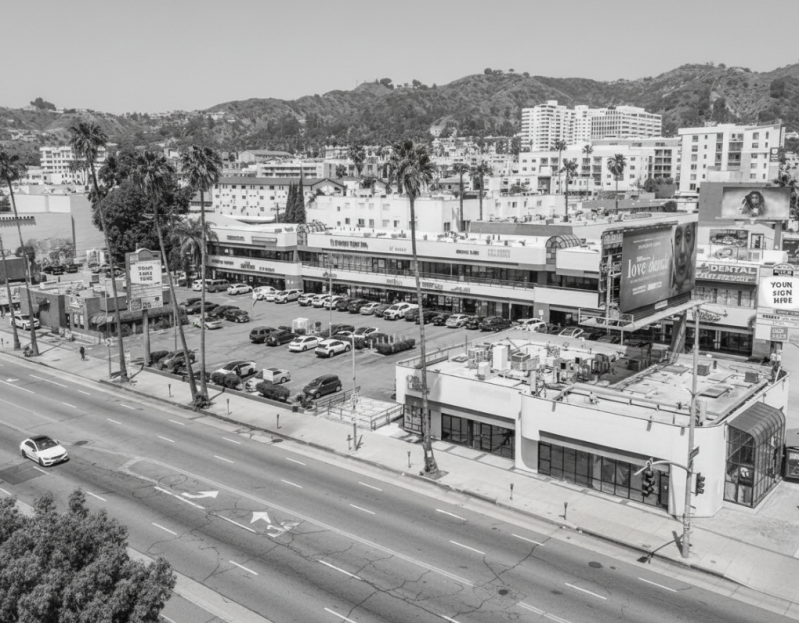
Above, the former site of Tiny Naylor’s Drive-In at the northwest corner of Sunset Boulevard and La Brea Avenue, as it appears today.
Do you remember Tiny Naylor’s Drive-In at Sunset and La Brea? From its futuristic architecture and Hollywood heyday to the unsuccessful fight to save it from demolition, this beloved landmark has quite a history! Share your memories, leave a comment, rate the article, and please share it with others who love Hollywood history!

Add comment
Comments