New details have emerged regarding the final disposition of Sir Patrick Stewart, the much-loved British actor who passed away on October 28, 2026, at the age of 86. As per his death certificate (obtained by TMZ and reported by various entertainment news sites), his remains were subjected to alkaline hydrolysis (i.e. water cremation) on November 3, six days after his death.
By Allan R. Ellenberger

Although it's still a fairly unfamiliar option to many people, alkaline hydrolysis is an increasingly available alternative to both traditional flame cremation and burial. It's also known as aquamation, resomation or flameless cremation and works by using water, alkaline chemicals and heat rather than fire to reduce the human remains.
The body is placed in a specially designed stainless steel chamber which contains a solution of approximately 95% water and 5% alkaline chemicals (potassium hydroxide or sodium hydroxide). The solution is heated and circulated (sometimes under pressure) to accelerate the natural decomposition which would otherwise take place after burial.
Over several hours the soft tissues are broken down to their basic chemical constituents and the skeleton is left behind. The bones are then dried and ground down to a fine pale powder which is effectively the same as the ash produced by conventional cremation.
The remains can be returned to the family in the same way as with conventional cremation; for burial, in an urn or scattered. The residual liquid (water and dissolved organics) is treated as required and discharged via an approved wastewater system in accordance with local regulations.
One of the main selling points of alkaline hydrolysis is its environmental profile. As it doesn't involve burning the body it's generally thought to use less energy and to produce fewer direct emissions into the atmosphere than conventional flame cremation. It's seen by many as a far more environmentally friendly way of dealing with the deceased, even if it does require water, chemicals and energy.
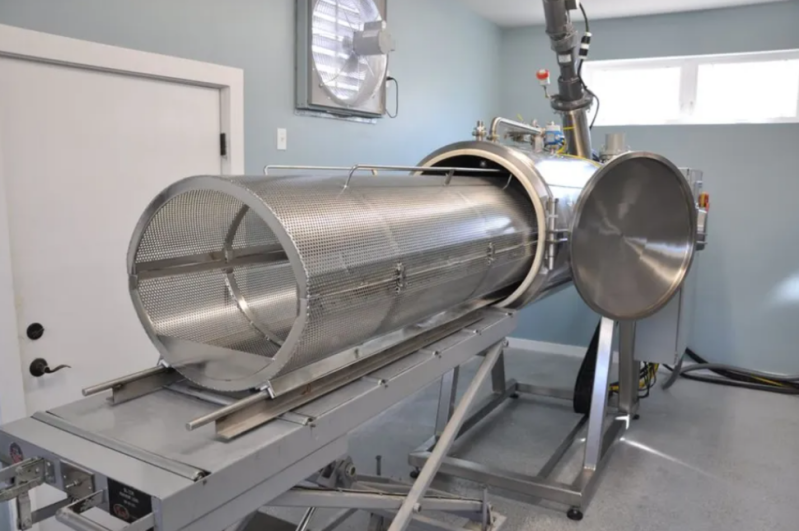
The process is legally permissible in California and in a number of other states (though it's by no means as common as traditional cremation). Whether Stewart himself asked for it or it was his family who made the decision has never been made public. Indeed, the final disposition of his processed remains has not been confirmed.
For an actor whose career was as impressive as it was varied (Shakespeare on the stage, Star Trek: The Next Generation and the X-Men films to name but a few) this rather odd little detail about the funeral industry is a fascinating one. As our views on death, burial and the environment continue to shift, water cremation is very much likely to become a more common alternative to the traditional funeral practices we've all been used to for so long.
This lesser-known alternative to traditional cremation is raising interesting questions about how we choose to handle our remains. What do you think of water cremation? Would you consider it for yourself or a loved one, or do you prefer traditional burial or cremation? We'd love to hear your thoughts! Please leave a comment, rate the article, and share it with others to keep the conversation going.
Add comment
Comments