

Hollywood has always been a place where people come to look for stars. Some go along the Walk of Fame; some go to the forecourt of Grauman's Chinese Theatre and try to place their hand in the impression of a star who's been there for decades. For those who want a more personal connection with Hollywood history there's another option entirely: the cemeteries where the men and women who made the movies have all finally found their graves. Arthur Dark, filmmaker and historian, has just published a new book, Hollywood Graveyard: The Guide (Plum Hollow Press, 2026), which takes you to those cemeteries and brings the stars of old back to life.
Reviewed by Allan R. Ellenberger
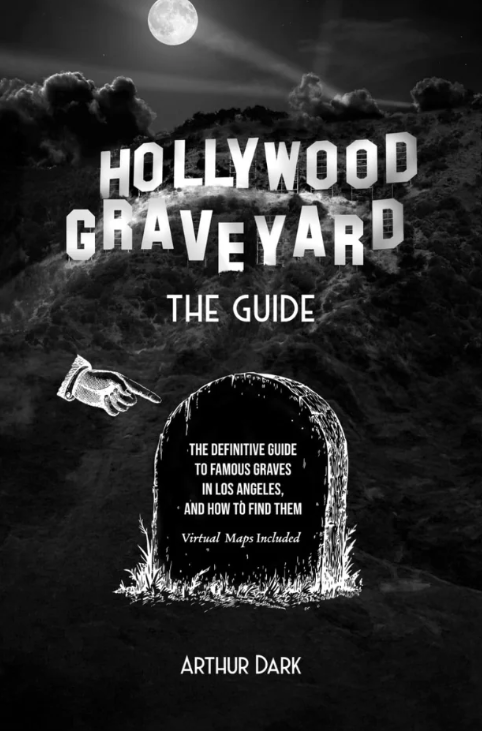
Dark is very much a name known to classic cinema and cemetery people as the maker and host of the very popular YouTube series Hollywood Graveyard. For pretty much a decade now he's had a series of beautifully shot videos taking people through the graveyards of Hollywood, showing them the final resting places of actors, directors, musicians, comedians and all sorts of other entertainers. His approach has always been a very respectful one, combining the biographical details with the photography and there's a clear love of the people he's writing about. Rather than dwelling on the death of the subject he reminds you of the lives they led and the achievements they made which is why they're worth remembering in the first place.
He's now brought that same approach to the printed page with a 282-page, full color guide published independently through Plum Hollow Press. It's a guide to over 700 graves across the Los Angeles area and covers twenty-four of the major cemeteries (Hollywood Forever, Forest Lawn, Westwood Village Memorial Park, Holy Cross and Hillside Memorial Park to name but a few). It's another opportunity to come across the incredible concentration of entertainment history that is scattered all over Southern California, in places you wouldn't necessarily think to look.
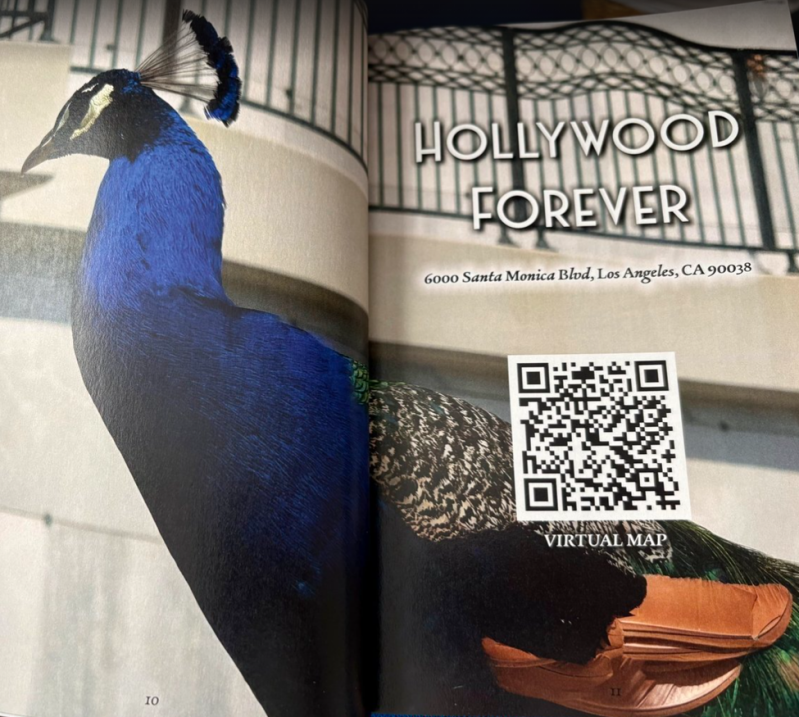
What sets Dark's book apart from the run of the mill cemetery guide is the blend of the traditional with the modern. In addition to the photos and grave profiles you'd expect, you get a series of custom virtual maps which can be accessed via QR codes. You can therefore use your phone to take you directly to the grave in question. If you've ever trawled through a large cemetery trying to find a particular grave, you'll know how much of a godsend this can be. It can be a real piece of detective work to find a grave, especially if it's a small one, tucked away amongst hundreds of others or in a section you're not familiar with.
Dark went to considerable lengths in preparing the book, personally revisiting the gravesites to record precise GPS coordinates. His goal was to combine the pleasure of holding a traditional guidebook with the convenience of modern navigation technology, giving readers the best of both worlds. He was also insistent on full color printing (at a cost) because he felt the photos were absolutely vital to the presentation of the cemeteries and monuments. The end result is supposed to be both a useful travel companion and a visual record of the Hollywood cemetery landscape.
That practicality is probably the book's biggest strength. Previous guides to celebrity graves were often reliant on written instructions, section numbers and in some cases hand-drawn maps. These would often become obsolete as the grounds of the cemeteries changed or as new burials took place and altered the familiar features. Dark's electronic mapping system is a very useful improvement in that respect. The downside is that you still have to deal with mobile reception, GPS accuracy and cemetery rules. It's a useful bit of technology rather than a magic bullet which will get you to every grave instantly.
The book also comes at a time when interest in Hollywood cemeteries has really expanded far beyond the realm of the traditional film historian. Dark's videos have been instrumental in introducing a whole new generation to a range of stars they would never have come across in any other way. His work has shown that a cemetery can be so much more than a series of headstones. It can be an outdoor museum of entertainment history, of architecture, of sculpture and of personal memorials. That's what gives Hollywood Graveyard: The Guide a raison d'etre that goes beyond just telling you where the stars are buried.
There's something very satisfying about finding the grave of a well-known performer, particularly one whose name has long since slipped out of the public consciousness. Hollywood history is replete with supporting players, silent film stars, character actors and the countless others who have been a vital part of the industry's fabric. A guide of this nature is a good opportunity to get people to look beyond the big names and see the sheer variety of lives that are represented. It's also a chance to introduce family and younger generations to a whole host of performers whose films and careers may never have been heard of.
The book's real selling point is the combination of Dark's name recognition, the actual cemetery research he's done and the practical features he's created for the visitor. Any guide attempting to cover hundreds of graves in a fairly limited number of pages is going to be constrained. The individual biographies are going to have to be very brief and anyone looking for a detailed account of a particular star's life is going to have to turn to a more specialist history. Cemeteries are also constantly changing with new burials, remains being moved and occasionally monuments being altered. The accuracy of the associated digital maps will be a key consideration as time goes on.
The real draw of Hollywood Graveyard: The Guide is its accessibility. It's something you can pick up and enjoy at home if you're at all interested in Hollywood history, or something you can take with you if you're out exploring a cemetery in the afternoon. The photos give you a visual link to the memorials and the maps take away a lot of the apprehension that can stop people off at the outset. For anyone who's ever stood in front of the grave of an actor they'd admired and felt a real sense of connection to the past, the appeal is completely obvious.
Arthur Dark has spent his life proving that Hollywood's story doesn't end when the cameras stop. With this book he takes that work a stage further and puts it directly into the reader's hands. Hollywood Graveyard: The Guide is a very welcome addition to the literature of Hollywood remembrance and provides a very tangible way for the reader to get to grips with the people, the places and the stories that are still so very much part of what makes Hollywood capital so fascinating.
The stars of the old Hollywood school are long gone, but their stories are still out there to be found. All you sometimes need is someone to point you in the right direction.
Have you discovered Arthur Dark's HOLLYWOOD GRAVEYARD: THE GUIDE? Whether you're fascinated by Hollywood history, celebrity graves, or the stories behind the stars, I'd love to hear your thoughts! Please comment on, rate, and share my latest book review on The Hollywoodland Revue. Have you read the book or watched Dark's popular Hollywood Graveyard series? Let me know what you think!
Add comment
Comments