

Long before Hollywood and Vine became one of the most famous intersections in the world, the southeast corner looked nothing like the urban crossroads we know today. Hollywood was still a semi-rural community of orchards, scattered houses, and dusty roads, and Hollywood Boulevard was still called Prospect Avenue. The land at the southeast corner of Prospect and Weyse Avenue—later Vine Street—had once been part of a lemon grove owned by Hollywood pioneer Daeida Beveridge.
By Allan R. Ellenberger
In 1903, the corner acquired its first major landmark: the Hollywood Memorial Church, also known as the Hollywood Methodist Episcopal Church. Built in the Mission Revival style, with a prominent tower rising above the surrounding neighborhood, it became an early community landmark at a time when Hollywood was still years away from becoming synonymous with motion pictures.
Then Hollywood changed almost overnight. The arrival of film studios brought actors, directors, producers, technicians, and thousands of people hoping to find work in the new motion-picture business. The Famous Players-Lasky studio operated nearby on Vine at Selma Avenue, and by the early 1920s the once-quiet intersection was becoming increasingly valuable commercial real estate. Churches and orchards were giving way to offices, apartments, hotels and theaters.
One of the men who recognized the possibilities was Alfred Z. Taft Jr., generally known as A. Z. Taft Jr., a member of a prominent local real-estate family.
In 1923, Taft purchased the Hollywood Memorial Church property for $125,000. The church was demolished, and Taft commissioned a building that would permanently change Hollywood's skyline.
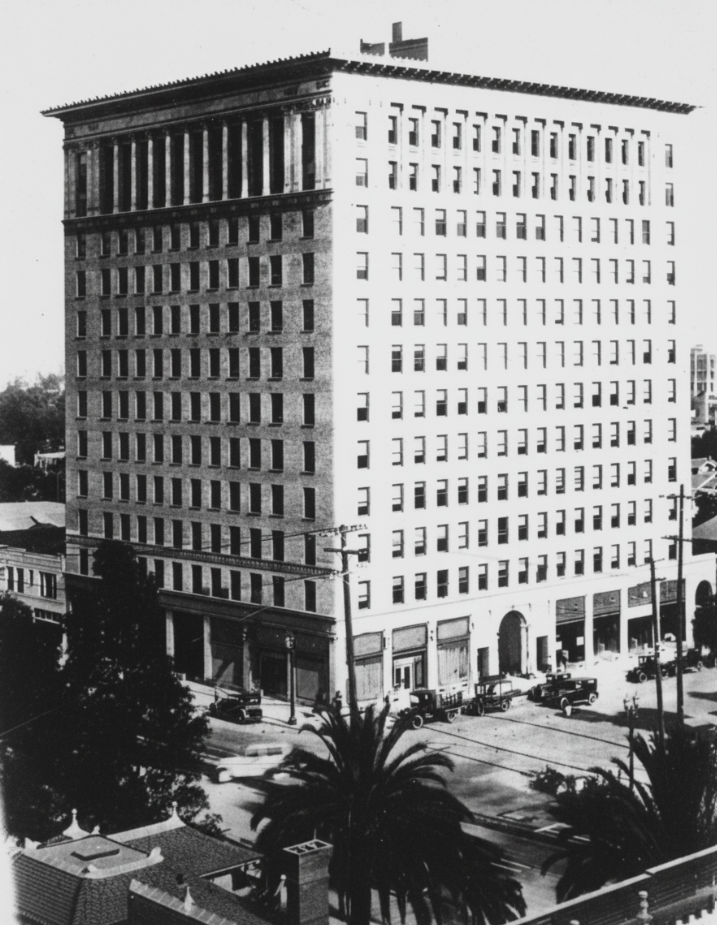
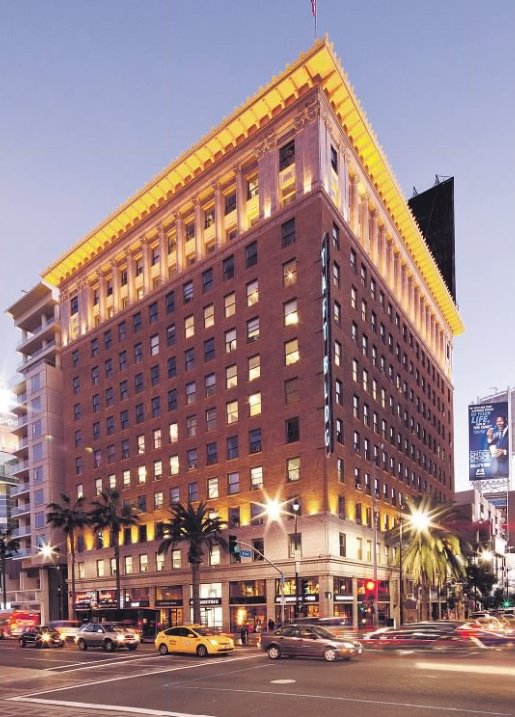
Taft selected architects Albert R. Walker and Percy A. Eisen, whose firm, Walker & Eisen, would become one of Southern California’s most important architectural partnerships of the 1920s. Their other work included the Fine Arts Building and James Oviatt Building downtown and the Beverly Wilshire Hotel in Beverly Hills. For Taft, they designed a twelve-story reinforced-concrete office tower in a restrained Renaissance Revival, or Neo-Renaissance, style, with classical ornamentation, decorative terra cotta, and an imposing upper section that gave the building a sense of dignity appropriate to its increasingly important location.

Alfred Z. Taft Jr. (1889–1941), a Hollywood real-estate developer, commissioned the landmark Taft Building at Hollywood and Vine and belonged to a prominent family that helped shape Hollywood.
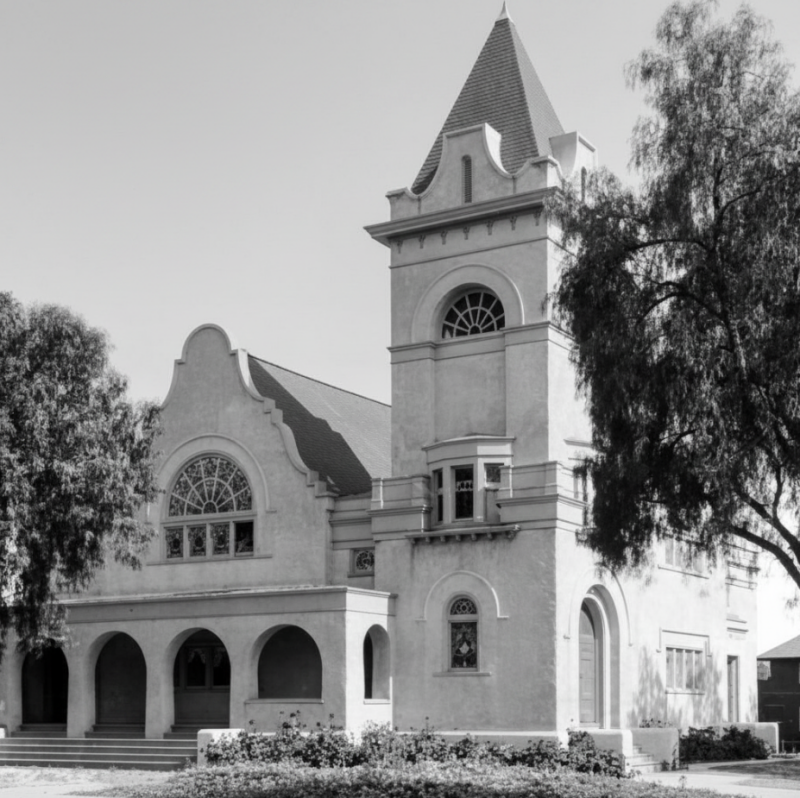
Above is the Hollywood Memorial Church, also known as the Hollywood Methodist Episcopal Church, which once stood at the southeast corner of Hollywood and Vine. Built in 1903, it was demolished in 1923 to make way for the Taft Building.
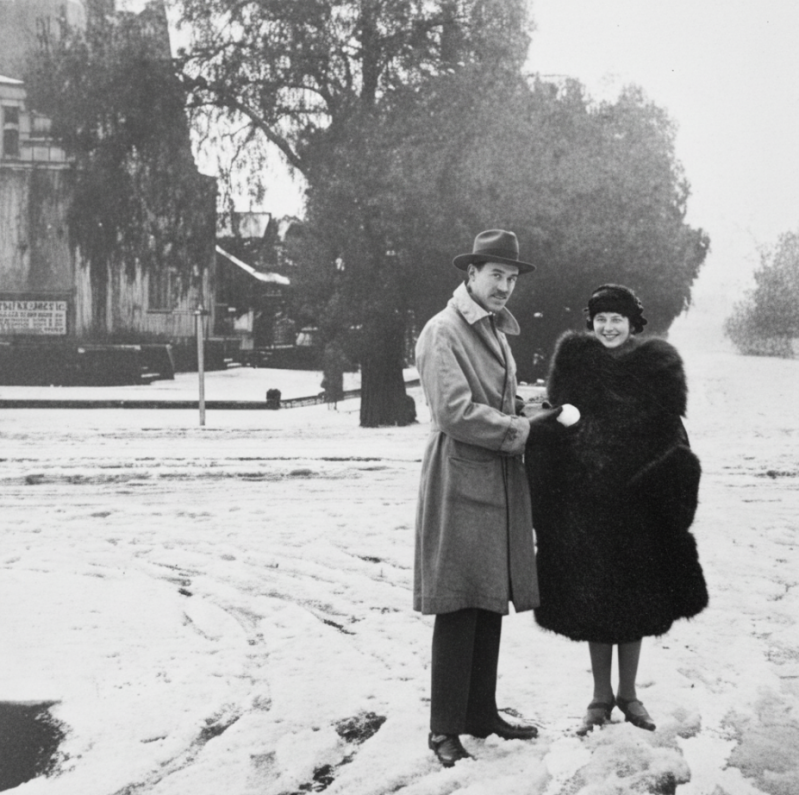
Taken in 1919 during a rare Hollywood snowstorm, this view looks south along Vine Street at Hollywood Boulevard. Director William Beaudine stands with a Christie Comedies actress who later became the wife of Paramount executive M. C. Levee. At upper left is the Hollywood Methodist Episcopal Church, which once occupied the southeast corner of Hollywood and Vine before being replaced by the Taft Building.
Construction began on September 20, 1923, and proceeded with remarkable speed. At twelve stories, it was Hollywood’s first true high-rise commercial office building and one of the earliest “limit-height” towers in the district. It immediately announced that Hollywood was no longer merely a suburb where movies happened to be made. It was becoming a business center in its own right. The Taft was officially completed in May 1924 and had its grand opening on August 20, 1924.
The Taft quickly filled with exactly the kinds of tenants one would expect in the rapidly expanding film capital. Doctors, dentists, lawyers, agents, casting companies, publicists and entertainment executives moved into its offices. Hollywood professionals who once had to conduct much of their business downtown could now work within minutes of the studios.
Among the famous names associated with the building were Charlie Chaplin and Will Rogers, both of whom maintained offices there. City historic records also associate Ronald Reagan with office occupancy in the Taft during his Hollywood years. At various times, every major motion-picture studio reportedly maintained some form of office presence in the building.

Architectural rendering of the Taft Building.
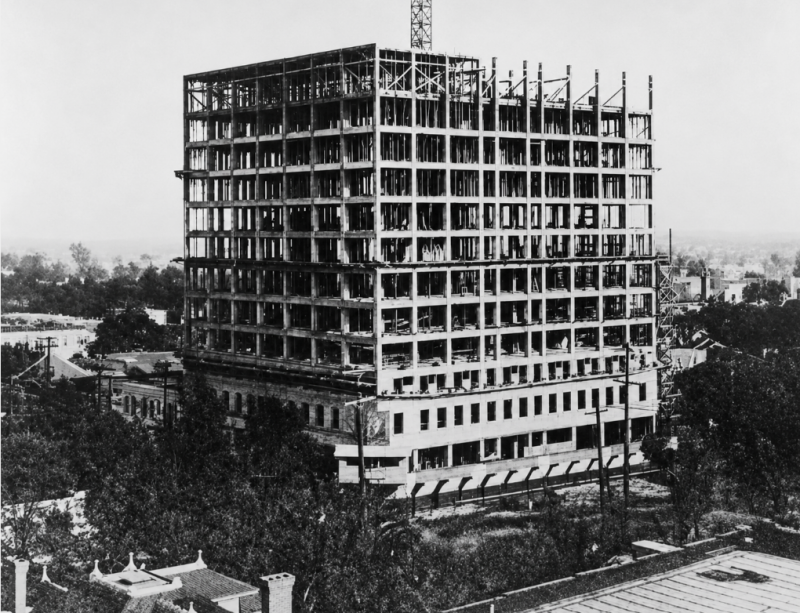
The Taft Building rises at the southeast corner of Hollywood Boulevard and Vine Street during construction in early 1924.
Even the medical offices acquired Hollywood lore. One dentist practicing in the Taft is remembered for having worked on the teeth of the young Clark Gable, helping refine the appearance that would soon become one of the most recognizable faces in motion pictures.
Its importance grew considerably in 1935, when the Academy of Motion Picture Arts and Sciences moved its executive and accounting offices into the building. The Academy had been founded only eight years earlier, in 1927, and was still developing many of the traditions that would define it. It remained headquartered in the Taft until 1946, eleven years encompassing some of the most celebrated years of Hollywood’s Golden Age.
While the Academy was based at Hollywood and Vine, films such as Gone with the Wind and Casablanca won Best Picture. Frank Capra and Bette Davis served as presidents, and new Oscar categories—including Supporting Actor, Supporting Actress, and Special Effects—were introduced. The Oscars themselves were not presented inside the Taft; ceremonies were held elsewhere. But much of the administrative work behind the Academy Awards was carried out in offices overlooking Hollywood and Vine.
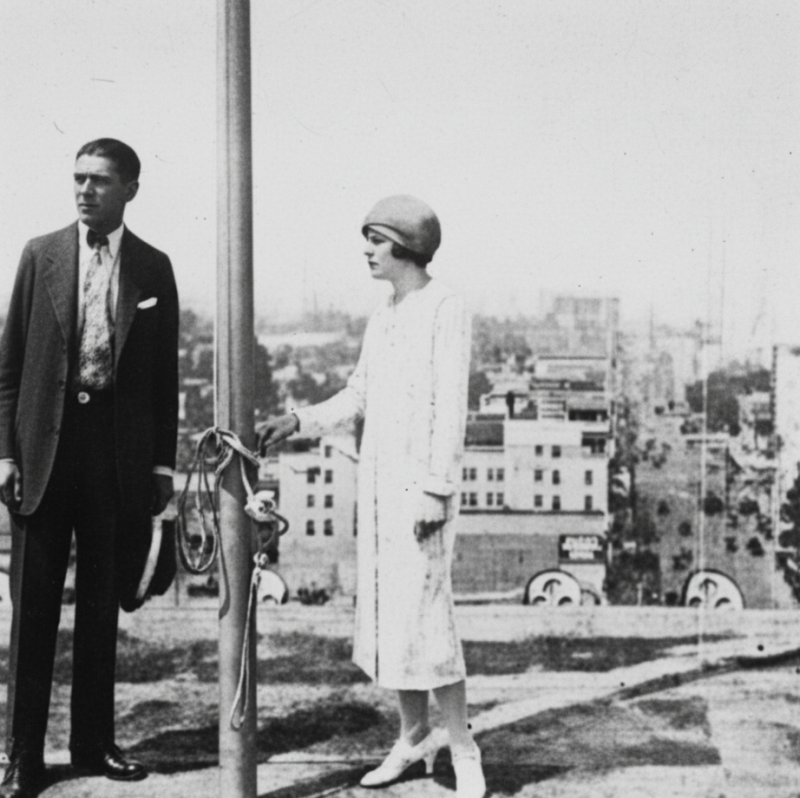
Actress Vera Reynolds and realtor B. Y. Taft look out over Hollywood from atop the newly completed 12-story Taft Building in August 1924.
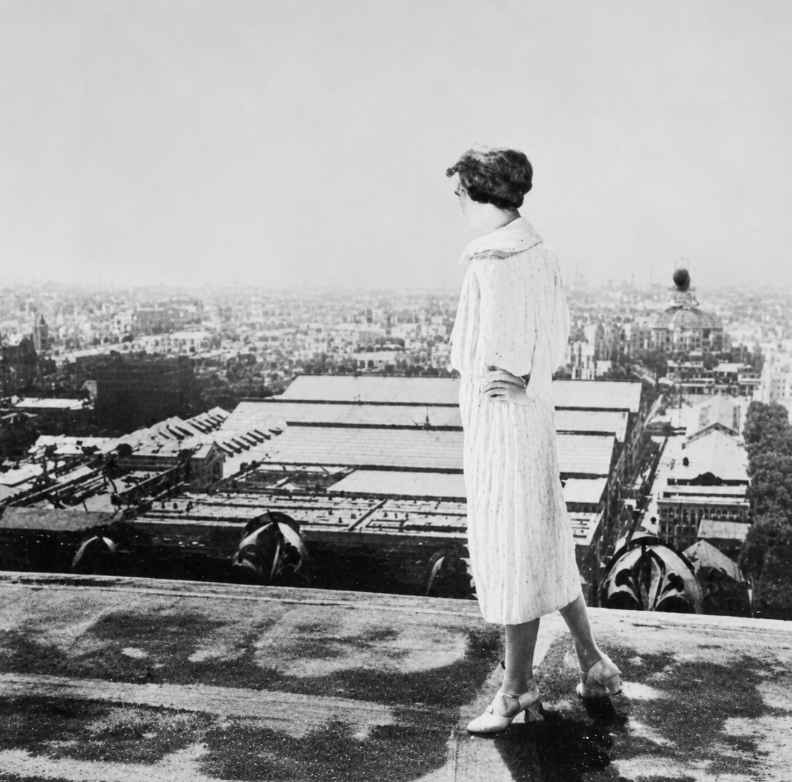
From the Taft's roof, Vera Reynolds looks south over the Famous Players-Lasky Studio, where she made films.
The Taft also became part of Hollywood’s emerging radio industry. By the 1930s and 1940s, Hollywood and Vine had grown into a broadcasting center, with numerous businesses serving radio networks and performers occupying offices nearby. The intersection became so closely identified with show business that it was sometimes compared with Times Square.
At street level, the Taft had a more everyday presence. One of its best-known tenants was the Owl Drug Company. Pedestrians, streetcars, automobiles, and buses streamed through the intersection beneath the building while enormous advertising signs and electric displays transformed its upper stories into a kind of Hollywood billboard.
By the 1940s, an electric news display mounted on the building drew crowds to Hollywood and Vine, reinforcing the intersection’s reputation as the symbolic center of the entertainment industry. The Taft also became part of Hollywood folklore. One oft-repeated story claims that Clark Gable and studio chief Jack Warner sometimes played craps in the building’s basement during lunch breaks. The tale is colorful, but unlike the Academy tenancy or Chaplin’s offices, it has never been firmly documented. It is best regarded as part of the legend that accumulated around the building.


Its influence extended beyond the building itself. After the Taft rose above the intersection, other developers quickly followed. The Hollywood Plaza Hotel went up nearby, followed by the B. H. Dyas department store building—later the Broadway Hollywood—and other substantial commercial structures. Within only a few years, what had once been an intersection marked by a church and modest development had become a dense urban center. In that sense, the Taft did more than occupy Hollywood and Vine. It helped create it.
The building remained prominent throughout Hollywood’s Golden Age, but the neighborhood changed after World War II. Studios moved increasingly toward Burbank, Culver City, and other areas. Television and changing business patterns weakened Hollywood and Vine’s position as the unquestioned center of the entertainment world. By the 1960s and 1970s, the intersection had begun a long decline, and the Taft aged along with it, by which time the neighborhood’s commercial fortunes were already slipping.
A major remodeling during the 1980s covered or altered some of the original architectural details. Yet the building survived at a time when many other pieces of old Hollywood did not. Preservation recognition eventually followed. In 1985, the Taft became a contributing property in the Hollywood Boulevard Commercial and Entertainment District when that district was placed on the National Register of Historic Places. On September 29, 1999, Los Angeles designated the building Historic-Cultural Monument No. 666.
Its most important modern transformation began after DLJ Real Estate Capital Partners purchased the property in 2011 for approximately $28.5 million. The company undertook a restoration costing about $15 million, completed in 2014–15. The work strengthened the building seismically, removed later alterations, and uncovered architectural features that had been hidden for decades. The team restored or revealed decorative marble, terra cotta, polished concrete floors, original brick, and previously obscured windows.
The project returned much of the dignity Walker & Eisen had given the building ninety years earlier. Today the Taft still stands at Hollywood and Vine, continuing its original role as a commercial office building with retail and restaurant space at street level. It survives in a neighborhood that has once again undergone dramatic redevelopment, surrounded by newer hotels, apartments, entertainment venues, and the constant flow of visitors along the Hollywood Walk of Fame.
What makes the Taft particularly compelling is how much Hollywood history you can read through one corner. First there was a lemon grove. Then came a Mission-style church serving a small community.

Twenty years later, that church was demolished for a twelve-story office tower filled with agents, lawyers, doctors, stars, studio representatives, and eventually the Academy of Motion Picture Arts and Sciences. Electric signs flashed from its walls while crowds gathered below. The movie business expanded around it, and Hollywood and Vine became shorthand for an entire industry.
Much of that world is gone. But the Taft remains. More than a century after it first rose above Hollywood Boulevard, it still occupies the same corner, its brick and terra-cotta façade looking down on an intersection it helped transform from a neighborhood crossroads into one of the most famous addresses in show business.
In a city notorious for erasing its own past, the Taft Building has done something rather extraordinary. It stayed.
If you enjoyed my history of the Taft Building at Hollywood and Vine, please take a moment to comment, rate the post, and share it with others who enjoy Hollywood architecture, film history, and the stories behind the landmarks that helped shape the entertainment capital. Your support helps keep these pieces of Los Angeles history in circulation and introduces them to new readers.
Add comment
Comments