

By Allan R. Ellenberger
Never before—and never again—would the illness, death, and funeral of a Hollywood actor command such extraordinary attention. For more than a week in August 1926, Rudolph Valentino’s final days became not merely a Hollywood story, but front-page news around the world. The New York Daily News chronicled Valentino's drama as it unfolded, from anxious reports outside Polyclinic Hospital to Valentino’s death on August 23, the enormous crowds that gathered to view his body, and the funeral that brought New York to a standstill. Presented together, these remarkable front pages offer a visual record of how one newspaper captured the shock, grief and sometimes astonishing public spectacle surrounding the death of the screen’s greatest romantic idol. A century later, the headlines still convey something that ordinary photographs cannot—the feeling that, for those few August days, Rudolph Valentino was the biggest story in the world.
TAKEN FROM THE FRONT PAGES OF THE NEW YORK DAILY NEWS...
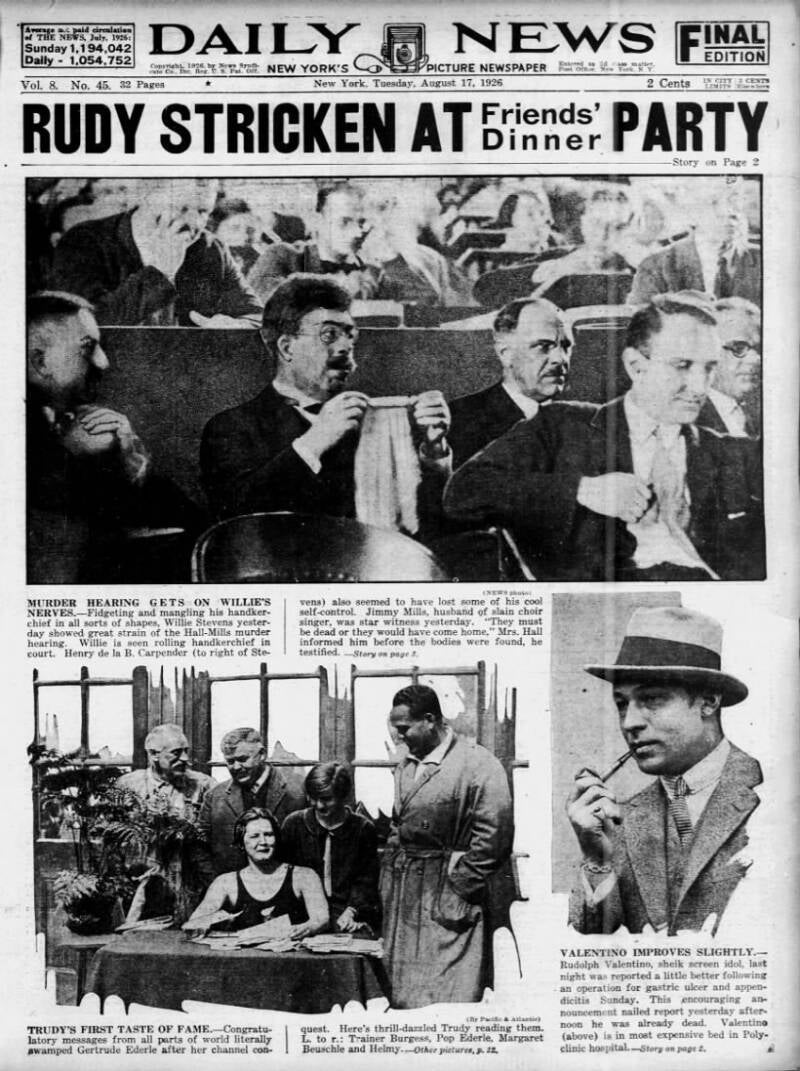
The August 17, 1926, New York Daily News announced Valentino’s sudden illness with the dramatic headline “RUDY STRICKEN AT Friends’ Dinner PARTY.” A photograph of Valentino at lower right accompanied a brief report saying that he had improved slightly following surgery for a gastric ulcer and appendicitis and had spent a comfortable night at Polyclinic Hospital. At this early stage, the coverage remained cautiously optimistic, with no indication that within six days Rudolph Valentino would be dead.
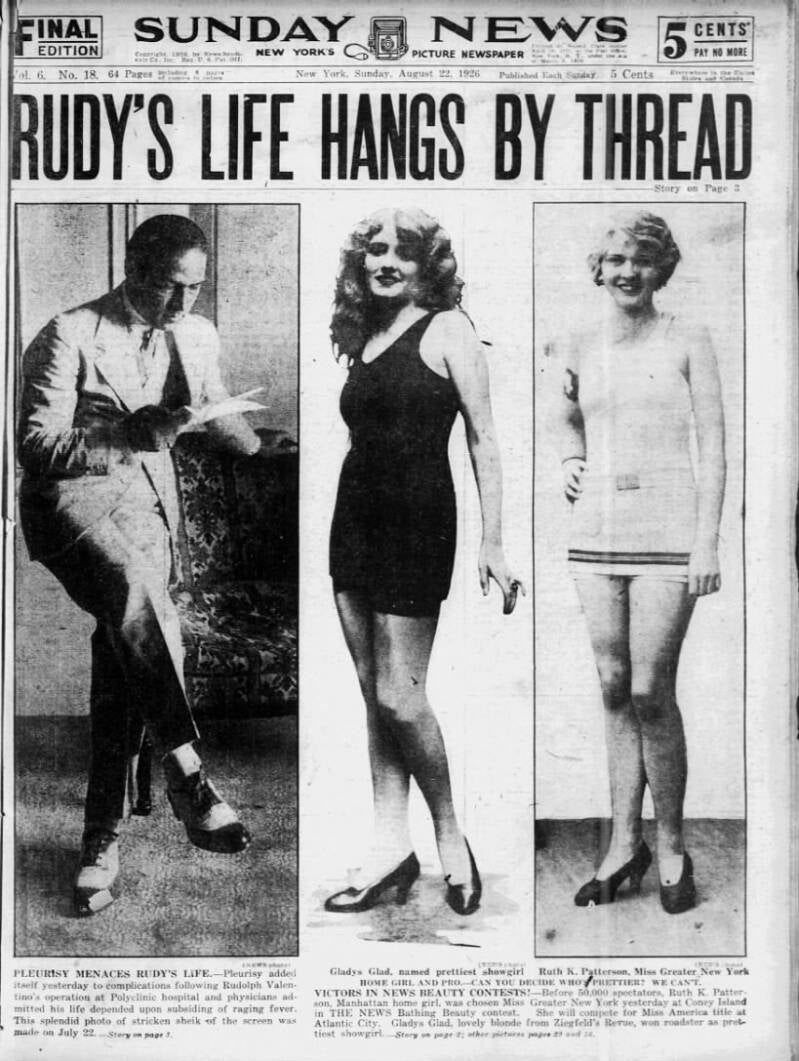
The August 22, 1926, Sunday Daily News dramatically announced, “RUDY’S LIFE HANGS BY THREAD.” After several days of apparent improvement, Valentino had suffered a dangerous relapse, developing pleurisy following his abdominal surgery. The caption reported that physicians considered his condition so grave that his survival depended on bringing down a raging fever. The stark headline marked a dramatic change in the newspaper’s coverage: optimism had given way to the very real possibility that the 31-year-old screen idol might die.

The August 23, 1926, New York Daily News carried the ominous banner “VALENTINO SINKS; AT CRISIS.” Beneath a large photograph of Valentino as The Sheik, the newspaper reported that he was “at death’s door,” with physicians watching anxiously for a hoped-for improvement. More than 100 people had gathered outside Polyclinic Hospital, awaiting news, while Valentino had spent a restless night and remained in critical condition. Tragically, this edition appeared on the very day Valentino would die, at 12:10 p.m.
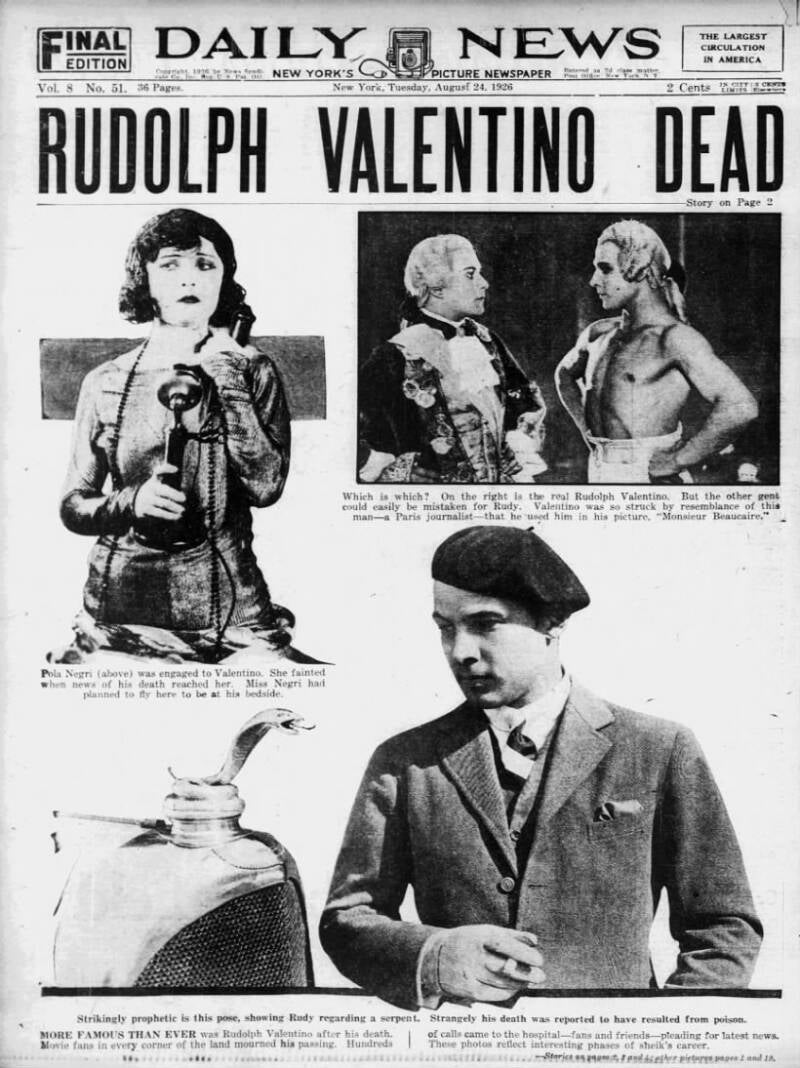
The August 24, 1926, New York Daily News—the first of three different covers the newspaper issued that day—announced the news in enormous, stark type: “RUDOLPH VALENTINO DEAD.” The cover featured photographs from Valentino’s career along with an image of Pola Negri, identified as his fiancée, who reportedly fainted upon learning of his death while preparing to travel to New York. The newspaper noted that Valentino had become “more famous than ever” following his death, as hundreds of telephone calls poured into the hospital from anxious fans and friends. It was the beginning of an extraordinary wave of press coverage and public mourning that would only intensify in the days ahead.
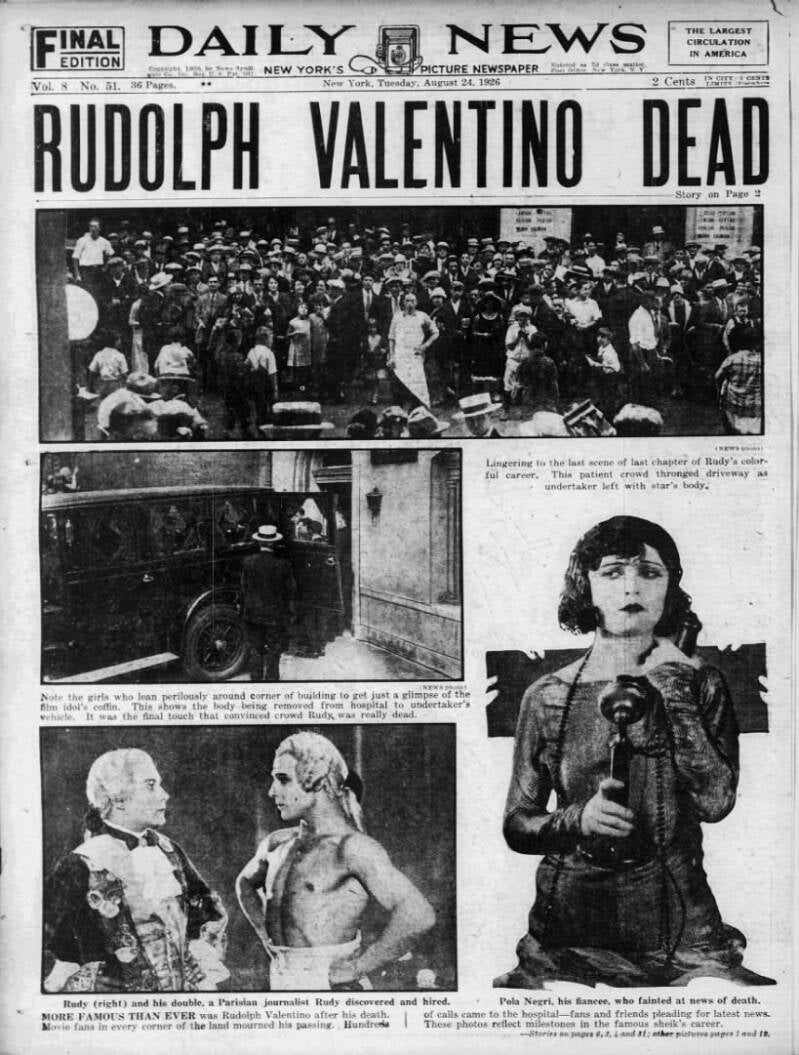
The second of three August 24, 1926, New York Daily News covers retained the stark headline “RUDOLPH VALENTINO DEAD,” but shifted its emphasis to the extraordinary public reaction. Photographs showed crowds gathering outside Polyclinic Hospital, including people lingering in hopes of catching a final glimpse connected with the fallen star. The cover again featured Pola Negri, identified as Valentino’s fiancée, along with an image from his film career.
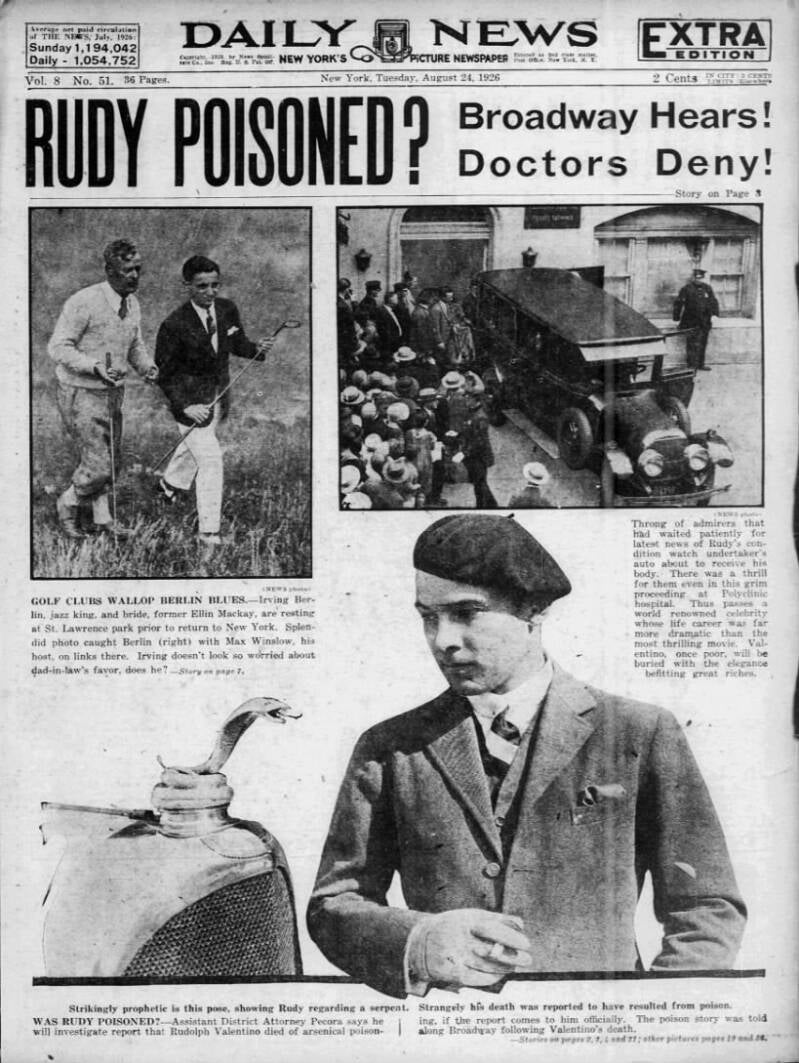
The third of three August 24, 1926, New York Daily News covers took a sensational new turn with the enormous headline “RUDY POISONED? Broadway Hears! Doctors Deny!” Rumors had begun circulating that Valentino’s death resulted from poisoning, even prompting mention of a possible investigation, although his physicians firmly denied the story. The cover also showed the hearse preparing to receive Valentino’s body at Polyclinic Hospital as crowds gathered nearby. Within hours of his death, fact, rumor and speculation were already becoming intertwined—an early indication of how quickly the tragedy of Rudolph Valentino would become part of his legend.
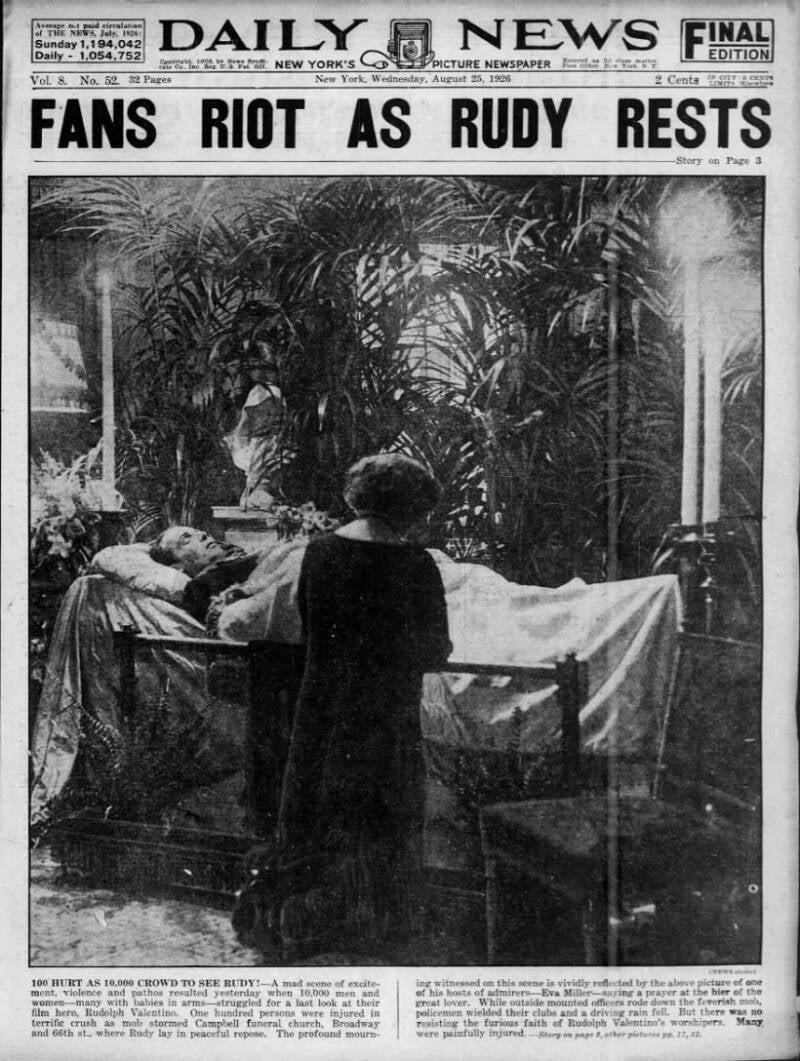
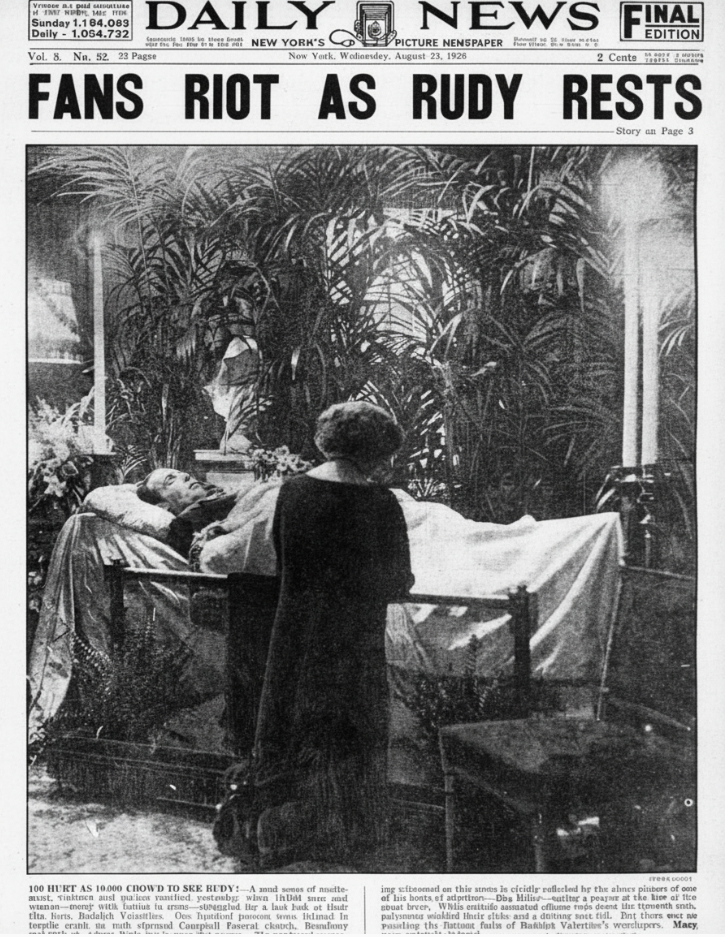
The August 25, 1926, New York Daily News captured the extraordinary public hysteria following Valentino’s death with the headline “FANS RIOT AS RUDY RESTS.” A large photograph showed Valentino lying in state as a mourner prayed beside his bier. Outside the funeral home, an estimated 10,000 people gathered in hopes of seeing the fallen star, and the newspaper reported that about 100 people were injured as the crowd surged and police struggled to maintain order. The cover vividly documented how Valentino’s death had already grown from a personal tragedy into an unprecedented spectacle of mass mourning.
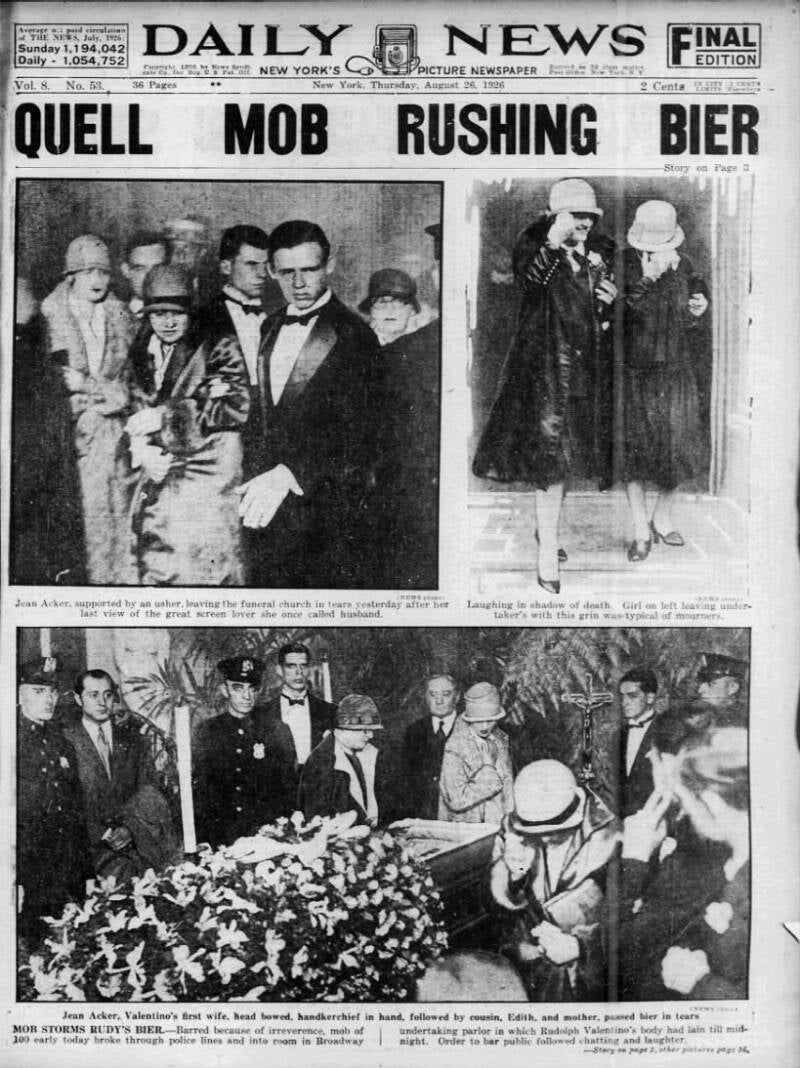
The August 26, 1926, New York Daily News continued its coverage of the extraordinary crowds surrounding Valentino’s bier with the headline “QUELL MOB RUSHING BIER.” The cover showed mourners filing past his body, including Jean Acker, Valentino’s first wife, who was photographed leaving in tears after viewing him. The newspaper reported that although most mourners were respectful, about 100 people broke through police lines and rushed into the undertaking parlor, forcing authorities to restore order. The photographs captured both sides of the spectacle—the genuine grief of those saying farewell and the increasingly unruly public fascination surrounding Valentino in death.
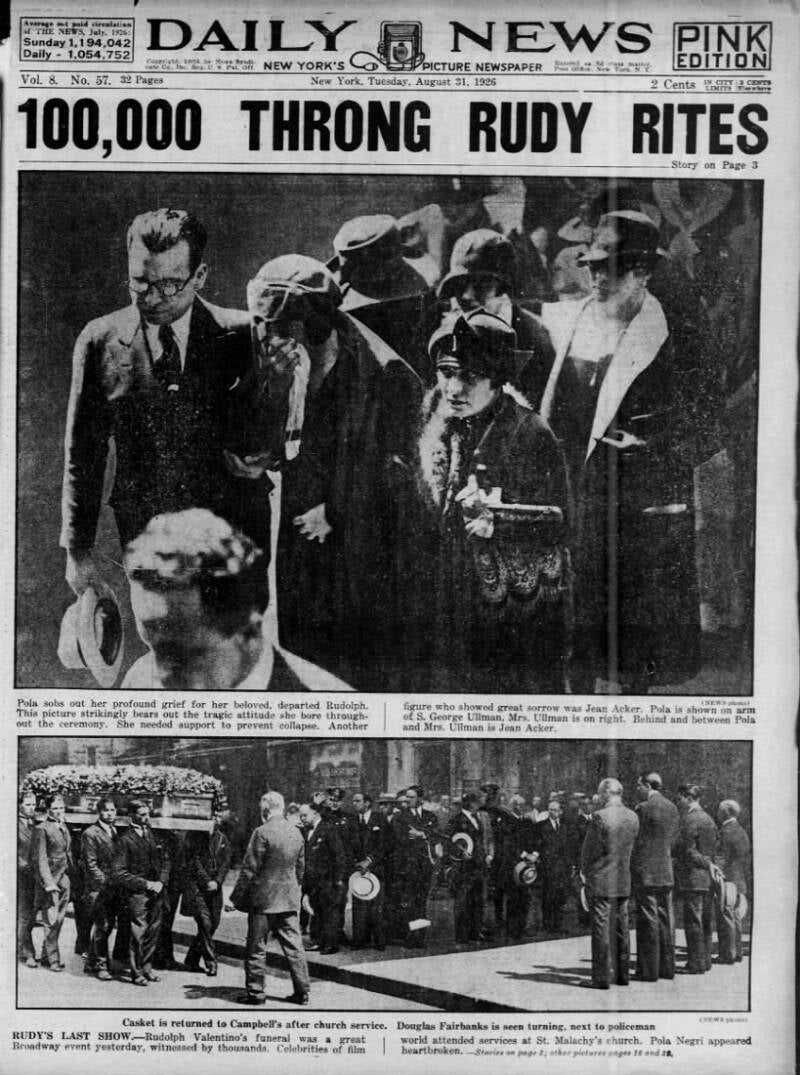
The August 31, 1926, New York Daily News devoted its cover to Valentino’s New York funeral under the enormous headline “100,000 THRONG RUDY RITES.” Photographs showed a grief-stricken Pola Negri, who required support as she left the ceremony, as well as Jean Acker, Valentino’s first wife, and the flower-covered casket being returned to Campbell’s Funeral Church following services at St. Malachy’s Church. The newspaper described the funeral as “Rudy’s Last Show,” reporting that an estimated 100,000 people crowded the area while prominent figures from the film world, including Douglas Fairbanks, attended the rites.

Taken together, these New York Daily News front pages not only chronicle Rudolph Valentino’s illness, death and funeral—they reflect the frenzied atmosphere of a nation caught up in the unexpected tragedy. Day by day, newspaper readers followed Valentino’s decline, his death, the growing crowds outside his funeral home and the final services for a man whom many had known only through his movies. Even now, a century later, the covers leap off the shelf at us. Bold headlines and sensational photos capture a moment as fresh as yesterday. They remind us that the death of Valentino was more than the loss of a beloved movie star. It was one of the first times that mass mourning for a celebrity was brought to millions through the pages of the daily newspaper. The man was dead, but the legend was just beginning.
If you enjoyed this look back at how the New York Daily News chronicled Rudolph Valentino’s illness, death and funeral in August 1926, I invite you to share your thoughts. Which of these remarkable front pages made the greatest impression on you? Please take a moment to comment, rate and share the article with fellow Valentino admirers, silent-film enthusiasts and anyone fascinated by the history of Hollywood and the extraordinary power of celebrity a century ago.
Local readers are invited to attend the 99th Rudolph Valentino Memorial Service on August 23, beginning at 12:10 p.m. in the Cathedral Mausoleum at Hollywood Forever Cemetery. The service will commemorate the centenary of the silent screen idol’s death while continuing a Hollywood tradition that has endured for nearly a century.
For those unable to attend in person, the memorial will be streamed live on Facebook through the “We Never Forget” Rudolph Valentino page, allowing admirers around the world to take part in remembering Valentino and his enduring legacy.
In addition to the memorial service, that evening, Hollywood Forever will present the Los Angeles premiere of the restoration of The Son of the Sheik, accompanied by a recorded orchestral score by renowned composer and conductor Carl Davis. The screening will begin at 6:00 p.m. in Hollywood Forever’s Masonic Lodge.
Add comment
Comments