

Long before Hollywood scandals arrived with publicists, attorneys and carefully worded statements, trouble at a movie star’s home could be wonderfully uncomplicated. Someone called the police, a patrolman arrived, and the next morning the newspapers told everybody what happened.
By Allan R. Ellenberger

In the summer of 1917, one such domestic disturbance erupted inside the household of Mary Pickford, already one of the most famous women in the world. It involved Pickford, her mother and sister, an angry French maid named Katherine Lipkine, several household employees, a hatpin, two chauffeurs, the Hollywood police and a threat of six months in jail.
At the center of it all was a servant who apparently had no intention of being quietly dismissed. Pickford was then 25 years old and at the height of an extraordinary ascent. Born Gladys Louise Smith in Toronto in 1892, she had gone from child performer to Broadway actress and then motion pictures, where her combination of curls, innocence and remarkable screen presence made her an international celebrity. By 1917 she was commanding enormous salaries and exercising a degree of control over her films almost unheard of for an actress of the period. But even "America's Sweetheart" had household problems.
Mary was living with her formidable mother, Charlotte, and her younger sister Lottie at 1519 North Western Avenue, near the heart of the developing Hollywood film colony. Contemporary accounts describe a substantial household that included a gardener, chauffeurs, and domestic servants. Historical references confirm Pickford's residence at the North Western Avenue address during this period, while Los Angeles building records show residential development on the property before its later commercial transformation.
Among the servants was Katherine Lipkine, described in the press as a French maid who had only recently arrived from France. She spoke little English. Whatever hopes she had for her new position in one of Hollywood's most famous households, the arrangement did not last.
On the afternoon of August 1, 1917, Mary, Charlotte and Lottie were reportedly discussing the maid and concluded that she was not suitable for the household. Lipkine apparently overheard enough of the conversation to understand what was happening. Mary told her she was "fired." Lipkine refused to go.
What followed sounds less like an incident in the home of America's Sweetheart than a scene from one of the slapstick comedies being produced around Hollywood at the time. Lipkine armed herself with a hatpin—a common fashion accessory that, in the wrong hands, could become a surprisingly effective weapon—and allegedly attacked Lottie Pickford with it. One of the family's chauffeurs rushed to Lottie's aid and soon found himself under attack as well.
The household staff attempted to remove the maid from the house and into the yard, but Lipkine continued resisting. Two chauffeurs and a gardener finally managed to corner her and keep her there while someone summoned the Hollywood police.
Patrolman Peter Bradley responded. By the time he arrived, the scene must have been extraordinary: Mary Pickford, her mother and sister, servants scattered around the property, and an enraged maid being guarded in the yard after allegedly threatening people with a hatpin. Bradley took Lipkine into custody.
Mary Pickford then went to the Hollywood Police Station and formally swore out a battery complaint against her former servant. Lipkine was jailed, and bond was set at $50. Unable—or unwilling—to post it, she remained behind bars overnight.
The Los Angeles Times couldn't resist the story. On August 2, it announced the domestic rebellion under the playful headline “MARY HAD LITTLE MAID—FIRED NOW,” followed by the equally irresistible subheading, “PICKFORD CIRCLE ENLIVENED BY REBELLIOUS SERVANT.” But the story didn't end with Lipkine's night in jail.
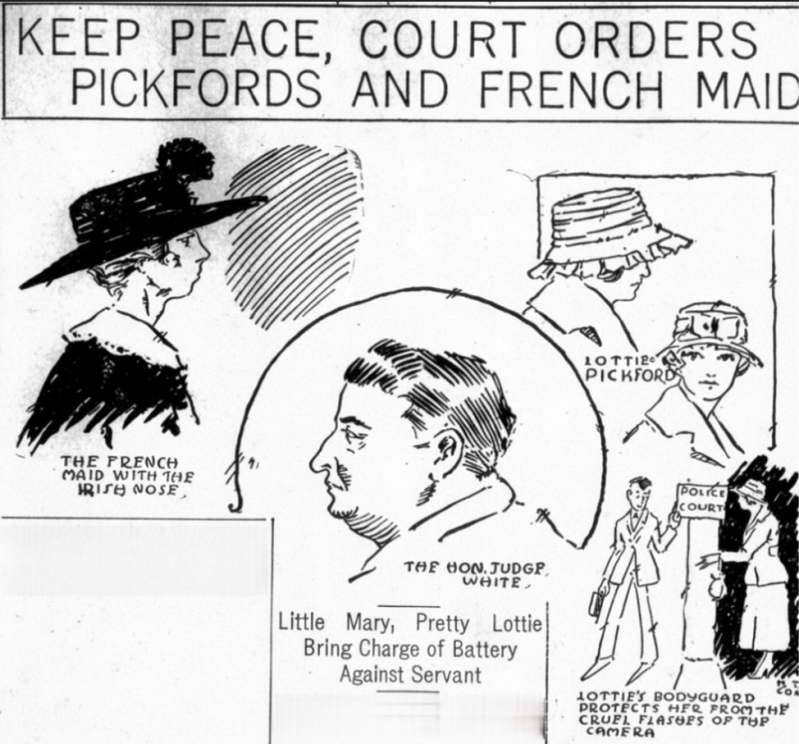
A contemporary newspaper illustration captures the 1917 courtroom drama involving the Pickford family and their former French maid, Katherine Lipkine, depicting Lipkine, Lottie Pickford, Police Judge Thomas P. White, and the heightened security surrounding the battery case.
When the case came before Police Judge Thomas P. White, the courtroom became a miniature Hollywood attraction. Mary and Lottie appeared to testify, and their presence reportedly drew film fans into what was otherwise a dingy police courtroom. The proceedings were postponed while the judge questioned witnesses and tried to determine exactly what had happened.
Other Pickford employees appeared as witnesses, and Lipkine herself was escorted into court under guard. The press reported that Lottie told authorities the maid had threatened her with "six months behind the bars" before police arrived—a remark that would become rather ironic once Lipkine herself faced possible punishment.
On August 14, the Morning Tribune reported the outcome under another teasing headline: “Little Mary, Pretty Lottie Bring Charge of Battery Against Servant.” Judge White found Katherine Lipkine technically guilty of battery. But he did not immediately send her to jail. Instead, he decided that justice would be better served by putting the matter behind everyone. The case was effectively held over Lipkine's head on the condition that she keep the peace. The judge warned her that another disturbance could revive the proceedings and bring punishment. In other words, Katherine Lipkine was free—but she would definitely not be returning to work for the Pickford’s.
The episode is minor compared with the enormous events in Mary Pickford's life. Within two years she would help create United Artists with Douglas Fairbanks, Charlie Chaplin and D. W. Griffith. In 1920 she would marry Fairbanks, and together they would become Hollywood's unofficial royalty, reigning from their Beverly Hills estate, Pickfair. Pickford would eventually win an Academy Award, become one of the most important women in the history of the motion-picture industry, and live until 1979.
Katherine Lipkine, by contrast, appears to have slipped back into obscurity. There is no reliable evidence establishing what became of her after the court proceedings. What survives is this peculiar little snapshot of Hollywood in 1917, when the movie colony was still small enough that a domestic squabble at a star's home could spill onto the lawn and end at the neighborhood police station.

Mary Pickford and her mother, Charlotte, reportedly photographed in front of the Pickford family’s home at 1519 North Western Avenue in Hollywood.
There is also something revealing about the newspaper coverage itself. Pickford's carefully cultivated image as "Little Mary" was already so familiar that reporters could play with it in their headlines. The affair was presented almost as entertainment: pretty Lottie, Little Mary and the rebellious French maid with her hatpin. Yet behind the joking language was a real immigrant domestic worker who spoke little English, had recently arrived in America, lost her job, spent a night in jail and faced a courtroom filled partly with spectators who had come to see two movie stars.
More than a century later, that contrast may be the most interesting part of the story. For Mary Pickford, it was an amusing footnote in an extraordinary career. For Katherine Lipkine, one suspects, it wasn't nearly as funny.
If you enjoyed this unusual glimpse into Mary Pickford’s Hollywood household and the day a dispute with a disgruntled French maid ended with a hatpin, police intervention and a trip to court, please leave a comment, rate the article and share it with others who enjoy the stranger, lesser-known stories of Hollywood history.
Add comment
Comments