

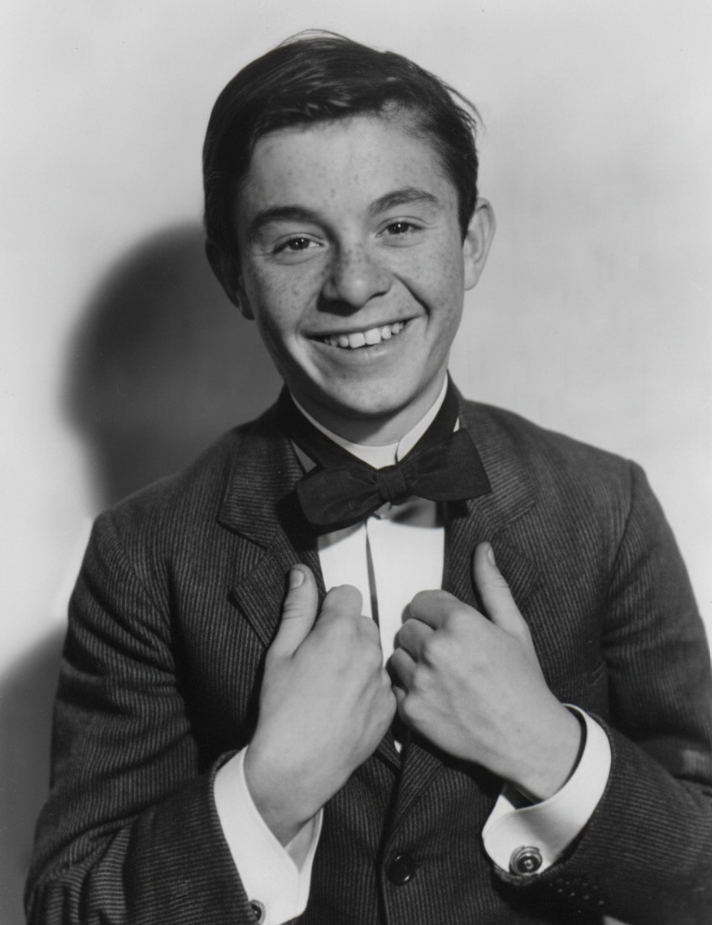
To generations of moviegoers, Carl Switzer would forever be “Alfalfa,” the freckle-faced, cowlick-haired boy whose off-key serenades and hopeless devotion to Darla made him one of the most recognizable members of Hal Roach’s Our Gang comedies. By 1958, however, the little boy on the screen was thirty years old, his days of childhood stardom long behind him. Acting jobs had become sporadic, and Switzer supplemented his income as a bartender, dog trainer and professional hunting guide. Then, on a January night in Studio City, someone apparently tried to kill him.
By Allan R. Ellenberger

The strange incident occurred on Sunday night, January 26, 1958. Switzer had parked his car along Ventura Boulevard in Studio City. Contemporary reporting placed the automobile in front of 11950 Ventura Boulevard. As he was opening the door of the car, without warning, a bullet tore through a window.
Shattered glass sprayed across Switzer's face and the bullet struck him in the upper right arm. He immediately dropped down inside the automobile and waited. There was no second shot. He apparently neither saw the gunman nor knew from where the bullet had been fired.
When it seemed safe, the wounded actor got out of the car and ran for help to a nearby bar, Jimmie O’Brien’s, at 11916 Ventura Boulevard. An employee drove him to North Hollywood Receiving Hospital, where doctors operated on his arm.
The following morning, the Valley Times carried the story under the unsettling headline, “Actor Struck By Mystery Bullet.”
Switzer, identified naturally as the former “Alfalfa” of the Our Gang Comedies, told police that he could offer no explanation for why anyone would have fired at him. He listed his occupation as “actor and professional guide.” At the time, his home address was given as 6122 ½ Santa Monica Boulevard in Hollywood.
At first, police had little to work with. There was a bullet, a wounded man and an automobile with a shattered window, but apparently no eyewitness who could identify the shooter. Whether Switzer had been deliberately ambushed, struck by a stray bullet, or targeted by someone with a personal grudge was unclear. Then detectives developed a suspect.
Four days after the shooting, Eugene Earl Butler, 30, a real-estate salesman living at 5337 Canoga Avenue in Woodland Hills, was arrested and booked on suspicion of assault with intent to murder Switzer. Butler emphatically denied shooting him.
Detective Ernest Johnston of the Van Nuys Division told reporters that Butler claimed he had been attempting to sell property to a couple when Switzer was shot. Initially, according to the Valley Times, police believed Butler's alibi did not check out.
There was also a possible personal connection that immediately gave investigators reason to look more closely. Switzer had been dating Butler's former wife, Susan. Detective Johnston acknowledged that the relationship might provide a motive for an otherwise baffling attack.
There was another disturbing detail. Police reported that Butler had been arrested the previous September on suspicion of assault with intent to murder another man, Eric J. Harper of Panorama City. According to detectives, Butler had allegedly fired at Harper following an argument but missed him. Harper ultimately declined to press charges.
Taken together, the circumstances must have appeared suspicious: Switzer was dating Butler's former wife, Butler reportedly had a previous gun-related arrest, and his original alibi apparently raised questions. But suspicion was not proof.

Eugene Earl Butler at the Van Nuys jail after he was booked on suspicion of attempted murder in connection with the ambush shooting of Carl “Alfalfa” Switzer. Butler denied the accusation.
Detectives continued investigating and eventually determined that Butler's alibi did check out. He was cleared of any connection with Switzer's shooting and released. A subsequent report announced that Van Nuys detectives were “Still Seeking ‘Alfalfa’ Foe.” They never found him.
Switzer survived and went on with his life. The incident became another strange footnote in the difficult adulthood of one of Hollywood's most famous former child actors. Born Carl Dean Switzer on August 7, 1927, in Paris, Illinois, he had arrived in Hollywood as a boy and, with his brother Harold, attracted attention during a visit to the Hal Roach Studios. Carl joined Our Gang in the mid-1930s and quickly became one of the series' defining personalities. His Alfalfa—with his cowlick, freckles, squeaky singing and romantic catastrophes—became so thoroughly identified with him that escaping the character as an adult proved nearly impossible.

Switzer continued acting after leaving Our Gang, but increasingly in small or uncredited roles. His later screen appearances included films such as Going My Way, State of the Union and The High and the Mighty. He also appeared briefly in It's a Wonderful Life as Freddie Othello, the young man who opens the gymnasium swimming pool beneath George and Mary's Charleston dance. By the 1950s, however, acting alone was not enough to support him. His skill with animals led him toward training dogs and guiding hunting expeditions.
What makes the January 1958 shooting especially haunting in retrospect is what happened less than a year later. On the evening of January 21, 1959, Switzer went with his friend Jack Piott to a house in Mission Hills where Moses Samuel “Bud” Stiltz was staying. The dispute involved approximately $50 connected with a lost hunting dog. An argument escalated into a violent confrontation. Stiltz produced a .38-caliber revolver, and during the struggle a shot was fired into the ceiling. Moments later Stiltz fired again, striking Switzer.
The bullet caused catastrophic internal bleeding, and the 31-year-old former child star was pronounced dead on arrival at the hospital. Stiltz maintained that Switzer had threatened him with a knife and that he fired in self-defense. A knife was recovered beneath Switzer's body, although accounts differed about precisely what occurred during those frantic final moments. A coroner's jury subsequently ruled the shooting justifiable homicide, clearing Stiltz. Decades later, eyewitness Tom Corrigan publicly disputed important elements of Stiltz's version of events, ensuring that questions surrounding Switzer's death would persist.
There is an eerie symmetry to the two shootings. On January 26, 1958, a bullet crashed through Switzer's automobile window on Ventura Boulevard and struck him in the arm. He survived. The suspected gunman was cleared, no one was ever charged with shooting Switzer, and the identity of the person who pulled the trigger remained unknown.
Then, nearly a year later, on January 21, 1959, another bullet struck Carl Switzer. This time he did not survive. His death came on the same day as legendary filmmaker Cecil B. DeMille. In another peculiar Hollywood coincidence, Switzer had appeared uncredited in DeMille's The Ten Commandments. Six days later, Switzer was buried at Hollywood Memorial Park Cemetery, now Hollywood Forever, where his marker includes the image of a hunting dog—a reminder of the second career that occupied so much of his adulthood.

Above is the former site of Jimmie O’Brien’s bar at 11916 Ventura Boulevard in Studio City, where Carl “Alfalfa” Switzer sought help after being shot by an unknown assailant.
The 1958 shooting remains the more tantalizing mystery because it has no ending. There was an investigation, an arrest and what seemed briefly to be a plausible motive. Then the suspect was cleared and the trail went cold. Someone fired that gun on Ventura Boulevard. Nearly seventy years later, we still do not know who—or why.
Check in tomorrow on The Hollywoodland Revue for the first installment of my new series, The Women Who Built Hollywood Before the Movies, beginning with Daeida Wilcox Beveridge—the pioneering woman who helped give Hollywood its name and shape the community long before the studios arrived.
If you enjoyed my story on the shooting of Carl “Alfalfa” Switzer, I’d love to hear your thoughts. Please leave a comment, rate the article, and share it with anyone interested in Hollywood history, true crime, and the darker stories behind familiar screen faces. Your comments, ratings, and shares help The Hollywoodland Revue reach more readers and keep these forgotten stories alive.
Add comment
Comments