

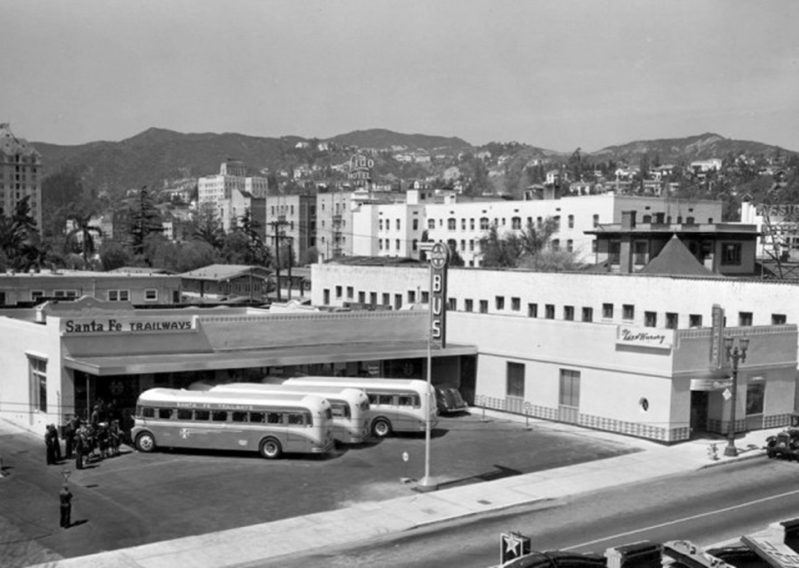
Once upon a time, before craft cocktails and velvet-roped nightclubs came to colonize Hollywood, there was another first taste of the city. Not beneath a neon marquee, but through the doors of a spotless, streamlined restaurant at 1743 North Cahuenga Boulevard. Today the address is a shape-shifting nightlife space, rebuilt, repainted, reinvented so many times its origins have nearly slipped from memory. But in 1939, this was one of Hollywood’s most polished, modern welcome centers: the Fred Harvey Restaurant and Travel Center, a collaboration between the famed Harvey House empire and Santa Fe Trailways designed to greet starry-eyed newcomers with efficiency, glamour, and the faint promise of possibility.
By Allan R. Ellenberger

The Fred Harvey Restaurant located at 1743 N. Cahuenga Boulevard in Hollywood. (Photo Credit: LAPL)
The building went up during the last great period of bus and rail ascendancy, when travel centers were civic showpieces, not anonymous boxes. Santa Fe Trailways had commissioned a show-stopping complex on a triangular lot just north of Hollywood Boulevard. Its sleek modernist design announced that the movies were not the only industry keeping pace with the future. One facade was occupied by Trailways’ active ticket counters and waiting rooms; the other—the side that continues to grab the eye in old photographs—was home to the Fred Harvey Company, which had made a name for itself across the country with its genteel service along the Atchison, Topeka & Santa Fe Railway line.
Its Hollywood outpost offered the same hospitality: shiny floors, white tablecloths, a sparkling cocktail bar, and walls decorated with murals by Edgar Miller and paintings by Doris Lee, who had made a name for herself just the year before by painting in her inimitable style a series of Harvey Girls murals. Travelers debussed and crossed a short ramp into a dining room that felt more like the lounge of a first-class hotel than a terminal restaurant.
But the real story was not the décor—it was the clientele. This was the doorway through which countless would-be actors, tourists, and dreamers first entered Hollywood. Families on vacation ordered lunch beneath the murals; aspiring actresses fresh from Kansas City sipped coffee while rehearsing their introductions; men in ill-fitting suits and too much optimism scanned the room for any hint of the movie colony. Bus drivers, Harvey staff, and office workers moved among them, giving the place a sense of purpose and movement. It was, for a brief moment, the Ellis Island of Hollywood dreams.
The Travel Center prospered through the 1940s and into the postwar era. The automobile, however, was fragmenting the streams of private travelers, and the concentration of commercial travelers was diminishing. Fred Harvey shuttered the restaurant, and the handsome building, elegantly aging and ever more out of style, awaited its next role. Hollywood, never still for long, would provide one.
By the early '80s, the building had been turned into a nightclub. The white tablecloths and Harvey Girls murals were gone, replaced by Crush Bar, a dance-oriented, neon-infused gathering place for the rock-and-roll set. Musicians, punks, and young actors from the area filled the newly darkened space, the walls now reverberating with the tremulous guitar licks and shiny new sounds of early MTV. Directors noticed. When Martha Coolidge filmed the cult classic Valley Girl in 1983, Crush Bar was featured in the film as one of its real-life fragments of Hollywood nightlife, a cameo that would forever preserve the lost interiors in amber-streaked celluloid.
Above: After renovations made in the late 1940s

More transformations followed. Through the late 1980s and 1990s, the building hosted the Continental Club, the Hogie Club, and other short-lived venues that made Cahuenga Boulevard one of the city’s busiest after-dark corridors. Each incarnation left a mark: a new awning here, a remodeled façade there, a shift in the cultural weather as old Hollywood gave way to an edgier urban scene.
Enter the 2000s, a new golden era of Hollywood nightlife. 1743 N. Cahuenga is at the center of this glittering comeback. As the White Lotus, it becomes a celebrity magnet for paparazzi. Where once tourists bought roast beef sandwiches and boarded a bus to San Bernardino, now limousines line up, velvet ropes flutter, and young actresses strut for flashbulbs. Hollywood has transformed, and so has the building: at this point nearly every trace of the original Fred Harvey building had been remodeled or erased, through decades of reinvention.


White Lotus eventually gave way to Ritual, then Halo, then The Colony, each capturing a moment in the city’s fickle nightlife cycle. By the 2010s the venue operated briefly as Boardwalk, a nautical-theme restaurant and lounge. The Cahuenga Corridor, once the border between Hollywood’s commercial grid and its industrial backstreets, was now one of Los Angeles’s liveliest late-night districts—and 1743 stood right in the churn of it.
What's left now is a building in the same place, with the same address, but unrecognizably different. The original 1939 building was partly demolished in the late 2000s to install modern club interiors, with shards of the original shell remaining under layers of modern resurfacing. If you pass by today, you have to squint to picture the Fred Harvey waiters, the Greyhound passengers, the hopeful faces pressed against the glass windows of the restaurant.


Later incarnations at the highly renovated versions of the old Fred Harvey Restaurant at 1743 North Cahuenga: Left: The Colony. Above: Boardwalk
But it's not completely a lost story. Old photos, however, show us what the restaurant was: a crisp streamlined jewel box aglow at night under Art Deco signage, its curved windows shining with civic hope. There, one can still see the building as the travelers did—bright, lively, and promising.
1743 N. Cahuenga Boulevard has never been a fixed point. It's been a travel center, a fine-dining restaurant, a disco, a movie set, a star spot, and a nightlife shapeshifter. What it's always been is a portal: initially to the Hollywood of train whistles and bus lines, subsequently to the Hollywood of velvet ropes and weekenders.
The Fred Harvey restaurant is gone, but its spirit lingers in the layers of reinvention that have shaped the address for more than eighty years. In a city that sheds its past with startling ease, it is worth pausing to remember that one of Hollywood’s great portals once stood here—where the dreams of countless travelers first met the irresistible, unpredictable streets of Hollywood.
What do you think? Please share your comments below:
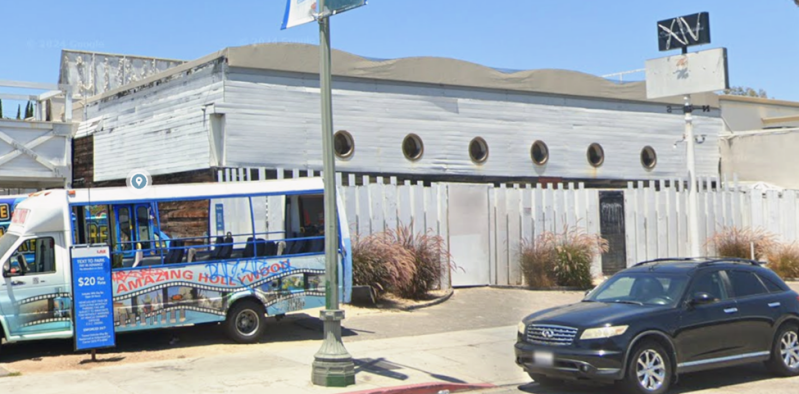
1743 North Cahuenga Blvd. today
Add comment
Comments