

Few stars of postwar cinema burned as brightly—or as briefly—as Brigitte Bardot. To an entire generation, Bardot remains the apotheosis of liberated European glamour: bronzed and sun-streaked hair; bare feet, bare teeth and a bare, sultry come-hither; a demeanor that defied convention with a toss of the head, a toss of the hair, a toss of the hip, a toss of the salad and an insolent pout and laugh. Bardot didn’t just act in movies; she changed the culture’s temperature. In the late 1950s and early ’60s, she became an international icon of erotic freedom at a time when Europe was emerging from the last shadows of war and America was sticking its head through the keyhole.
By Allan R. Ellenberger

Her rise was meteoric. Studied in ballet and discovered as a teenager, Bardot made a breakthrough with And God Created Woman in 1956, a film whose influence was much greater than its box-office performance. She followed it with a series of roles that mixed innocence and provocation, comedy and sadness. Directors and photographers loved her; fashion houses pursued her; tabloids followed her love life with a ferocity verging on obsession. But by her mid-thirties, Bardot had had enough. In 1973, at the young age of thirty-nine, she retired from acting completely, returned to the south of France, and reappeared as a fierce—and, for many, admirable—animal rights activist.
It is here, in that second act, that the Bardot that most fans think they know comes to a stop. The rest of her is awkward and conflicted and mostly disregarded.
Bardot’s private life was scandalous even by the indulgent standards of celebrity: multiple marriages, high-profile affairs, bouts of depression and suicide attempts that she later discussed with a bluntness that unnerved interviewers. Fame, she claimed, was something that had been done to her, rather than something she had earned; an arena in which nuance is squashed and projection amplified. When she left the screen, many applauded what appeared to be a principled retreat: a woman choosing conscience over commerce. Her animal-rights work, and in particular her campaigning against seal hunting and factory farming, won her sincere respect and institutional honors.
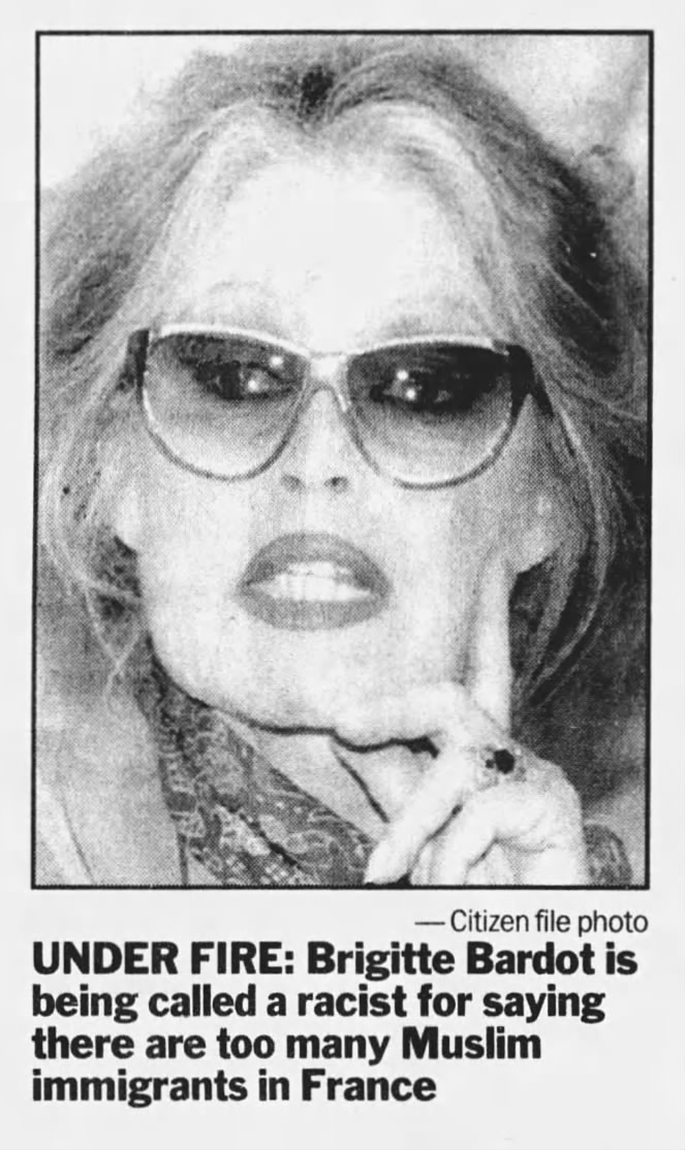
But alongside that activism ran another, darker current. Beginning in the 1990s and intensifying in the decades that followed, Bardot became increasingly vocal about immigration, Islam, and what she framed as the erosion of French identity. She published letters and books that railed against multiculturalism, denounced Muslim religious practices in France, and warned of a country “being invaded” culturally and demographically. These were not offhand remarks or misunderstood jokes; they were sustained positions, repeated over years, and delivered with the same blunt force she once brought to scandalizing the screen.


Critics (many in France) accused her of racism and Islamophobia. Bardot herself dismissed those allegations, saying that she was only upholding the values of secularism, animal rights, and traditional French culture. However, her rhetoric often strayed from political opposition to mockery, and Bardot was repeatedly found by French courts to have gone too far and to be guilty of hate speech. She paid fines and made no apologies. Her statements on homosexuality, feminism, and modern movements had a similar tone: dismissive, nostalgic for a rigid past, hostile to identities she deemed performative or corrosive. The woman once celebrated as a symbol of sexual freedom increasingly positioned herself as a guardian of cultural purity.
After Bardot's death, American pop star Chappell Roan briefly shared a glamorous tribute to the actress before deleting it when fans pointed out the French icon’s long-documented far-right views and record of racist and anti-LGBTQ+ statements. Roan later said she was disheartened to learn more about Bardot’s politics, a reaction that neatly encapsulates the enduring tension between Bardot’s mythic screen image and animal-rights activism and the decades of extremist, anti-immigrant rhetoric many admirers once chose not to confront.
So why, then, was Roan and many of her fans been so in the dark (or perhaps in denial) about this other Bardot?
Timing is partly to blame. Bardot made her films in a pre-social media, pre-outrage-cycle culture. Her movies travel in pristine containers, abstracted from the more complicated trajectory of her later life. Her younger fans find her through magazine spreads, old posters, and internet clips with no context. The Bardot they meet is from 1960, not fighting on TV in 2010.
Another reason is selective nostalgia. Bardot fits neatly into a romantic narrative of Old Europe—sun, sex, cigarettes, and rebellion without consequence. To acknowledge her later views is to complicate that fantasy, to admit that icons age, calcify, and sometimes turn their rebellion against new targets. Many admirers prefer the illusion of continuity: the belief that a liberated woman must always remain liberating.
But there's also a cultural aversion—particularly outside France—to contend with the European far-right discourse when it comes from cherished icons. Bardot's words are dismissed as "eccentric," "provocative," or the mutterings of an aging star past her prime. That characterization downplays their influence and absolves the public of having to confront the implications of when celebrity fuels bigotry.


None of this invalidates Bardot’s accomplishments, nor does it mean we have to retroactively revoke her legacy. But it does require us to be truthful. Brigitte Bardot was a subversive force on the screen, a woman who cracked open the door on female libido and agency. She was also, in her later years, a woman who held xenophobic beliefs and used her fame to advance reactionary politics. These things are both true, even if it’s an uncomfortable truth.
Maybe the real lesson isn’t about Bardot, but about us. How easily we curate our idols, how willingly we divorce art from artist when it flatters us, how queasy we get when the past won’t stay put. Bardot didn’t change in private. She said these things loudly, often, in her own voice. That so many fans never heard her is less a mystery than a mirror.
How do you reconcile Brigitte Bardot the cultural icon with Brigitte Bardot the controversial public figure? I welcome your reactions and perspectives below.
Add comment
Comments