

It's one of the great lost films of silent cinema. Four Devils (1928), F. W. Murnau's second American film and his most obscure Hollywood endeavor, was made in the immediate aftermath of Sunrise and released right before the sound revolution began. Because of its timing, the film hit theaters at exactly the wrong moment to succeed as a movie that valued poetry over gimmick. It's doubly unfortunate because Four Devils wasn't forgotten or unpopular upon release—it was praised, debated, and considered by most people to be a major success.
By Allan R. Ellenberger

The story came from Fox's urge to harness Murnau's talent for more crowd-pleasing material. When studio heads suggested the circus as subject matter, he realized that it could offer action, peril and spectacle, yet would still be ideal for a silent movie. Murnau based the picture on a 1890 novella by Hermann Bang called The Four Devils. Bang's melodrama focused on theatricality, jealousy and the hazards of risking your heart. But most importantly, the circus is a business ruled by gravity that punishes human weakness, which Murnau instinctively grasped.
For authenticity, Murnau became involved with the circus life so he could film it accordingly. Fox marketed the realism of the circus. Circus elements used were true to life and some circus performers were even from renowned traveling circus troupes. The aim was authenticity, not spectacle: sawdust under the glamour.
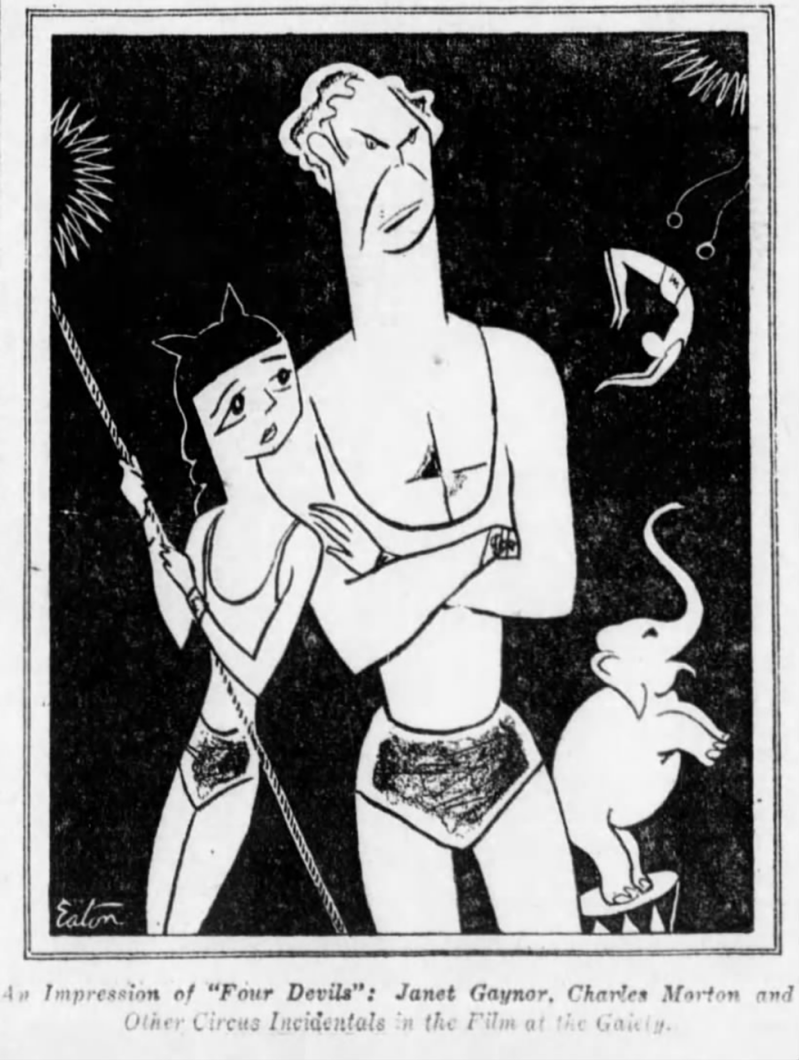
Actors were selected to contrast purity with seduction. Bright and open-hearted, Janet Gaynor was the picture's virtuous heartbeat. Mary Duncan played "The Lady", the rich seductress who disturbs the balance of the troupe. Charles Morton, Barry Norton, and Nancy Drexel rounded out the cast. Physical trust is key to the plot, so emotional treachery is deadly serious.
So it starts. Four orphans are beaten severely by a sadistic ringmaster. They're saved by a veteran clown who takes them in. Raised into adulthood as a trapeze act known as “The Four Devils,” they live bound by shared trauma and discipline. Romantic pairings form naturally—until The Lady arrives, seducing one of the performers and destabilizing the act. In this world, emotional imbalance is fatal. Love triangles become engineering failures.
He staged the circus as action, not spectacle. Instead of presenting it as something comfortably viewed from below, Murnau wanted to present the circus as it was lived. Stories abound of camera rigs built to accompany performers on wires so that the camera could glide alongside them, swing from performers, or simply hover through space. At one point, he even wanted to film audience reactions to heighten realism. In true silent-era fashion, legend has it that Murnau had revolvers fired behind extras during filming to illicit real shock at a pivotal moment.
Four Devils premiered in October 1928 at New York’s Gaiety Theatre, released as a silent feature with synchronized music and sound effects via Fox Movietone. Critics praised its visual elegance and emotional force, noting its “soft, seductive” photography and convincing circus atmosphere. It was not treated as a novelty, but as a serious work of cinematic craft.
Yet the ground beneath it was already shifting. As talkies surged, Fox grew anxious about silent films’ marketability. The studio withdrew Four Devils to insert dialogue into the final reel, reissuing it in 1929 in altered form—without Murnau’s involvement. Reports suggest the ending was softened, possibly more than once, creating multiple versions of a film now entirely missing. The loss is therefore layered: not one vanished work, but several.
Why Four Devils disappeared is depressingly familiar. Shot on nitrate stock, the film existed in an era when studios viewed prints as expendable assets. The chaos of the sound transition encouraged disposal of “obsolete” versions, and Fox’s catastrophic 1937 vault fire destroyed vast portions of its silent-era library. Whether Four Devils perished in that blaze or vanished earlier remains uncertain.

Charles Morton, Janet Gaynor, Nancy Drexel and Barry Norton
A persistent rumor holds that a print once circulated privately—possibly linked to Mary Duncan—and was never returned. Like many such legends, it is unproven yet stubborn, fueled by the fact that lost films have reappeared before, misidentified or forgotten.
What makes Four Devils endure is what it represents. It sits at the crossroads of silent mastery and sound-era disruption, and at the heart of Murnau’s American period. Audiences that experienced it remember ethereal performances, lush visuals, and a heartbreaking climax. It was more than a circus movie; it was a meditation on faith, equilibrium, and consequences of want.

Today, Four Devils survives only in stills, scripts, and critical memory—a trapeze act frozen midair. Its absence is one of cinema’s great wounds yet hope persists. Film history is rich with miracles, and “lost” has often proved to mean “misplaced.”
If Four Devils ever returns, it will not simply fill a gap—it will restore a missing heartbeat. Until then, the film remains one of silent cinema’s most haunting ghosts: a work built on faith, now sustained by it.
I’d love to hear your thoughts—please share your reactions, insights, or memories of Four Devils in the comments below.
Add comment
Comments
What people like to call a miracle is usually just the part of the story that begins after the labor has been forgotten. Effort has to be expended. Things are found because that effort is poured into the search. I do not intend to sound rude or argumentative, but neither do I think I should conceal my frustration at what I consider counterproductive passivity.
My research has taken me well beyond the usual public account of the film’s disappearance. It has given me very little reason to trust the assumptions that have calcified into accepted fact. You do this long enough and it is slowly revealed to you that the work one imagines must have been going on behind the scenes has often been far less substantial or serious than one might have hoped. In a very real sense, people stopped looking for this picture with intention over fifty years ago, and the prevailing posture ever since has too often amounted to waiting for the thing to turn up on its own. Hope is the word I see tossed around most often.
Whether it is Mary Duncan-Sanford, Little Ferry, the engineer in Tacoma, a print scheduled for Locarno, or the belief that every print of the film was merely melted down for nitrate, every rumor and public assertion about 4 Devils is testable. These are just the iceberg's tip.
What passes for certainty here is not a settled account, but an accumulation of repeated and often incompatible stories. Some are accepted too easily. Others are waved away as hoaxes before the work required to test them has been done.
Thank you for sharing.
Again you've uncovered a juicy cinema memory-- If only some miraclous rediscovery brings it back to
Thanks Rick, that would be a miracle, but it has happened.