

Eugene Rafael Plummer was born January 8, 1852, in San Francisco. The adventurous spirit of restless mid-nineteenth century California was evident even in his parents. His father was Captain John Cornelius Plummer, an Anglo sea captain who had come west during the Gold Rush years. Eugene's mother was Maria Cecilia McGuire Pacheco; a Latina woman of Irish ancestry whose spirit and independence were to greatly influence Eugene Plummer. From birth his life was connected to the unique transformation of California from Spanish-Mexican rancho culture to an American one of law, land litigation, and squatters.
By Allan R. Ellenberger

Eugene's early years, as Plummer later recounted them, were equally colorful. His father's long absences fishing left Maria Plummer to raise Eugene and his brother. Instilling sturdy independence, Maria educated her sons in self-sufficiency and strength of character. The Plummer family also spent several years farther south during Eugene's youth: first in Mexico during the turbulent 1860s, then briefly in Fort Yuma, Arizona. There his mother managed a hotel and raised stock. Eugene learned to cope with hardship and adapt to changing circumstances from an early age. When his father purchased land along the Cahuenga Creek, just outside of Los Angeles, in 1867, Maria and her boys began construction of a ranch house that would eventually stand on the grounds of Paramount Studios.
As a young man, Eugene Plummer became deeply rooted in the land that surrounded him. The Plummer Ranch, encompassing roughly 160 acres between today’s Sunset and Santa Monica Boulevards and La Brea and Gardner Avenues, was more than a working homestead; it was a stage where the old days of California—the era of vaqueros, Spanish land grants, and horseback fiestas—seemed to linger just out of step with the rapid urbanization taking hold around it. Fluent in Spanish and intimately familiar with the shifting cultures of Southern California, Plummer served for decades as an official court interpreter, helping Spanish-speaking residents navigate a legal system that often worked against them.
Plummer was fluent in Spanish, and he possessed a natural sense of graciousness and hospitality. These traits endeared him to many early Angelenos. Plummer eagerly celebrated and encouraged Spanish and Mexican traditions when most Angelenos wanted nothing to do with them. He revived fiestas, horse races, barbecues and parades that attracted crowds from all over Southern California. Plummer held events under the pepper trees he planted fifty years before, stirring memories with his folklore, folklore-inspired tales, and love of days gone by.
In 1906, the Plummer Ranch even played host to what may have been one of the first films shot in Southern California, when a Biograph Company camera captured scenes of one of his Vaquero Club barbecues—an early cinematic echo of a landscape that would soon be dominated by the motion picture industry. Despite the irony, Plummer never resisted the encroachment of film studios so much as he observed it with a storyteller’s eye; as Los Angeles grew into a global entertainment capital, he remained tethered to a vision of California that was pastoral, dramatic, and deeply personal.

In his personal life Plummer was devoted to family and tradition. In 1881 he married Maria Amparo Lamoraux, a woman of French heritage whose family had deep roots in the region’s early ranching history. Together they raised two children, though one died in infancy, and their surviving daughter Frances became part of the continuing Plummer family lineage in California. Maria Plummer passed away in 1928, leaving Eugene to carry on both the ranch and the cultural legacy they had fostered together.
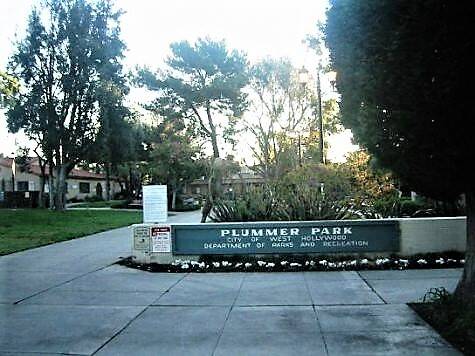
As the 20th century wore on and urban development from Hollywood started to infringe upon ranch land that Plummer loved, he became wealthy in land but poor in money. He sold off parts of the ranch over the years. What was once tens of thousands of acres during his youth became only a small portion of that. Instead of becoming bitter about it, Plummer tried to save what would be left of history in the middle of the metropolis. He negotiated with Los Angeles County for years before finally selling his remaining land and ranch house to the county with the stipulation that it would forever be preserved as a public park that would showcase the area's early history. Plummer Park was dedicated in 1938 and a recreation center was built with the help of the Works Progress Administration. The original ranch house was eventually used for park purposes.

Eugene Plummer lived into his nineties, witnessing the transformation of the Los Angeles area from cattle trails and dusty ranch roads to the paved boulevards and studio facades of a burgeoning metropolis. He died on May 19, 1943, at County General Hospital from congestive heart failure. He was 91. He was buried at Hollywood Memorial in the family plot beside his father and wife (Garden of the Exodus, Sect. 13, Lot 417, Grave 4). Though his name does not appear on the family stone, Plummer’s legacy endures through Plummer Park, a reminder of Hollywood’s frontier roots.
Remembered by many as “Senor Plummer” or “Don Eugenio,” a man whose life bridged centuries of California history and whose stories were as rich and sprawling as the landscape he once owned. He was buried with due respect for his status as an early Californian pioneer, and his funeral would have brought together friends, family, and community leaders who recognized in him a link to a bygone era.
Today, Plummer Park stands as a quiet testament to his life’s work—a green space amid concrete, a place of memory more than monument, and a reminder that Hollywood’s origins were not just in celluloid dreams but in the lived experiences of rancheros, storytellers, and the land itself.

Add comment
Comments