

Steve Tracy breezed through Hollywood with starry charisma you don't have to squint to read: He was that kind of actor. Guys like him seem nervous when they're charming and kind when they're strong. He'll probably be remembered best as Percival Dalton, Nellie Oleson's shy bespectacled husband on Little House on the Prairie, a square of decency dropped right into the television show's big sky prairie storms. In Tracy's personal life, however, his journey would wind into another uniquely American narrative: the panic and misinformation of AIDS' early days when hysteria spread faster than understanding and kindness was considered political.
By Allan R. Ellenberger

Born Steven Crumrine on October 3, 1952, in Canton, Ohio, he came from the kind of place where you don't expect anybody to get taken by Hollywood. What they all agree upon about his childhood and teen years, however, is that he had instincts for performance and an eagerness to leave Canton behind. He went to college in Ohio (usually cited as Kent State University) and continued his study in Los Angeles. There he worked at acting—not trying to become glamorous, but studying and working with a focus on craft, timing, and the earned discipline of making someone else believe.
Tracy's first break came in the late 1970s, the era of made-to-fill-an-hour television guest spots that were to creating acting résumés one credit at a time. He popped up on shows like Quincy, M.E. and other time capsule programs, and picked up on how the sausage was made and just what kind of actor was needed to work in television: Say your line, be in the right place, and don't sweat the small stuff. Tracy eventually landed roles in films such as Russ Meyer's Beneath the Valley of the Ultra-Vixens (1979) and other pictures of varying reputations. It's a testament to what working actors will accept and try to elevate that many of his credits fall into that gray area between studio wonders and exploitation traps. Tracy also appeared in the ensemble comedy National Lampoon's Class Reunion (1982).
But it was television—specifically Little House on the Prairie—that provided him with a role that would enjoy an afterlife. As Percival Dalton, Tracy came into a pre-existing world and a pre-existing villainess named Nellie Oleson and did something quietly tricky: he made Nellie's romance earn its credibility. Percival could have been a straw man or an emender of behaviors; under Tracy's stewardship, he became fully human—awkward and loyal, protective and unexpectedly courageous. Through his multiple appearances, the character helped redeem Nellie without negating her and gave the series one of its sweetest moments of emotional juxtaposition.
What gave the performance staying power was that Tracy never portrayed Percival as a saint. He played him as a man who wanted a good life and kept reaching for it anyway—an idea audiences recognized at the time and in a different key, recognize still. Offscreen, Tracy became best friends with Alison Arngrim, who played Nellie. Decades later, Arngrim would recall him as her mentor and confidante: someone who made her laugh, grounded her, and showed her, when the ground fell out from underneath her, what courage looked like up close.


After Little House, Tracy kept working: guest spots, minor roles and a series of credits that speak to an actor keeping busy. He appeared on The Jeffersons and popped up in films including Party Games for Adults Only (1984) and the feature Say Yes (1986). There would be one posthumous credit, an episode of Tales from the Darkside. A tiny ghost of a presence, it highlighted how quickly his life and career had ended.
But you can't talk about Steve Tracy without talking about the manner of his death—and, more crucially, how he lived while dying. In the mid-1980s AIDS was discussed in code words, reported with sensationalism, treated by many as a moral judgment instead of a public-health crisis. Medications were trial-level and few and fraught with punishing side effects. Arngrim remembers going with Tracy to doctor appointments, to workshops, to vigils, and a sort of hodgepodge of hopefulness that people with AIDS were granted in those early days: hope for a cure, hope for more time, hope that maybe the next news story would be filled with facts rather than fear mongering.
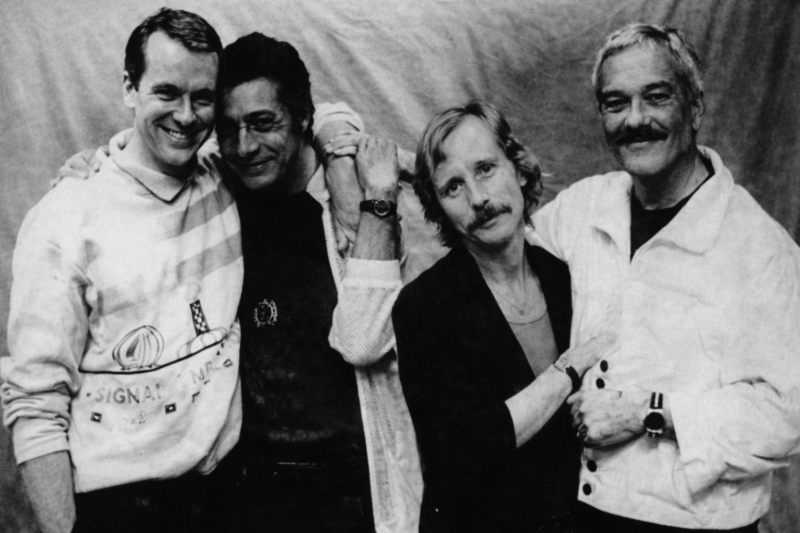
From left: Tom Trimm, Jerry Minor, Steve Tracy and Don Staiton from the stage production, AIDS/US (1984).
In 1984, Tracy became involved in the Hollywood stage production AIDS/US, a bold and deeply personal theatrical work in which 11 of the 13 cast members were themselves living with the disease. Instead of shying away from society, Tracy spoke out about having AIDS. AIDS/US was originally scheduled to run only for a weekend at a small theater in Hollywood but ran for four months due to popular demand. Plans were made for a UCLA revival of the play.
Arngrim explained that Tracy consented to go through something grueling: experimental drugs that were painful, required procedures Tracy would have to repeat every few hours, all undertaken with the knowledge that it might not work soon enough to help him. She recalled him telling her, essentially, that if it was too late for him, maybe it could help save someone else. Throughout those years, before anyone knew how it was transmitted, before there was widespread compassion for the disease, Tracy fought not just by living, but by allowing people to see him and learn from him.
Steve Tracy died on November 27, 1986, at the age of 34, from AIDS-related complications; multiple accounts place his death in Tampa, Florida. The details of what came after are as revealing as the illness itself—because the epidemic did not end at the hospital door. Arngrim later wrote that Tracy’s mother and sister, living in Tampa, faced repeated refusals from funeral homes that would not accept his body for cremation, gripped by ignorance and fear. They ultimately found help through the only funeral home in town willing to take those who had died of AIDS—an African-American–owned establishment whose owners, shaped by their own history with discrimination, understood the cruelty of being told, “We don’t serve your kind.”
After he was cremated, Arngrim said Tracy’s mother and sister brought his remains back to Los Angeles to fulfill his final wish. His ashes were scattered beneath the Hollywood Sign—specifically, she recalled, under the letter “D.” There was also a small memorial gathering at a friend’s home, a Hollywood goodbye marked not by pomp, but by the intimate language of the people who had loved him: wine in plastic cups, stories traded in a kitchen, and the sudden recognition that someone so young should not already be a memory.
Tracy's death, Arngrim has said, drove her into AIDS activism—hotlines, education and that long, often exhausting process of erasing stigma with information. In that way, his legacy stretched farther than a credits list. It entered the lives of strangers he would never meet, the terrified people who called those hotlines, the people who needed to hear you couldn't catch AIDS from a kiss, the people who learned—slowly, painfully—that fear doesn't trump knowledge.

Above photo taken of the letter "D" illuminated originally honoring the L.A Dodgers
In the years since, Steve Tracy has gone on to become one of those fondly remembered “what might have been” guys—a capable actor whose persona promised greater depths, a comic who delivered such flashes of timing and brutal honesty that we wondered why we didn’t see more of him. But here’s another way of looking at Steve Tracy: Not as a footnote to a television series. Not as a sob story topped off with an autopsy verdict. But as someone who approached his life—and this era’s cruelest tragedy—with humanity, humor and a demand for dignity. Even his posthumous saga echoes that demand. Those ashes tucked beneath the Hollywood Sign feels like another quiet act of defiance. Hollywood memorializes its icons in blinking neon. Sometimes it memorializes the bravest with dust and wind and whispering rocks, tucked under one letter on the hillside where the city outlines its dream in white, and life is infinitely more complicated.
If Steve Tracy’s courage and compassion moved you, I invite you to please take a moment to comment, rate, and share so that his legacy continues to inspire.

Add comment
Comments
I loved watching him on Little house on the Prairie. His character forever changed the Oleson household. He taught Nellie to cook and brought the gift of twins to make Harriet a loving grandmother and Nellie a beautiful changed woman.
Hi Debbie, thanks for those memories.
Loved watching him on LHOTP. We should all be as courageous as Steve was.
I agree Cindi. Thanks.
My dad worked with him and so did I when I was younger. He was always so kind. An amazing human. This was a wonderful piece sky Steve. Thank you
Thank you, Sherri, appreciate your memories.
Nice article. Added a link to my website, https://littlehouseontheprairietvcast.com/steve-tracy
Thanks Mike!
As a gay sr man in my 60s now I challenge the 20s 30s something LGBTQ to speak out and help that's what Steve Tracey did
Thank you Jeff.
So lovely to see Alison commenting on this article. What a legend she is. In a world where you can be anything, be kind. May god bless Alison for her kindness to Steve and all other gay people during the 80's and the years following. Loved Nellie & Perival. Xx
David, thank you for your thoughtful words. Alison’s compassion and steadfast support during such a difficult era truly made a difference
Eternal Percival
Thank you Wendy.
I was a nurse during this time and it made me so angry to see how the patients were treated. I would make it a point to interact and treat the with dignity and respect just like the rest of my patients. He played an awesome role as percival!!!!
Rose, thank you for sharing this. Your commitment to treating patients with dignity and respect during such a painful and fearful time speaks to the very humanity that Steve and so many advocates were fighting for.
It is because of Steve and Alison’s (and a lot of advocates) efforts that young gay people can walk into a clinic, and quickly get tested for free with no judgement or worry. This is a gift to future generations. Thank you.
Diane, thank you for putting that so beautifully. That legacy — dignity, access, and compassion may be the most meaningful gift of all.
David Taylor said almost the same thing "I want to help others even if it will not help ME after I am gone" Test days, I would put on my best side because it would mean another day in what my David would call the torcher chambers of the Dr office Thank you for the very nice piece of history that none of us should forget ! Peace be with us everyone.
Tim, thank you for sharing. These memories remind us that behind every diagnosis was extraordinary courage, and I’m grateful you added that truth to the story.
I grew up with Little House, and of all the characters, 'Percival' was the one I loved best. He was both gentle and strong, tender yet unflinching, and respectful while also not taking Mrs. Oleson's crap!
He was so dear, and it was obvious to me that what we saw on screen was more than a character, but his character.
My children now watch Little House with their children, and they love Percival, too. Steve lives on and on in our laughter, and in our hearts.
Loren, what a beautiful tribute — thank you for sharing this. Steve’s work has become part of family memory, and that is a legacy few actors are fortunate enough to leave behind.
Yes, you got it right. Kent State , Tampa, all correct. And yes, he knew the experimental drug, Interferon D, would not save him in time. But he said "I want to save other people after I'm gone. "
Thank you for this lovely piece.
Alison, thank you so much for your generous words — and for confirming those details. Your insight into Steve’s awareness and his courage speaks volumes about the kind of man he was. I’m deeply grateful for your perspective and for your kindness in reading the piece.