

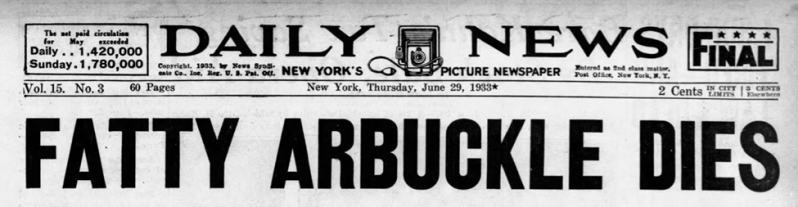
Roscoe “Fatty” Arbuckle died in his sleep early on June 29, 1933, in a suite at the Park Central Hotel in New York. Once America’s favorite movie comedian, he was just forty-six. Newspaper accounts say his wife, former actress Addie McPhail, awoke around 2:45 a.m. and found him groaning. When she roused him, he didn’t respond. Doctors were summoned, but it was soon clear that Arbuckle had died of heart failure. Just hours before, he had been joyously celebrating “the happiest day of my life”—his anniversary.
By Allan R. Ellenberger

Death was humiliatingly anticlimactic for a man whose journey had followed one of Hollywood's arch storylines: rapid rise, spectacular fall, and a new beginning of redemption he'd only just begun to embrace.
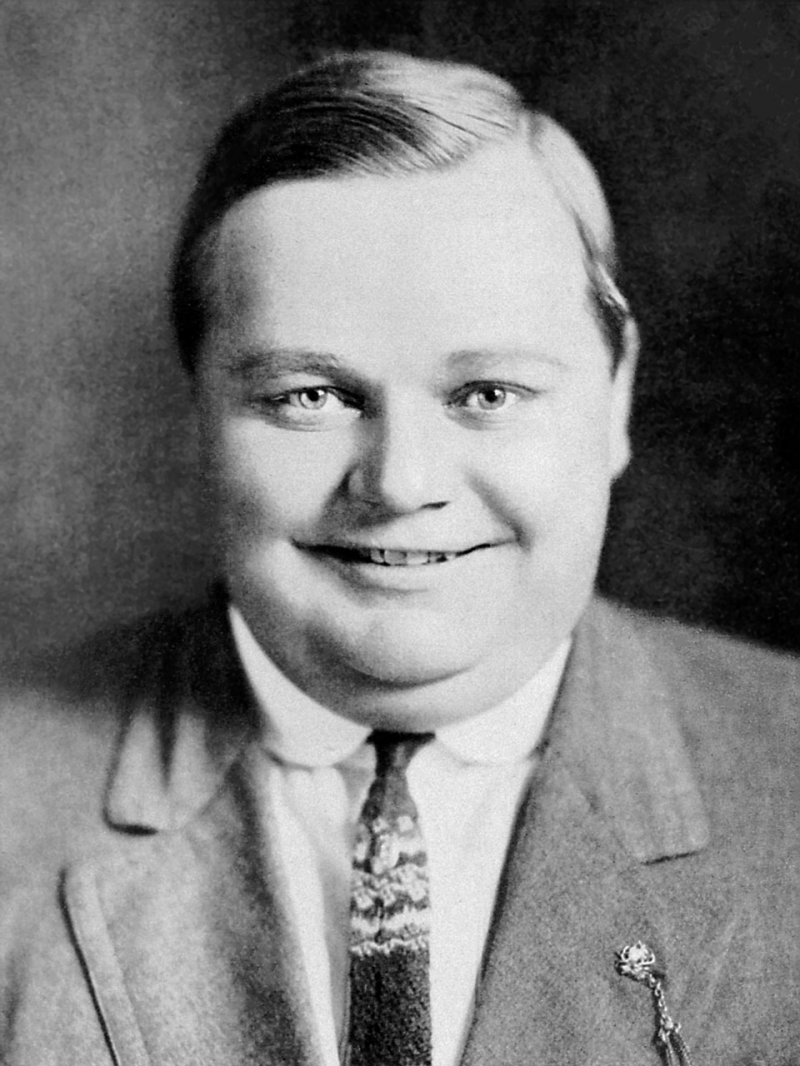
Born in Smith Center, Kansas, on March 24, 1887, Arbuckle was a sizeable baby whose weight allegedly caused his father to question his legitimacy. Despite his rocky home life, young Arbuckle discovered the stage. A natural performer, he began honing his skills with vaudeville acts, his astonishing athleticism (considering his ample frame) winning him great attention and praise. In the 1910s, Arbuckle began performing in motion pictures and was quickly scooped up by comedy legend Mack Sennett for his Keystone Studios; Arbuckle became one of the biggest draws of his generation.
Arbuckle's comic genius shone on film. He had an elegance and creativity to his slapstick that few of his peers could match. He could be spectacular, but he was also a deft technician of pace and personality. He discovered and collaborated with some of comedy's all-time greats like Charlie Chaplin and Buster Keaton, and helped pioneer much of the vocabulary of silent screen humor. By the late teens, Arbuckle was commanding huge salaries and unheard-of powers over his work, becoming Hollywood's first bona fide superstar.
That enormous success was shattered in September 1921. Arbuckle attended a Labor Day party at San Francisco's St. Francis Hotel. Actress Virginia Rappe became seriously ill there, and died days later. Arbuckle was charged with causing her death, and what ensued was one of the most sensationalized scandals of American history. Arbuckle was tried three times for manslaughter. There were hung juries for the first two trials, and the third ended in complete acquittal and an unprecedented apology issued by the jury. The apology read: “acquittal is not enough... he has been made to suffer a great injustice.”
But the damage was done. The public outcry had been inflamed by salacious newspaper stories, and Arbuckle had become public scapegoat for Hollywood greed at a time when that industry itself was facing more public criticism than ever before. Newly appointed head of the Motion Picture Producers and Distributors of America, Will H. Hays, banned all Arbuckle films from showing. The ban was later rescinded but the damage remained. His career as a star was over.
Arbuckle spent almost ten years banned from filmmaking. During that time, he continued to work as a director under the alias William B. Goodrich. Behind the scenes and away from public view, Arbuckle's name could still not be used in conjunction with any film as it was toxic with exhibitors and fans. The man who had once commanded the screen retreated into the margins of the industry he had helped build.

Arbuckle and his third wife, actress Addie McPhail
Still, Arbuckle never stopped hoping for a return. Sentiments began to soften by the early 1930s, and Warner Bros. took a gamble on him. They signed Arbuckle to a series of short comedies. These two reelers would gauge audience response to him. The response was good. Hey Pop!, Buzzing Around and the rest of the shorts played well, they were said to play nationwide. Arbuckle hadn't lost his touch; if anything, time had deepened the poignancy of his performances.

Roscoe Arbuckle, Phyllis Holden in Tomalio (1933), Arbuckle’s final film, completed the day before he died.
Encouraged by this small but significant victory, Warner Bros. signed him to a feature contract. It was finally--after more than ten years--complete restitution. A return to the top. Redemption. Friends said he seemed rejuvenated, hopeful and eager to start anew.
And then, almost immediately, it was over.
On the evening of June 28, 1933, Arbuckle and his wife marked their first anniversary. They visited friends, played games, and returned to their hotel around midnight. In the early hours that followed, his health failed without warning. Despite earlier indications that he had been in good spirits and looking forward to future work, his heart gave out before dawn. He died, as newspapers across the country reported, just as his “comeback fight” was beginning to succeed.
His reputation as a legendary figure both contributed to and overshadowed his legacy. Arbuckle's body lay in state at Campbell's Funeral Church. Thousands of mourners passed by his coffin similar to the crowd that attended Rudolph Valentino's funeral just seven years earlier. The turnout indicated that despite the controversy surrounding his previous trials, the public still remembered Arbuckle.
Yet there were sobering realities as well. Rumor had it that Arbuckle passed away with only a few thousand dollars to his name. Gone were the days when he had millions. Lawsuits, lost opportunities and lost earning capacity had eroded most of his fortune.

Arbuckle’s widow, Addie McPhail (center, in white), is supported as she leaves the funeral at Campbell’s Funeral Church.

Pallbearers carry out the flower-decked casket containing the body of Roscoe Arbuckle.
Funeral services were conducted in New York under the auspices of the Benevolent and Protective Order of Elks, of which Arbuckle was a member. Arbuckle’s widow remained composed throughout the service, but as she departed for the crematory in Queens, her grief overcame her. Supported by friends, she was guided to the funeral car through the dense crowds that had gathered along Broadway to witness the passing of the once-beloved comedian.
In accordance with his wishes, his body was cremated at Fresh Pond in Middle Village, Queens, and his ashes were later returned to California—the scene of both his greatest triumphs and deepest setbacks—where they were reportedly scattered into the Pacific Ocean.

Arbuckle was cremated at Fresh Pond Crematory in Queens and his ashes taken to California for spreading in the Pacific Ocean.
Roscoe Arbuckle's life was filled with contradictions, and death proved no exception. Here was a man who played a key role in developing the art form of screen comedy, but whose very name became all but synonymous with criminality and public vilification. Here was a man found innocent by a jury of his peers, yet somehow never able to fully clear his name in the eyes of the public ... until, perhaps, the very end, when audiences began to embrace him again.
That his life concluded at the very moment of renewal lends his story a tragic symmetry. The laughter he gave the world had not quite returned to him in full. But in those final days—on soundstages once more, before cameras again, greeted by audiences willing to watch and laugh—Roscoe Arbuckle came closer than he had in years to reclaiming the life that had been taken from him. And then, just as suddenly as the silence that follows a punchline, he was gone.
Tomorrow on The Hollywoodland Revue: a journey back to 1943 and the very first live-action appearance of Batman and Robin in Columbia’s wartime serial that launched the Caped Crusader onto the screen.
Please share your thoughts on Roscoe Arbuckle’s final days—leave a comment, rate the article, and share it with fellow film history enthusiasts.
Add comment
Comments