

There are figures in cultural history who never set foot in Hollywood, yet whose presence lingers there all the same—felt not in geography, but in myth. Among them stands Rupert Brooke, the English poet whose brief, luminous life and untimely death helped define an ideal that Hollywood would later elevate, replicate, and immortalize: the beautiful youth, touched by promise, claimed too soon.
By Allan R. Ellenberger

Born in Rugby, Warwickshire on August 3, 1887, Brooke came from a family interested in intellectual pursuits. His father, William Parker Brooke, was headmaster at Rugby School. Growing up in such an academic atmosphere, young Rupert was introduced to a sense of discipline that greatly affected him throughout his childhood. He later attended Rugby and proved to be a natural scholar and leader. As captain of his school, Brooke was known for being exceptionally handsome and charming, traits that would follow him throughout his lifetime. After finishing school, Brooke enrolled at King's College, Cambridge as a student of Classics.
At Cambridge, Brooke became associated with a circle of writers and thinkers often linked to the Bloomsbury milieu, though he was never a formal member. He formed friendships with figures such as Virginia Woolf and Lytton Strachey, moving easily within a world that prized wit, aesthetic sensibility, and intellectual daring.
Here, among his circle of friends, where same-sex attraction was not uncommon, he formed close emotional bonds with several men. Most notably, there is evidence of a complicated attachment to James Strachey, brother of Lytton Strachey. Some letters and accounts suggest that Strachey was strongly attracted to Brooke, and that Brooke may have experienced emotional—possibly romantic—feelings in return. However, there is no clear documentation that Brooke engaged in a physical relationship with him or with other men. Yet Brooke’s temperament set him slightly apart. Where others in that circle often embraced irony and skepticism, Brooke retained a romantic idealism that found its fullest expression in his poetry.
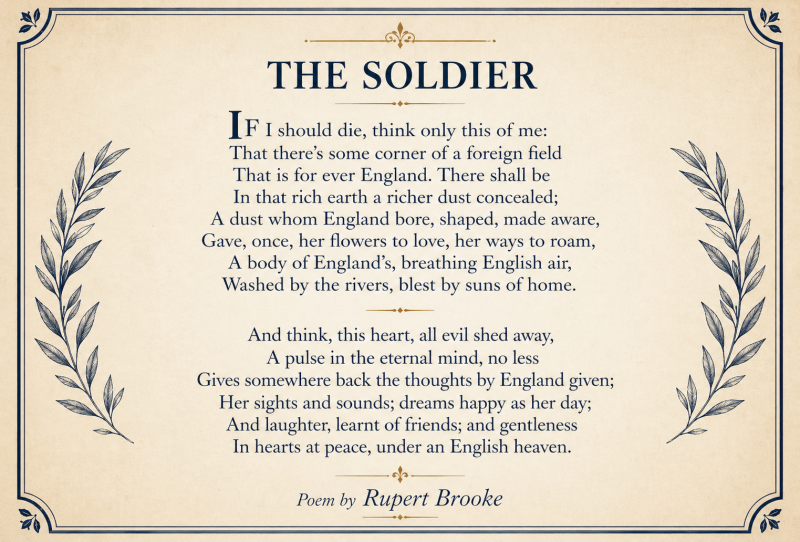
His earlier poetry combined elements of his classical scholarship with youthful passion. However, the declaration of the First World War in 1914 saw Brooke's emergence as a poet laureate figure for the war. Brooke had been commissioned as a lieutenant in the Royal Naval Division and began writing sonnets that became his most famous works, including "The Soldier". It begins: "If I should die, think only this of me." Brooke's blend of idealised war as noble sacrifice and tranquil acceptance was at the right place at the right time. He was publicly touted as the ideal England had to offer: handsome, intellectual, and without cynicism.
Brooke's life, however, was far more complicated than his legend suggests. His personal history was troubled and involved passionate but largely unconsummated affairs. Brooke suffered acutely by a romantic entanglement with Noël Olivier. Brooke experienced emotional instability that led him to travel abroad in 1913. Brooke journeyed to North America and the South Seas which expanded his views and infused his writing with a sense of restlessness and longing, even as he remained tethered to the idealism that defined his public image.
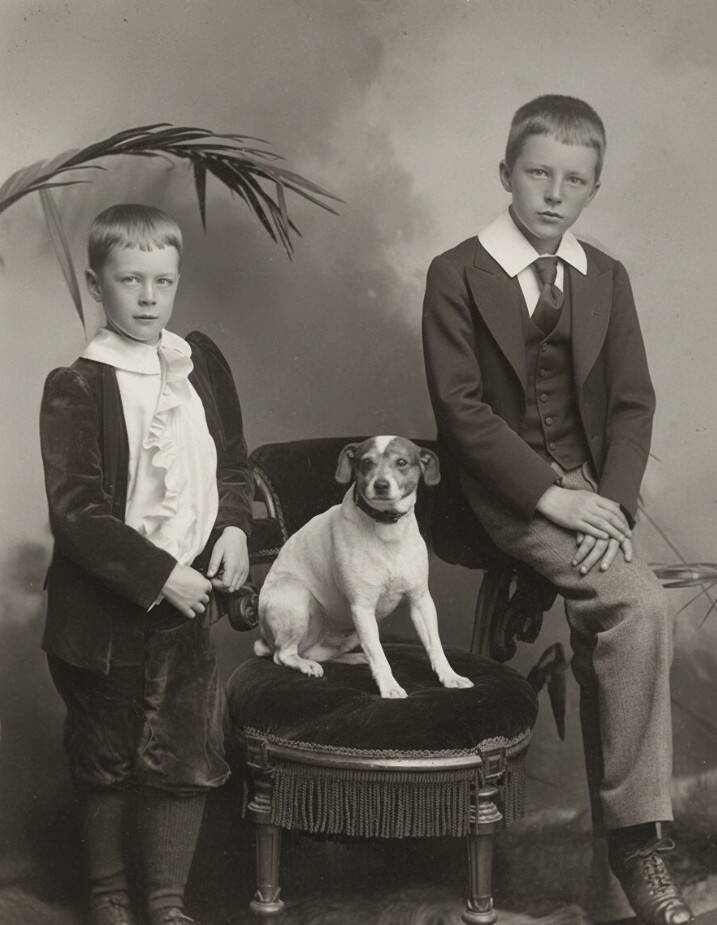
Childhood photograph of Rupert Brooke (right) with his younger brother Alfred Brooke (left) and dog Trim (1898) (Photo Credit: Edward Hall Speight - King's College)
Brooke welcomed war with idealistic fervour that would look heavy-hearted with hindsight. Seeing war as offering meaning and even salvation, Brooke brought to his war sonnets their peculiar note of serene affirmation. Brooke would not live to experience disillusionment. Suffering from sepsis caused by an insect bite while travelling with his unit to Gallipoli in early 1915, Brooke rapidly took a turn for the worse. On April 23, 1915, St. George's Day, he died on a French hospital ship moored off the Greek island of Skyros. He was twenty-seven years old.

Brooke’s original grave on the island of Skyros. (Photo: King’s College, Cambridge)
Brooke was buried that same day in an olive grove on Skyros which looked out onto the Aegean Sea. The grave itself was simple and almost classically picturesque, far from the romantic England that Brooke wrote about. Nestled in an area of rolling hills and sunshine, it looked like something out of Brooke's early poetry. It soon became a place of pilgrimage for literati and other visitors. Brooke in death, as in life, had become poetic shorthand.
News of his death made a profound impact on the artistic community and his reputation ballooned in the aftermath. For civilians who had not yet been exposed to the grisly reality of the trenches, Brooke embodied the idealism of a generation giving its life for king and country.
Later war poets, particularly Wilfred Owen and Siegfried Sassoon, would explode this myth with their graphic portrayals of the horrors of the war but Brooke remained – largely untouched, crystallized in time.


Rupert Brooke's grave today.
Brooke hardly needed to have stalked Hollywood's boulevards. The movie capital was content to mythologize him by osmosis. It gathered Brooke from many currents: from Europe's great watersheds to America; from books to the theater; from the emergence of modern celebrity. Brooke's poems were popular and in demand for anthologies.
In the end, Rupert Brooke’s life reads like a story Hollywood might have written for itself: a gifted young man, celebrated for both his talent and his appearance, lifted to symbolic heights and then lost at the very moment his promise seemed greatest. That he never saw California, never stood before a camera, and never participated in the machinery of film matters less than the fact that his legend anticipated it.
He remains, in a sense, one of Hollywood’s earliest ghosts—a figure whose life helped define the emotional language of an industry that would rise just as his own light was extinguished.

Statue of Rupert Brooke in Rugby, by Ivor Roberts-Jones.
Tomorrow on The Hollywoodland Revue: my five-star review of Remarkably Bright Creatures, the moving and visually beautiful new film starring Sally Field and an unforgettable octopus.
If Rupert Brooke’s life and legacy moved you, please take a moment to comment, rate, and share this post to keep his story—and its echoes through cultural history—alive for others to discover.

Add comment
Comments
Most excellently done Allan----