

Beyond the spotlight of Hollywood’s stars and studio elites, there was a different world filled with struggling actors, bit players, chorus performers, and hopeful men and women whose names rarely lasted past the credits of forgotten films. Among them was Tommy Hood, a small-framed character actor whose life ended in one of the strangest and most disturbing murder cases Los Angeles had seen in the early 1950s. The crime was so sensational that newspapers across California called it the “folding bed murder.”
By Allan R. Ellenberger

Today, few people remember Tommy Hood. But in the 1930s and 1940s, he was part of Hollywood’s entertainment scene, performing in the long-running melodrama The Blackguard alongside future director Ed Wood, Jr. He managed to get by in a city that was often harsh to those who didn’t become famous. His death in December 1950 revealed not just a brutal murder, but also the hidden realities of gay life in mid-century Hollywood, where people lived with secrecy, fear, and risk.
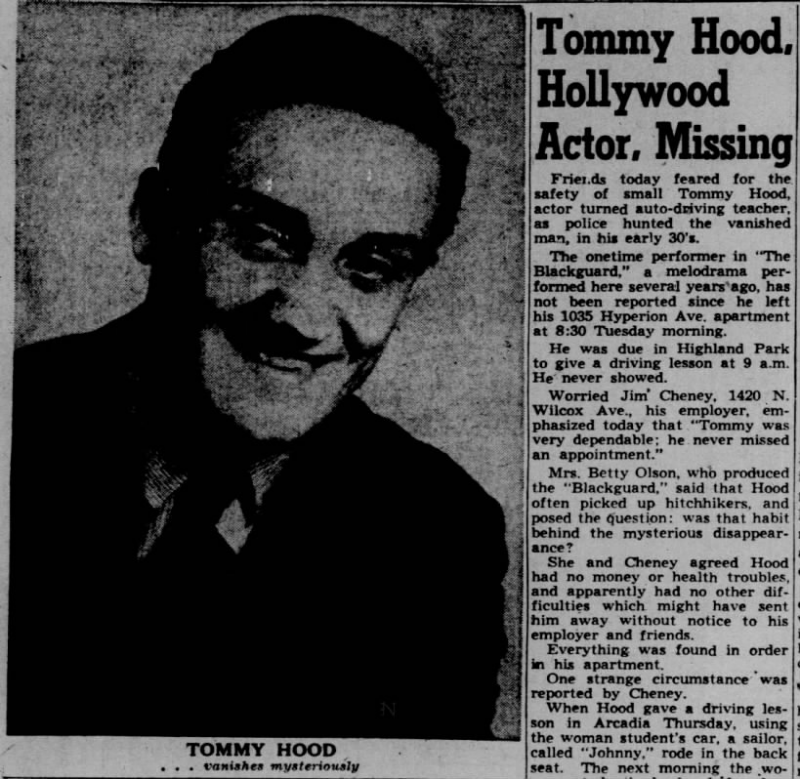
Tommy Hood was born Harold E. Sprankle on May 17, 1919, reportedly in Canton, Ohio. Not much is known about his early life, which is common for performers who never became stars. By 1937, he had moved to California, like many other aspiring actors looking for a chance in Hollywood. He was small—newspapers said he was five feet three inches tall and weighed about 120 pounds—but he stood out. Friends said he looked young, had brown hair, a crooked nose, and was always smoking a pipe.
World War II put Hood’s acting dreams on hold when he was drafted into the U.S. Army Air Corps in October 1942. While in basic training, he also lost his mother, who had been ill for a long time. Details about his military service are unclear, including whether he served overseas, but records show he had several illnesses, though the specifics are unknown. By late 1945, Hood was back in Los Angeles and trying to act again.
In March 1948, Hood finally found steady work with The Blackguard, a popular stage melodrama featuring exaggerated villains, audience participation, and lots of spectacle, sitting somewhere between vaudeville and traditional theater. Hood often played villains during the show’s long run and also appeared on radio. He wasn’t famous, but he became known in a small, active theater community.

Like many struggling actors, Hood’s career never gave him financial stability. By the late 1940s, he relied more on practical jobs to get by. For about five years, he worked as a driving instructor at a company on North Wilcox Avenue in Hollywood. People who knew him said he was reliable and always on time. Still, even with steady work, Hood seemed to live a lonely and somewhat isolated life in a modest apartment at 1037 Hyperion Avenue in Silver Lake.
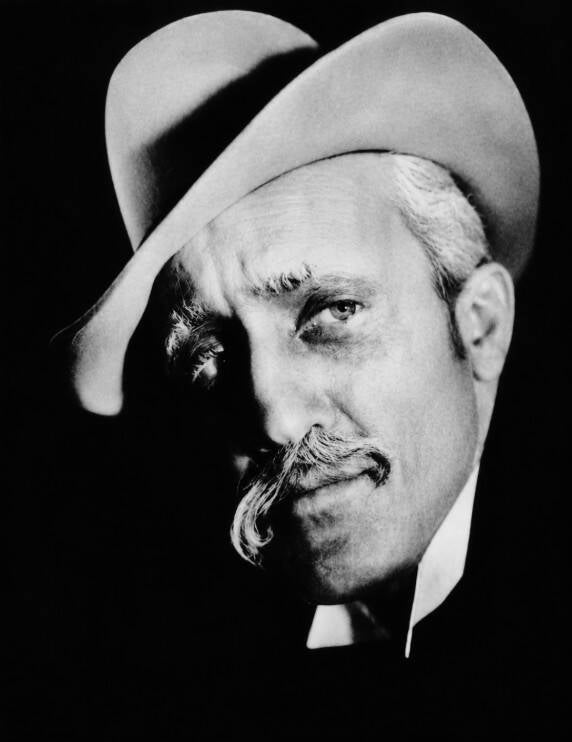
Tommy Hood as Father in The Blackguard, photographed during the production's third successful year at the Gateway Playhouse, where the young actor earned praise for his stage work before his life was cut tragically short.

In 1946, Wesley Steadman and Tommy Hood portray a pair of decidedly unsavory characters in Blackguard Returns at the Gateway Playhouse, showcasing the young actors' flair for melodrama in one of the theater's popular productions.
After his death, details suggested that Hood may have been homosexual, though newspapers at the time used careful and coded language to talk about it. In the 1940s and early 1950s, being gay in Hollywood meant living mostly in secret. People risked losing their careers if they were exposed, arrests were common, and gay men often depended on secret social circles and chance meetings. Police reports said Hood’s apartment had many photos of servicemen, and witnesses remembered seeing him with a sailor shortly before he disappeared.
On December 5, 1950, Hood disappeared. Friends grew worried when he didn’t show up for his scheduled driving lessons. His boss, Richard Cheney, and his theater colleague, Betty Olson, both said Hood was dependable and would never leave without telling anyone. His cream-colored Ford coupe was missing too.
As people became more worried, police went to Hood’s apartment on Hyperion Avenue and found the door locked. When they got inside, everything looked oddly untouched at first. Detectives noticed Hood’s unique decorating style: the apartment was filled with green and chartreuse colors, white drapes, Chinese prints, and small statues of Nubian slaves, giving it a theatrical feel. Later, a neighbor told police they saw Hood leave the apartment around 8:30 on the morning of December 5.
On December 8, police came back to Hood’s apartment and searched much more thoroughly. They noticed something odd about the folding wall bed. When they pulled it out from its hiding place, they found Hood’s decomposing body standing upright inside.

Tommy Hood's apartment building at 1037 Hyperion Avenue in Silver Lake, where the actor was found murdered in his apartment's Murphy Bed.
Someone had pushed a couch against the bed’s double doors to hide it. Hood’s body was partly wrapped in a blanket to keep it from falling when the bed was folded up.
The autopsy showed that Hood died from a fractured skull and bleeding in the brain caused by several blows to the head. Detectives thought the murder happened a few days earlier, probably soon after Hood was last seen alive. The shocking details of the crime drew a lot of attention from newspapers.
Investigators quickly focused on a mysterious young sailor reportedly seen with Hood before his disappearance. Witnesses described a Navy man with the name “Lefty” tattooed on one forearm. Hood’s missing automobile was later located, containing fingerprints that eventually led police to a former sailor named James Francis Silva.

Former sailor James Francis Silva struggles with detectives Joe LaMonica (left) and Lynn Bollenbach following his arrest in connection with the shocking murder of young actor Tommy Hood, a case that drew widespread attention in Southern California.
Silva, only twenty-one years old, was arrested in San Diego days later while sleeping at a service club. Though discharged from the Navy months earlier, he was still wearing part of his sailor’s uniform when apprehended. Under interrogation, Silva confessed.
According to detectives, Silva claimed Hood had made what was delicately described at the time as “improper advances.” During an argument inside the apartment, Silva struck Hood repeatedly with a cast-iron frying pan. Silva later insisted he believed he had merely knocked the actor unconscious. Panicking, he stuffed Hood’s body into the folding wall bed, closed it, stole Hood’s television and automobile, and fled Los Angeles.
The confession transformed the case into one of the era’s most lurid scandals. Though newspapers avoided direct discussion of homosexuality, the implications were unmistakable to contemporary readers.
In 1950s America, especially during the intensifying climate of the Lavender Scare, homosexual men were frequently portrayed in police reports as tragic, secretive, or dangerous figures. Hood’s private life became sensationalized in death in ways that would have been impossible to discuss openly while he lived.
Funeral services for Hood were held at Forest Lawn’s Church of the Recessional. His burial took place at Forest Lawn-Glendale, where his grave remains unmarked in the Liberty section.
James Francis Silva’s story, however, did not end with Hood’s murder.
Return tomorrow to The Hollywoodland Revue for Part Two of the shocking Tommy Hood murder case, exploring the dark and disturbing fate of his killer, James Francis Silva.
If you enjoyed Part One of my investigation into the murder of actor Tommy Hood, please take a moment to comment on, rate, and share the article as we explore one of Hollywood's most intriguing and little-known true crime mysteries.
Add comment
Comments
well.. now I am twisting in the wind awaiting part two of your uncovered tale!