

In June 1970, the Los Angeles Evening Citizen News featured a front-page story titled “A Man, A Minister … A Minority.” The article focused on Reverend Troy Perry, who was only twenty-nine at the time and a former Pentecostal minister. He had done something many people, both inside and outside organized religion, thought was impossible. He openly accepted his homosexuality while keeping his Christian faith. Even more, he started a church for people who had been told by almost every other church that God did not want them.
By Allan R. Ellenberger

Back then, Perry was seen as unusual. Reporters often described him as a contradiction. How could someone be openly gay and deeply religious? Looking back over fifty years later, this question reveals more about that time period than about Perry himself. What seemed radical in 1970 now seems ahead of its time.
Troy Deroy Perry Jr. was born on July 27, 1940, in Tallahassee, Florida. His early years were filled with instability, poverty, and hardship. His father, who was a bootlegger, died when Troy was young. After his mother remarried, Perry described his home life as abusive, which eventually led him to run away. Despite these challenges, religion became his safe place.
He started preaching as a teenager and became a licensed minister by fifteen. Before he was known as a gay-rights pioneer, he was just a boy who felt called by God.
Like many gay men raised in conservative Christian communities, Perry struggled for years to balance his faith and his sexuality. In 1959, he married Pearl Pinion, a minister’s daughter.
They had two sons, and Perry went to Bible schools in Illinois while working as a pastor. Still, his inner conflict remained. Eventually, he admitted he was attracted to men. This admission cost him his marriage and his position as a minister. Churches that once welcomed him now turned him away. He lost his role and was pushed out of the religious world he cared about.
Many people in his situation might have left religion behind. Perry almost gave up on life. After going through deep depression and a suicide attempt, he later said he had a spiritual awakening. Instead of believing God had left him, he began to think the churches were wrong. Maybe gay people did not have to choose between their faith and being true to themselves. Maybe there could be a church where both were possible. This idea changed history.
In 1968, Perry put a small ad in The Advocate to announce a new congregation. On October 6 that year, twelve people met in the living room of his rented house at 6205 Miles Avenue in Huntington Park. These twelve became the first members of the Metropolitan Community Church. They met in Perry’s living room because no other church would let them gather. The group soon outgrew the house, but its importance was huge. This was the start of the world’s first and oldest LGBTQ-focused Christian denomination. The timing was dramatic.
The Stonewall uprising had not yet happened. Most states still made homosexual behavior a crime. Mainstream churches almost always condemned homosexuality. But Perry was not just asking for tolerance; he was asking for acceptance. That difference was important then and is still important.

Above is the modest Huntington Park residence where Reverend Troy Perry founded the Metropolitan Community Church in 1968, welcoming twelve worshipers into his living room and launching what would become a worldwide LGBTQ faith movement. (This is a private residence; please respect the privacy of the current occupants.)


Within a few months, the congregation grew quickly. By 1969, Perry was already performing same-sex wedding ceremonies. At that time, these unions were not legally recognized anywhere in America, making his actions revolutionary. Time magazine later called one of these ceremonies the first public same-sex wedding in the United States. Perry went on to file lawsuits to get legal recognition for these marriages, starting fights that would lead to the marriage-equality movement many years later.

Above: Reverend Troy Perry participates in Los Angeles' first Pride Parade in 1970, held in Hollywood, helping lead a movement that would transform LGBTQ visibility and activism around the world.
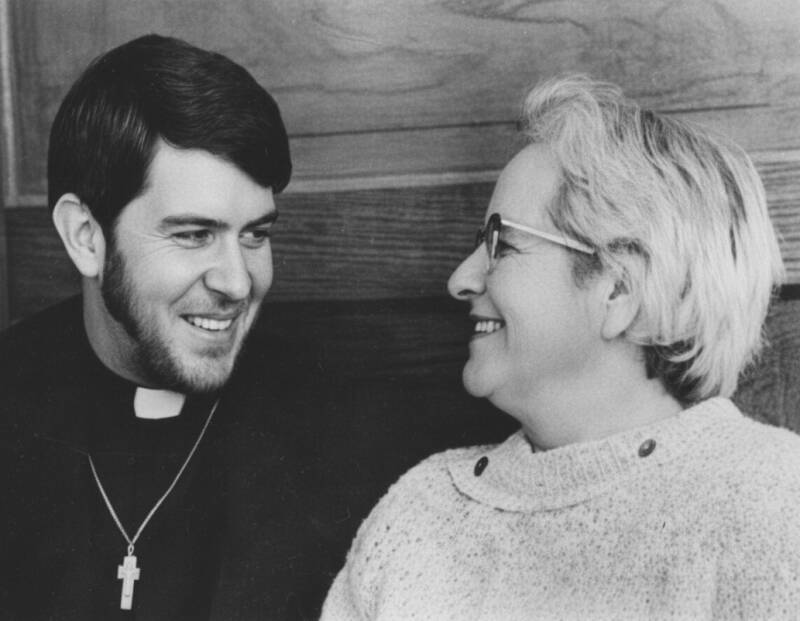
Reverend Troy Perry with his mother, Edith Perry, whose unconditional support became one of the most touching chapters in his life. As she famously said of her son, “He’s my son and I love him. It’s that simple.”
Perry’s impact went far beyond his church. He helped organize Christopher Street West, which put on Los Angeles’ first Pride parade in 1970. He fought against Anita Bryant’s anti-gay campaigns and opposed California’s Briggs Initiative, which tried to stop gay people from teaching in public schools. He also met with President Jimmy Carter’s administration to talk about LGBTQ civil rights. Perry became one of the first national leaders to say that gay rights were part of the larger fight for human dignity and religious freedom.
The Metropolitan Community Church became both a safe place and a target. As it grew across the country and around the world, some congregations faced bombings, arson, and violence. Still, the movement survived and kept growing. With Perry leading, MCC went from a small group in a living room to a global church with congregations on several continents. When he stepped down as Moderator in 2005, the church was one of the most influential religious groups in LGBTQ history.
One of the most interesting things about Perry’s story is how ordinary he often seemed, even with all he achieved. He never tried to act like a celebrity activist. In interviews from the 1970s, he spoke simply about faith, loneliness, rejection, and hope. He did not focus on academic theories. He wanted to fix a real problem: people were told that God hated them, and he believed that was not true. He held onto that belief throughout his life.
In 2003, Perry married his longtime partner, Phillip Ray De Blieck, in Toronto. When they returned to California, they worked to have their marriage legally recognized. This continued Perry’s long fight for marriage equality. The struggle that started with church ceremonies in the late 1960s had finally become part of the legal mainstream.
Now, as he reaches his mid-eighties, Troy Perry holds a special place in American history. He is a religious leader, a civil rights activist, a church founder, an author, and one of the most important figures in LGBTQ history. Still, his greatest achievement might be something less obvious than changing laws or leading protests. He created a spiritual home for people who had been told they did not belong. Many activists changed laws. Many ministers built churches. Few did both.
When Troy Perry welcomed twelve worshipers into his living room in Huntington Park in October 1968, he was doing more than starting a church. He was challenging a long-held belief in American religious life: that faith and homosexuality could not go together. Over fifty years later, many LGBTQ Christians around the world worship openly because one preacher refused to accept that idea.

Reverend Troy Perry and his longtime partner, Phillip Ray De Blieck, on the occasion of their marriage in Toronto in 2003, a milestone in Perry’s decades-long fight for LGBTQ equality and marriage rights. (Photo credit: revtroyperry.com)
That legacy is bigger than any one denomination. It is the story of a man who spent his life insisting that God’s love was greater than the barriers others tried to create.
If you enjoyed my latest profile of Reverend Troy Perry, founder of the Metropolitan Community Church, please take a moment to comment on, rate, and share the article to help preserve and celebrate this important chapter of LGBTQ history.

Metropolitan Community Church, 4607 Prospect Avenue, Hollywood
Profiles & Remembrances is an ongoing series at The Hollywoodland Revue devoted to writers, historians, archivists, collectors, and cultural stewards whose work has helped preserve and interpret Hollywood’s past. These profiles are independently researched and written to document contributions, context, and legacy—ensuring that the people who keep Hollywood’s history alive are not forgotten.
Add comment
Comments