

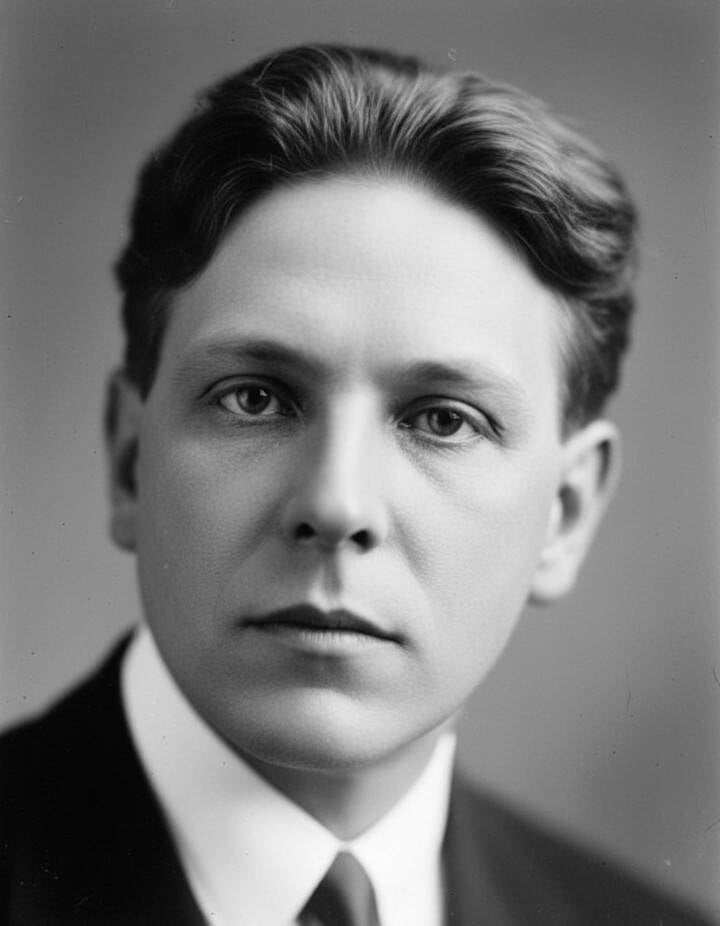
Very few people who visit Hollywood Forever Cemetery know that an important individual in Rudolph Valentino's early years in Hollywood is interred just a few feet from the famous crypt of the silent film idol. Although thousands go there every year to pay their respects to Valentino, they usually fail to recognize the crucial part that Maxwell Karger played in launching the career of one of cinema's first international superstars.
By Allan R. Ellenberger

Karger's name is now almost entirely absent from Hollywood history, having been overshadowed by the stars whose careers he had helped to establish. However, in the early days of the motion picture industry he was one of Metro Pictures' most influential executives, directing various productions, supporting new talent, and contributing to the foundation of what later became Metro-Goldwyn-Mayer. His friendship with Rudolph Valentino went beyond anything business-related and entered the actor's private life, which made him one of the trusted individuals who was with Valentino before his fame turned him into a global sensation.
Maxwell Karger, who was born on January 17, 1879, in Cincinnati, Ohio, began his career in the entertainment industry via music and the theatre, gaining a practical knowledge of both performance and production before motion pictures had become a fully established industry. In the same way as many of the pioneers of silent cinema, he took advantage of the rapidly evolving business in which there were few rules and in which innovation was always going on.
By the 1910s he had joined Metro Pictures Corporation, where he rose swiftly through the ranks to become director-general and treasurer and was in charge of some of the company's most ambitious productions.
Karger had a rare blend of creative instinct and executive discipline. When the American studio system was still being formed, he managed to combine his artistic aspirations with the practical demands of budgets, schedules, and production. The work he did behind the scenes was instrumental in setting up the efficient methods which later came to define Hollywood's golden age.
There were many young actors who went through the doors of Metro, one of them being an ambitious Italian immigrant called Rudolph Valentino. Even before women used to faint when seeing 'The Great Lover', Valentino was a performer who was struggling to secure his first real opportunity. Karger noticed his potential and therefore became not only his professional advocate but also a trusted personal adviser during the actor's difficult early years in California; their friendship went beyond the studio gates.

Above is the former site of Maxwell Karger’s home at 5051 Hollywood Boulevard, where he hosted the November 5, 1919, wedding of Rudolph Valentino and Jean Acker. Today, the property is occupied by a costume shop.
On November 5, 1919, Valentino got married to actress Jean Acker in a quickly arranged wedding ceremony which took place at Maxwell Karger's house in Hollywood. Karger and his wife acted as the official witnesses by signing the marriage license and thus became at the heart of one of Hollywood's most well-known—though in the end disastrous—marriages. Even though the marriage is famous for falling apart so soon afterwards, the ceremony did show how close Karger was to the young actor. Rather than selecting a hotel, a courthouse, or a minister's office for his wedding, Valentino chose to celebrate one of the most important moments in his personal life at the home of a friend he trusted.
Karger also played a professional role in overseeing the production of The Four Horsemen of the Apocalypse (1921). This epic drama raised Valentino from being an almost unknown supporting actor to becoming the world's most famous male movie star and it was one of the greatest box-office successes of the silent film era, thereby altering Valentino's career forever.
Even though the director Rex Ingram and the screenwriter June Mathis should receive a great deal of the credit for the creative work, Karger's position as director-general at Metro was instrumental in guiding the production which created a legend.
Even though Valentino's career was rising, problems in Karger's personal life grew worse. Modern-day accounts mentioned marital difficulties and accusations concerning his wife's unfaithfulness. Although it was usual during the silent film period for such issues to be kept out of public sight, the strain stood in sharp contrast to the confidence and authority he displayed in the executive rooms of Metro.
At the same time as Hollywood was about to enter its most glamorous decade, misfortune occurred. On May 5, 1922, Maxwell Karger died suddenly at the age of forty-three while aboard a train traveling through Indiana, collapsing in the drawing room of his compartment. His promising career ended abruptly at a time when Metro Pictures and the industry as a whole were expanding at a remarkable rate. Hollywood lost one of its most experienced early executives as a result of his death before he had the opportunity to see the studio system that he had helped to establish fully develop.
Karger was buried in Hollywood Cemetery; four years later, following Rudolph Valentino's early death in 1926, the silent screen star was placed in the Hollywood Mausoleum (now Cathedral) just a few feet away. What a remarkable historical coincidence it is that the mentor who had helped open the way for Valentino should have his wedding held by him and have assisted in Valentino's rise to stardom now lie almost in view of the actor whose fame would overshadow nearly all those who had helped him.
Nearly every day people go to Valentino's crypt, leaving behind flowers, letters, and other tokens of admiration almost one hundred years after his death. It is not widely known that Maxwell Karger, one of the overlooked architects of Valentino's success, is only a short distance away. Usually, Hollywood history honors its stars but fails to acknowledge the producers, executives, and visionaries who saw great talent before anyone else did.
Maxwell Karger's career was sadly brought to an early end, and history has not remembered him as favorably as a number of his fellow figures. But if it had not been for his advice, friendship, and support of a young actor called Rudolph Valentino, the course of Hollywood history could very well have been quite different. Now, at the Hollywood Forever Cemetery, the graves of the two men are joined in death, just as they had been linked during the early years of one of the most legendary figures in the history of the motion picture industry.

Above is Maxwell Karger’s crypt in the Cathedral Mausoleum, Corridor A, A-1 West, Crypt 1194. Below, the arrow marks its location within the alcove, showing just how close Karger rests to Rudolph Valentino’s crypt.

To add a footnote, Frederick Maxwell "Fred" Karger Jr. (1916–1979), the son of Karger, established his own career in Hollywood as a vocal coach, composer, and long-time music director at Columbia Pictures, having among his credits the film "From Here to Eternity." In 1948, Marilyn Monroe fell in love with Karger, but the relationship did not last. Karger reportedly ended it because he did not believe the young actress would make a suitable stepmother for his son from an earlier marriage. He married actress Jane Wyman on two occasions, first in November 1952 and then again in March 1962. In an eerie coincidence, he died on August 5, 1979, exactly seventeen years after Monroe's death.
Tomorrow on The Hollywoodland Revue: this week’s “Coming Attractions” roundup featuring the newest theatrical releases, critical reactions, audience buzz, and recommendations on what may—or may not—be worth your ticket money.
If you enjoyed discovering the life and legacy of producer Maxwell Karger, please take a moment to leave a comment, rate the post, and share it with others who appreciate classic Hollywood history. Your support helps keep these often-forgotten stories alive at The Hollywoodland Revue.
Add comment
Comments