

In 1956, thirty years after Rudolph Valentino's death, his name could still draw a crowd. This time there was no movie premiere, memorial service, or anniversary observance. The attraction was a room in a doomed Hollywood landmark and the ordinary furniture being auctioned from inside it.
By Allan R. Ellenberger

Above: The Hollywood Hotel in 1956, just months before its furnishings were auctioned and the legendary landmark was demolished.
The Hollywood Hotel at Hollywood Boulevard and Highland Avenue was nearing the end of its life. For more than half a century, the sprawling Mission Revival hostelry had stood at one of Hollywood's most famous intersections. In its heyday it was a social center of the early motion-picture colony. In this place, actors, directors, producers and writers lived, dined, danced and conducted business before Beverly Hills and the Sunset Strip became the preferred playgrounds of the film community.
Among the hotel's most famous residents was Rudolph Valentino. Before The Four Horsemen of the Apocalypse made him an international sensation in 1921, the young Italian immigrant was still struggling to establish himself in Hollywood. His association with the hotel, particularly Room 264, became part of Valentino lore, and long after his death, tourists continued asking to see the room connected with the Great Lover.
The hotel was also linked to one of the more notorious episodes of his personal life. On November 6, 1919, Valentino impulsively married actress Jean Acker. The marriage famously collapsed almost immediately, with Valentino reportedly locked out of his bride's room on their wedding night. Years later, Acker herself returned to the Hollywood Hotel and asked to see Valentino's old room, briefly revisiting a place connected to a painful episode that had long since become Hollywood legend.
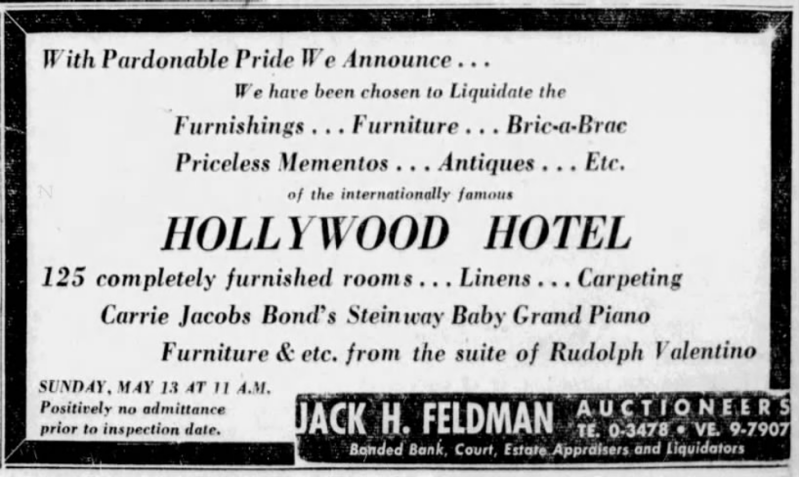
By the spring of 1956, however, the Hollywood Hotel's own story was ending. The valuable property was destined for redevelopment, and the contents of the old building were put on the auction block. Former guests returned for a final look, while bargain hunters and souvenir seekers crowded into the rooms as beds, bureaus, desks, lamps and chairs were sold.
Valentino's room naturally attracted special attention. Some fifty or sixty people crowded inside as auctioneer Lawrence Feldman called for bids on its furnishings. There was nothing particularly glamorous about the pieces. They were old hotel furniture, and there was no evidence that Valentino himself had used the specific items being sold. Three decades had passed since his death, and the room undoubtedly had been refurbished over the years. Their appeal came from their location: they were being removed from the room Hollywood remembered as Valentino's.
One of the bidders was Mark "Lucky" Marlatt, an ice-cream vendor who arrived wearing his white uniform, cap and change maker. Marlatt successfully bid $12 for two chairs. Then he spotted another opportunity.
With Feldman's permission, Marlatt began selling ice cream to the hot and thirsty crowd gathered for the auction. Before long, he was doing a brisk business and joking that he would soon earn back what he had paid for his chairs. He planned to put them in his new home in the San Fernando Valley.
It was a wonderfully incongruous scene: Rudolph Valentino's old room packed with souvenir hunters. At the same time, an ice-cream man sold refreshments among the bidders and waited to carry home two pieces of Hollywood history.
Whether those chairs still exist is unknown. If they do, their significance would lie not in an unproven claim that Valentino once sat in them, but in their documented connection to the final auction of the room associated with him.

Mark “Lucky” Marlatt, an ice-cream salesman, examines one of the chairs he purchased at the 1956 auction of furnishings from Rudolph Valentino’s former room at the Hollywood Hotel.
The sale was part of a much larger dismantling. The Hollywood Hotel had become outdated, and its prime location made redevelopment almost inevitable. Plans called for the old landmark to be demolished and replaced by a development reportedly costing $10 million.
Demolition began during the summer of 1956. The hotel that had witnessed Hollywood's transformation from a quiet community into the movie capital of the world was torn apart, taking Room 264 with it. A modern commercial complex eventually rose on the property, including the First Federal Savings and Loan building. That development, too, would eventually disappear. The site was later transformed into the Hollywood & Highland complex, which opened in 2001 and is now known as Ovation Hollywood. Today, millions of people pass through Hollywood and Highland without realizing that they are walking across the footprint of one of early Hollywood's great gathering places.
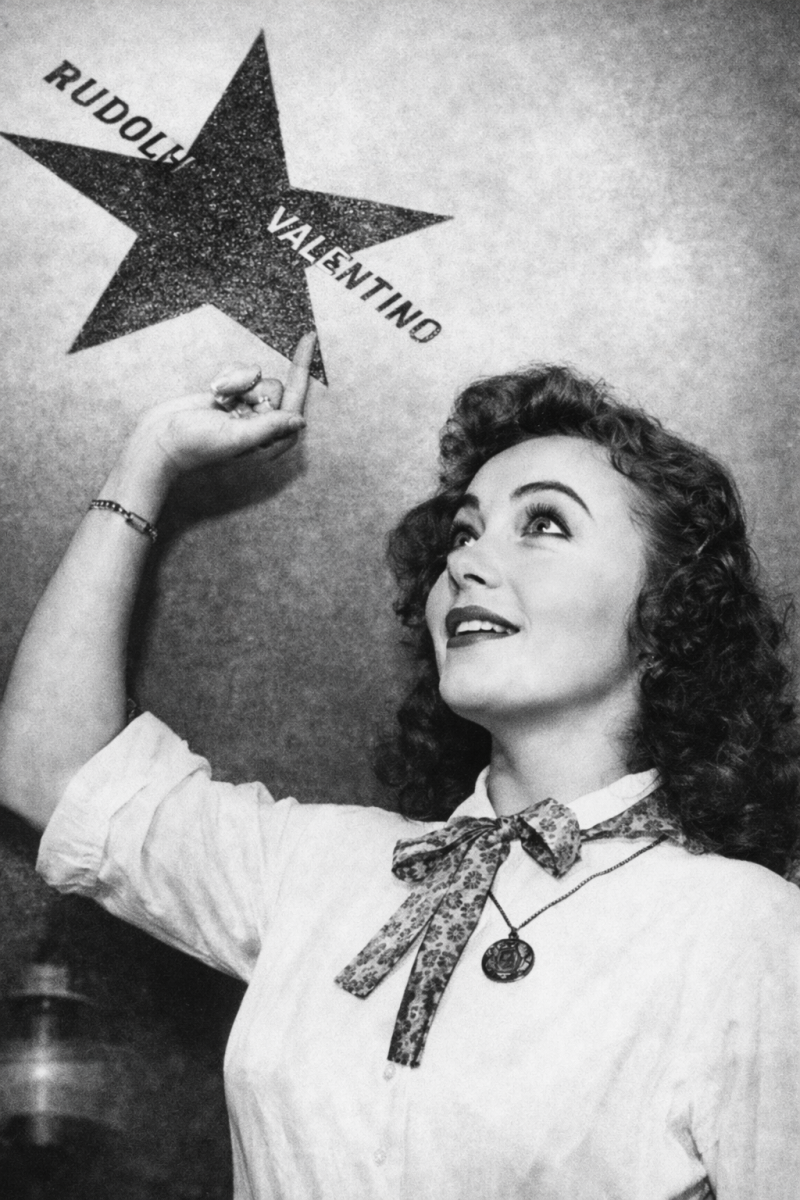
A young aspiring actress reaches up to touch Rudolph Valentino’s star on the ceiling of the Hollywood Hotel dining room, positioned above the table where the silent-screen idol reportedly once dined.
The auction of Valentino's room captures something particularly poignant about Hollywood history. The city has always been quick to demolish the places where its history happened, leaving later generations searching for photographs, documents and surviving fragments to reconstruct what was lost.
In May 1956, people understood that something was disappearing. Former guests wandered the corridors for one last look. Others carried away desks, lamps, beds and chairs. And in Room 264, three decades after Rudolph Valentino's death, his name still possessed enough magic to fill the room with strangers hoping to take home a small piece of the past. Somewhere, perhaps, Lucky Marlatt's two $6 chairs are still sitting in someone's home. If only they could talk.
COMING TOMORROW: Before Rudolph Valentino became one of the greatest screen idols of the silent era, producer Maxwell Karger recognized his potential and helped guide his emerging career. Check in tomorrow for my look at Karger’s fascinating life, his place in early Hollywood history, his connection to Valentino, and his final resting place at Hollywood Forever Cemetery.
If you enjoyed this glimpse into the final days of the Hollywood Hotel and the 1956 auction of furnishings from Rudolph Valentino’s former room, please take a moment to leave a comment, rate the article, and share it with others who enjoy Valentino and Hollywood history. Your support helps keep these fascinating stories from Hollywood’s past alive.
Add comment
Comments