

In the very beginning of American cinema, when motion pictures were still working out their style and the studios which were to shape an entire industry had only just started to be established, the McCutcheon family was one of the most influential. But no episode in that family's history is more tragic—nor does it reveal more plainly the instability of silent-era Hollywood than the short and turbulent life of Wallace McCutcheon Jr. Having once been a well-known figure on Broadway and the husband of the serial queen Pearl White, he died alone in a cheap Hollywood rooming house, all he left behind being a half-full bottle of gin and a moving goodbye: "Have a drink."
By Allan R. Ellenberger

Wallace McCutcheon Jr. was born on October 24, 1884, in Brooklyn and was the eldest of eight children, the children of Wallace "Old Man" McCutcheon Sr., a pioneer in the film industry, and his wife Mira West. His father, who had already become a pioneering cinematographer and director, played a key role in establishing the basic structure of early motion pictures and earned a reputation as one of the most important artisans at the Biograph Company. Wallace Jr. grew up in an environment filled with theatre activity and experimentation in filmmaking. Yet, unlike his father, he first turned to the legitimate stage. Because he was handsome, charming and quick-minded, he was known on Broadway simply as "Wally", a light-footed performer in musical comedies who enjoyed bohemian nightlife and the company of chorus girls.
He sometimes took on minor parts in his father's films, but his opportunity in the film industry came suddenly—almost by accident. In the spring of 1908, his father fell seriously ill and, in order to get a position for his son, asked Biograph to let Wally take over the directing.
The studio agreed and, for a number of weeks, the young man found himself in charge of the camera at one of the most important film production companies in America.
According to most people, the venture was a complete failure. Although Wally was gifted, he had no sense of discipline. The scriptwriter Gene Gauntier remembered him kindly but in a straightforward manner, calling him a "good-looking, frivolous musical comedy actor" who appeared to be more concerned with entertaining pretty women than with producing coherent films. Actress Kate Bruce was less kind in her assessment; she stated that one of Wally's films "nearly sent us all to the poorhouse." Because his output had been so poor—maybe no more than a dozen short films—Biograph gave up on the experiment altogether.
At that moment, fate stepped in. When the position previously held by the directors was suddenly vacated, the executives of Biograph decided to offer a young actor called D. W. Griffith his first opportunity as a director. Griffith's first film, The Adventures of Dollie, was a great success. As a result, Wally McCutcheon Jr. became the first director to be replaced in order to make way for the man who was soon to transform the entire language of cinema. Hollywood's future had come, and Wally's was already fading away.
After 1908, he disappeared from film credits and probably went back to the stage, since his charm and presence were more at home there. However, in 1917, at a time when America was getting ready to enter World War I, a dramatic change occurred in his life: he married Pearl White, the daredevil star of the silent serials and the beloved heroine of The Perils of Pauline. The marriage offered the prospect of glamour, adventure, and artistic collaboration—until Wally was sent to Europe to serve in the war.
The war left him ruined. He entered the Royal British Flying Corps, took part in intense fighting on various fronts, and suffered a serious head wound when a shell exploded near him. It was later reported that he had amnesia, was confused, and suffered from neurological instability that he never managed to recover from. As Wally drifted about, lost and injured, Pearl White waited—eventually concluding that he was not coming back home. She then divorced him in 1921 on the grounds of desertion.

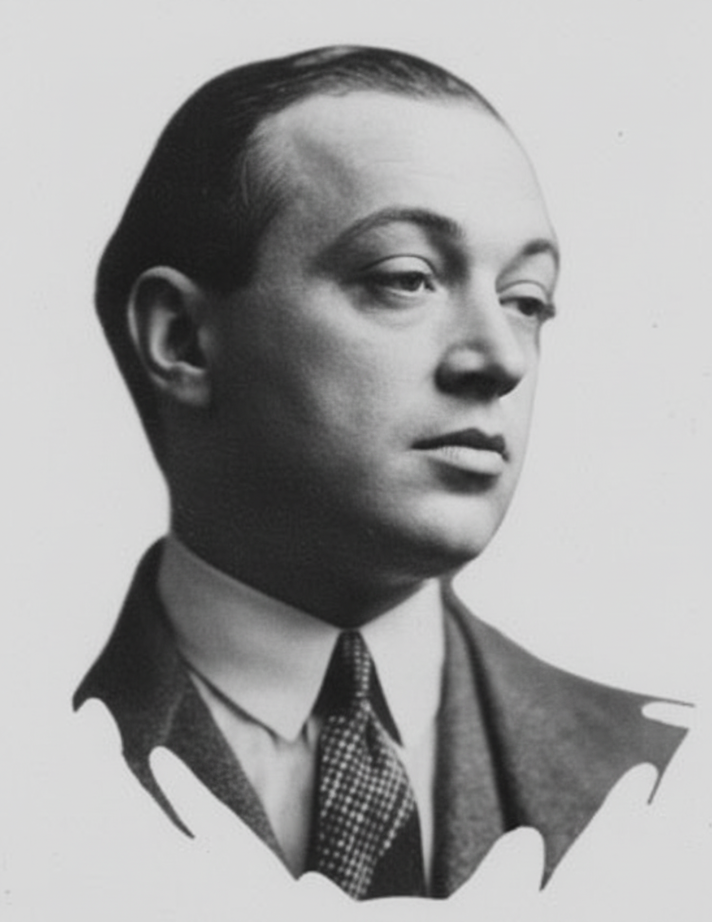
Wallace McCutcheon Jr. and his wife, serial actress Pearl White.
Following the war, Wally had a few appearances in films, one of which was alongside Pearl White's rival Juanita Hansen, but his life then began to decline. He moved back and forth between the two coasts, drank in large amounts, and had great difficulty in restoring his stability. What had once been a well-known figure on Broadway and a man who had toured abroad now led a nomadic life, shifting from cheap rooming houses to low-paid work in the theatre and from time to time taking on film roles.
By the mid-1920s when he had got to Los Angeles, it was clear that he was in decline. Those who knew him remembered him as a man who had once been charismatic, but who had now sunk into poverty, illness, and alcoholism. The film studios would not have any use for him and Broadway had already forgotten him.

The Brevort Hotel, formerly the Warner-Kelton Hotel, at 6326 Lexington Avenue in Hollywood, where Wallace McCutcheon Jr. was found dead from a self-inflicted gunshot wound.
On January 27, 1928, on a gloomy morning, the housekeeper at the Warner-Kelton Hotel, located at 6326 Lexington Avenue in Hollywood, found the man dead. He took his life by shooting himself in the temple with a revolver of heavy caliber. Next to his body, on a wooden stool, was a bottle of bathtub gin which had been only partly finished. Under the label of this bottle, the police discovered the last words he had written: "Have a drink."
He was identified by authorities through a notebook found in his room which had his brother's name in it.
The newspapers referred to him as "an ex-army captain, soldier of fortune, actor, and former husband of Pearl White," while Hollywood insiders saw him as a warning example—being one of the first important figures to be swept away by the industry's harsh currents.
No farewell note was found, nor was there anything to explain why the actor had chosen to end his life. His body was taken to the county morgue and, the following day, sent east to his mother’s home in Hillside, New Jersey, for funeral services. He was then laid to rest beside his father at Glenwood Cemetery.
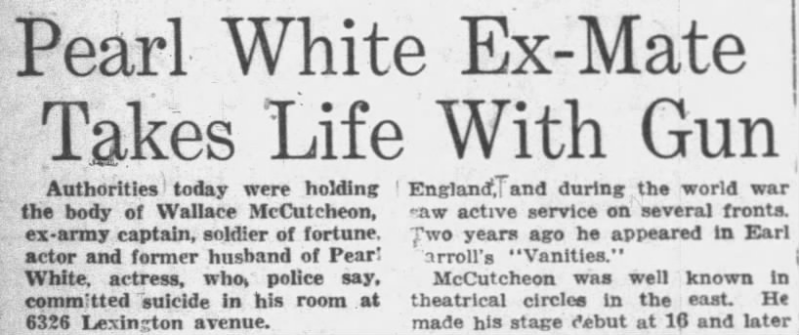
A January 1928 headline on page 2 of the Los Angeles Evening Post-Record reports the death of Wallace McCutcheon Jr., identifying him prominently as the former husband of serial star Pearl White.
Once, Wallace McCutcheon Jr. was seen on the rooftops of New York with the famous dancer Joan Sawyer, raced cars, performed various feats on horseback, and competed in shooting. He fought bravely in the First World War and was accepted in Broadway circles, marrying one of America's most well-known actresses. Nevertheless, his life ended in obscurity, overshadowed by his father's great reputation and Griffith's tremendous rise, which kept Wally on the periphery.
Although his story is tragic, it also shows the turbulent nature of early Hollywood, a world in which talent could be suddenly overshadowed, wartime trauma was not treated, and many pioneers are now forgotten. Wallace McCutcheon Jr. was not just a minor figure in film history; he was integral to its foundation and present when cinema made its first major advance. His death, like that of many early film stars, reminds us that Hollywood's golden reputation often casts long, dark shadows.
If you found Wallace McCutcheon Jr.’s story as fascinating and tragic as I did, I’d love to hear your thoughts. Please leave a comment, rate the post, and share it with other readers who enjoy forgotten Hollywood history. Your support helps keep these overlooked stories alive.
Add comment
Comments