

Stretching across Hollywood Forever Cemetery’s northwestern flank are long, quiet halls that most guests will likely never visit. It’s easy to overlook them, as they sit alongside the Cathedral Mausoleum and the lake, staring out over monuments and celebrity graves visited by thousands every year. Yet the Corridor Mausoleums are some of the cemetery’s uniquely atmospheric holdovers from an earlier era. When they opened nearly a century ago, their builders imagined them as part of a dramatic overhaul of Hollywood Cemetery and its burial practices. They might even have changed the way Americans approached death itself.
By Allan R. Ellenberger
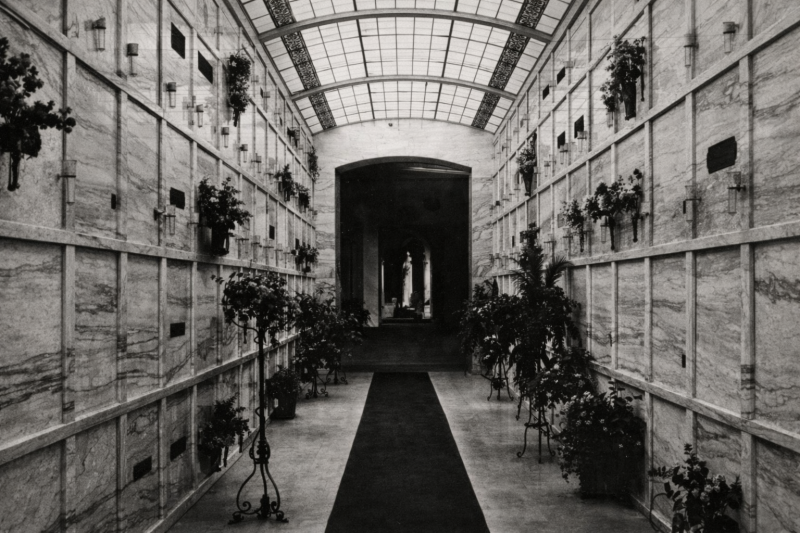
The story starts in Southern California during the 1920s. Mausoleum entombment was enjoying widespread popularity during this period as more and more families sought an alternative to traditional burial. Indoor entombment offered families permanence that ground graves could not: weatherproof structures, built-in surroundings, and decorative options that made corridors feel more like chapels and less like cemetery plots. Frank Heron, then president of Hollywood Cemetery, recognized the market potential and the practical advantages for his business. Land for conventional burial was finite at Hollywood Cemetery; mausoleums allowed far greater interment density within the same space. Heron and the Hollywood Cemetery Association soon broke ground on corridor mausoleums along the northwest section of the property, envisioning corridors that might one day stretch completely around the grounds.
The first corridor mausoleum was an experiment of sorts, but a successful one. Later called Building A, it featured marble-lined walls, leaded and stained glass, and a translucent glass roof that let filtered light shine down the long corridor. It was finished and open for crypt sales in roughly a month and reportedly proved so popular that crypts sold out quickly, earning the association around $25,000 in profits. If the reaction was any indication, Hollywood wanted more.
The rapid success of Building A led to quick development of additional corridors. Architect Lloyd Rally was contracted to design the next structures, with W.A. Corcoran acting as contractor. Construction began shortly thereafter on sections of corridor later known as Buildings B and C, which continued the line west toward Gower Street. There, Hollywood Cemetery bordered dense development throughout Hollywood’s boom period as the motion-picture district grew up around it. The original idea was grand: corridors would eventually stretch around the entire property in architectural symmetry, freeing up the interior of the cemetery grounds for lawn space.
Just three mausoleum corridors had been built when Hollywood Cemetery went public with its plans to continue constructing them around the cemetery perimeter. Never finished, those ambitions instead set the tone for perimeter mausoleum construction, which continued at Hollywood Forever for decades.
Though corridors served a clear purpose as additional burial space, designers made them feel as intimate as possible. Spaced between corridors were family rooms meant to accommodate as few as four to eight crypts. Decoration such as ornamental roofs, glass-fronted cremation niches, and abundant ivy and bougainvillea softened the marble architecture.

Frank Heron (1872-1941) was president of Hollywood Cemetery from 1922 to 1939.
Period photographs show chairs and flowers placed throughout the corridors, encouraging visitors to sit and linger. Despite their size, the corridors felt less like mausoleums and more like indoor cloisters.
Marketing these mausoleums depended both on price and presentation. One advertisement showing the new corridor boasted prices ranging from $175 to $350, calling it dignified, permanent, and affordable. Ads for crypts in Building D offered spaces at $180, including perpetual care, with initial payments as low as $45. The cemetery also promoted the ability for guests to visit their crypts at will, suggesting buyers would never feel pressured by overzealous salespeople. The ad implied that mentality set Hollywood Cemetery apart.

After years of construction, the corridor system was still growing by 1929. The Sanctuary of Hope spanned roughly 160 feet along Gower Street and contained 314 crypts within its walls. Space was still selling despite an American economy nearing collapse in October of 1929. By then, mausoleums had stopped being novelties and had become established institutions.
The largest corridor by far was built in the early 1930s, echoing American fascination with Egyptology and the discovery of Tutankhamun’s tomb several years earlier. Hollywood Cemetery dove headlong into the Egyptian revival style when planning began in June of 1931 for a $100,000 structure containing 638 crypts. Hollywood-area contractor Chester M. Williams built it on the cemetery’s west flank near Gower Street. The structure’s footprint was said to cover 48 feet by 144 feet, with an expected completion date of December 1931.
The building itself became one of Hollywood Cemetery’s most architecturally distinguished burial structures. Guests passed through a recessed courtyard and entered through raised entrances framed by Egyptian-style columns, battered walls, and a cavetto cornice. Total costs, including land acquisition, were estimated at around $120,000. Crypts were reportedly sold at $150 apiece during initial phases of construction.
Few pieces of architecture at Hollywood Forever Cemetery are as indicative of changing ideas about death in Los Angeles as its Corridor Mausoleums. From their Classical, Byzantine, and Tudor flourishes to their boldly Egyptian section, they reflected both Hollywood’s eclectic architecture and the Cemetery Association’s unabashed confidence as the surrounding city grew exponentially.
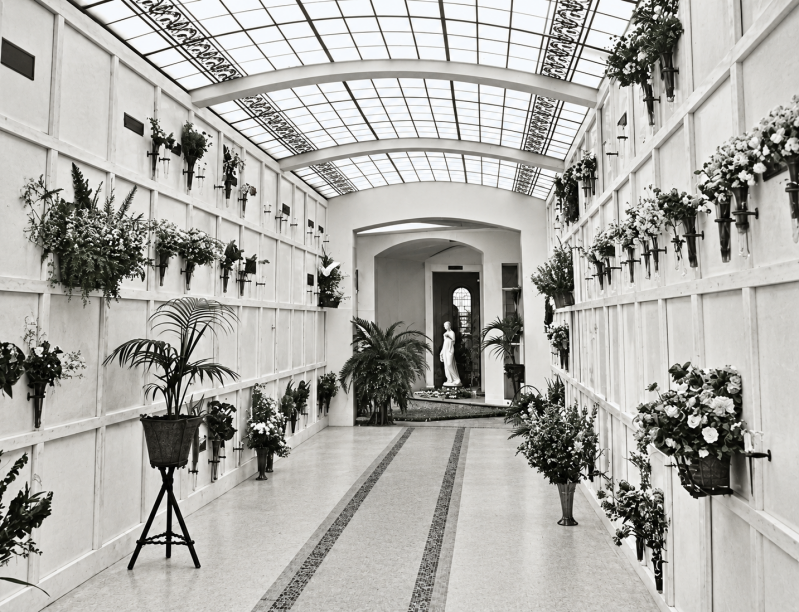
Above is Corridor Mausoleum B around 1928, looking toward the point where the passage turns south and becomes Corridor C. At the far end stands a statue installed at that time, remarkably still in place today.
Decline soon followed. After years of neglect under owner Jules Roth, cemetery maintenance suffered badly in the late 20th century. By the 1980s, newspapers were writing stories about Hollywood Memorial Park's deteriorating condition and California officials monitoring the property. One article from 1988 described maintenance-related complaints against the cemetery, along with increasing attention from state cemetery regulators.
The Corridor Mausoleums were especially hard-hit. Rain poured through leaky roofs, marble fronts cracked and fell from walls, ivy overwhelmed exterior walls, and temporary wooden reinforcements replaced permanent repairs. Some crypt fronts became so badly damaged that marble crypt interiors were visible from outside. Once-grand burial halls began to look abandoned and forgotten.

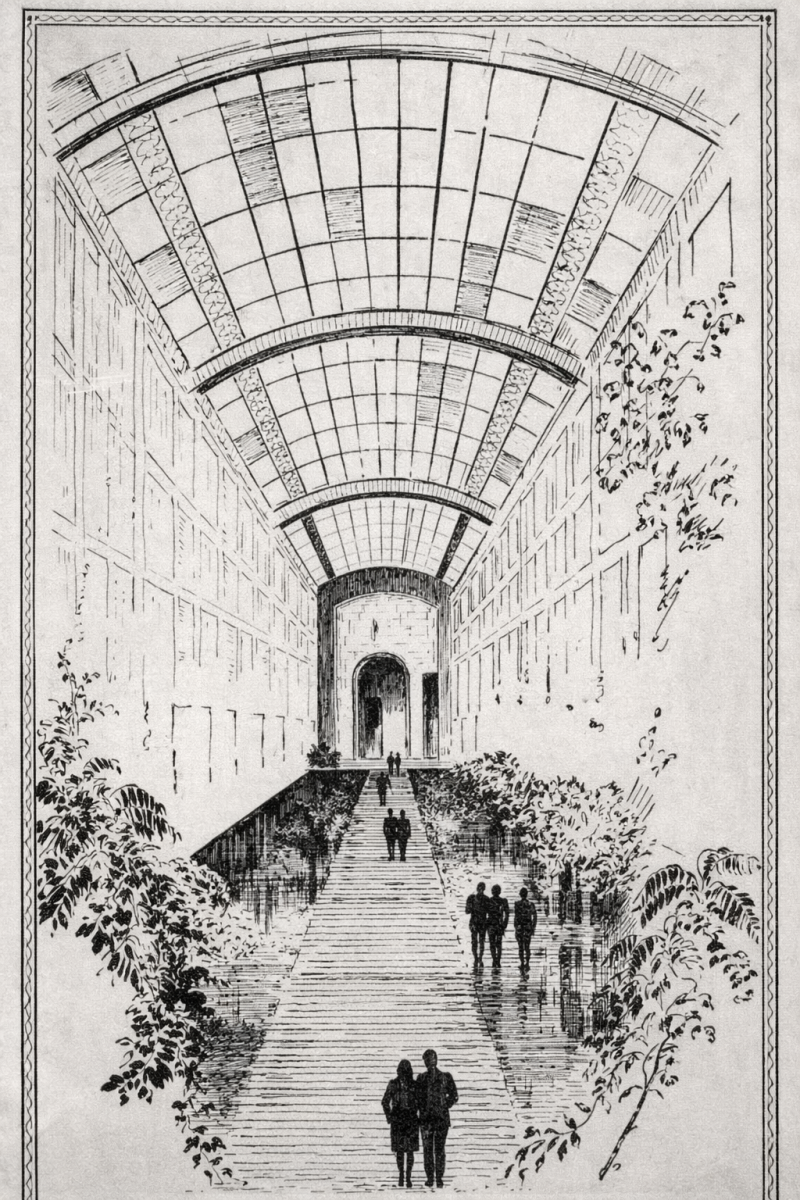
An architectural rendering of what was technically the final addition to the Corridor Mausoleums, though it would become far better known than the original three.
In 1994, an earthquake hit Los Angeles that further damaged the corridors. Called the Northridge earthquake, its magnitude 6.7 quake hit exceptionally close to the city. Building C took serious damage, including a noticeable crack running the length of the corridor floor. Portions of corridors ABC were closed off to the public for years, stranding families who could no longer visit loved ones within.
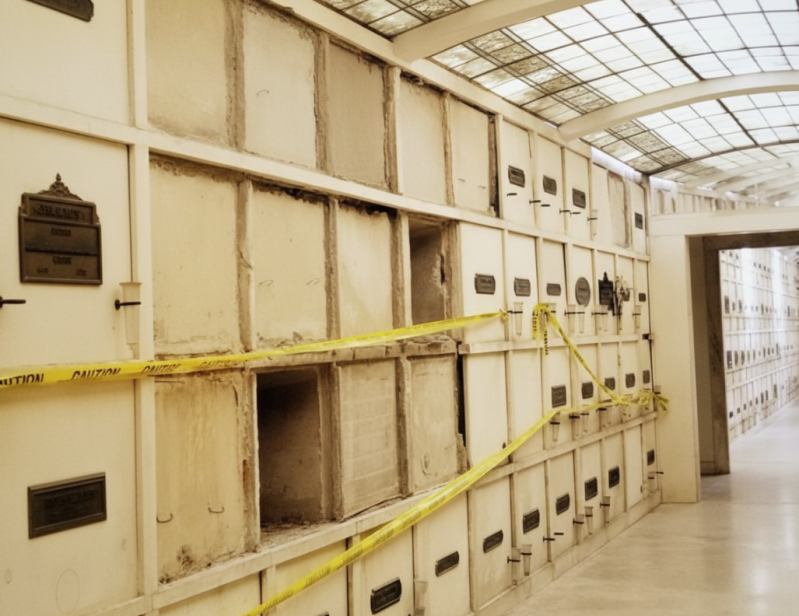

By the end of the twentieth century, the Corridor Mausoleums had fallen into serious disrepair, and several caskets were temporarily removed until the weakened walls were reinforced and stabilized. (Photos: Allan Ellenberger)
It wasn’t until Hollywood Cemetery changed hands and became Hollywood Forever that conditions in the corridors began to improve. In 1998, Tyler Cassity and his family purchased the property. Beyond antiquated records and massive maintenance backlogs, Cassity and his team also inherited crumbling structures like the Corridor Mausoleums. The corridor problem was severe, but the solution started with one thing: ensuring the buildings were safe to enter.
They took steps to stabilize earthquake damage, reinforce decaying floors, clean the buildings, replace crypt fronts, and address safety concerns. When groundbreaking occurred for Hollywood Forever’s Courtyard Mausoleum in 2011, renewed attention was paid to the northwest corner of the property, including its historic corridors. Those passageways once shuttered for years began to open back up.

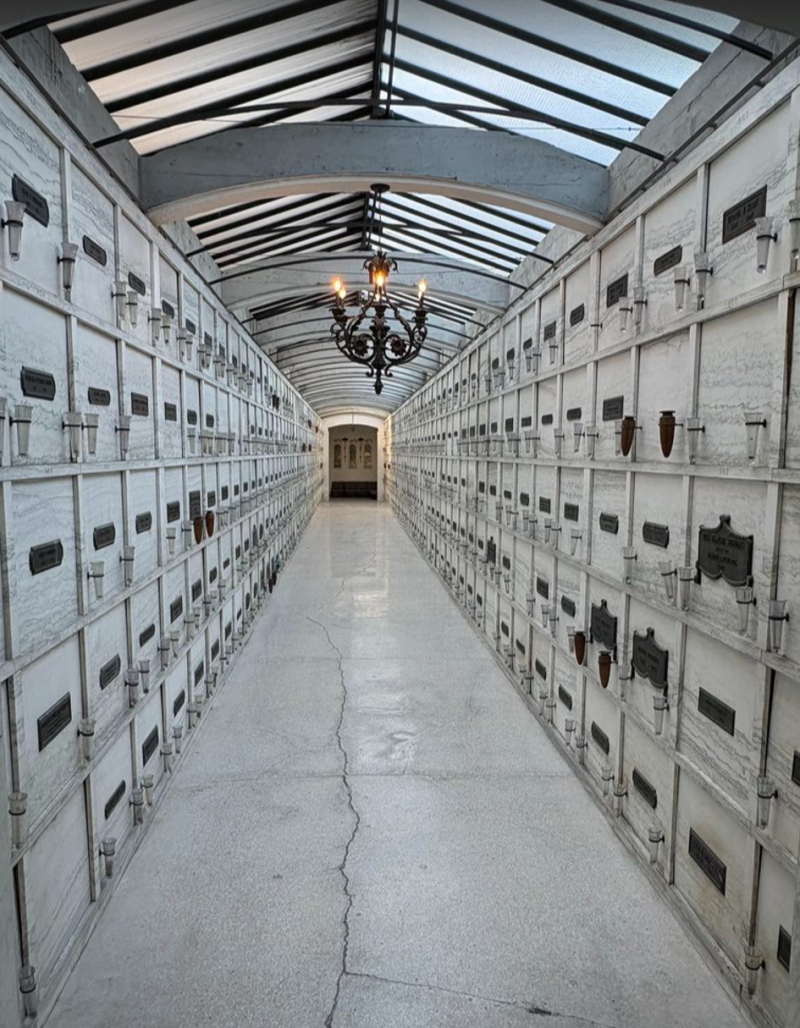
Above are two views of Corridor C from different eras. At left, circa the 1930s, chairs and flowers were placed throughout the passage, inviting visitors to sit and linger. At right, the corridor as it appears in 2026, with the long crack along the floor dating from the 1994 Northridge earthquake.
They contain history. Gertrude Claire, who acted in silent films. Edward Connelly, who appeared in hundreds of films between 1914 and his death in 1935. Tom Forman, director of nearly three dozen films. Ethel Grey Terry, a stage actress before moving to films in the late 1910s. Songwriter Jean Havez, who also penned gags for Harold Lloyd comedies. Producer Edward W. Rowland, who founded the Franklin Film Company in Hollywood before opening Colonial Films a few years later. Like these early Hollywood figures, the Corridor Mausoleums have faded from view.

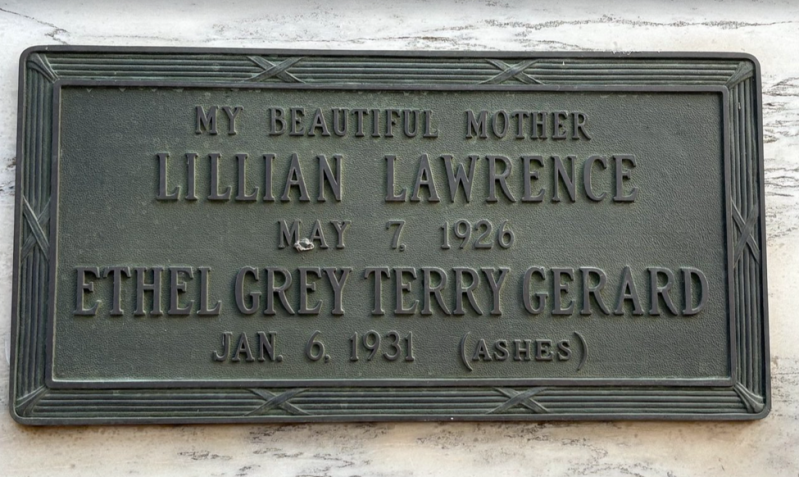

Yet 100 years after their initial construction, they remain among Hollywood Forever Cemetery’s unseen gems. A short distance from graves visited by hundreds of thousands of guests each year rest quiet corridors where early Angelenos once competed to spend hundreds of dollars on an assurance of permanence. The marble has weathered to muted hues. Flowers visitors had placed in long-ago photographs are gone. Original plans to surround Hollywood Cemetery with corridor mausoleums were never realized.

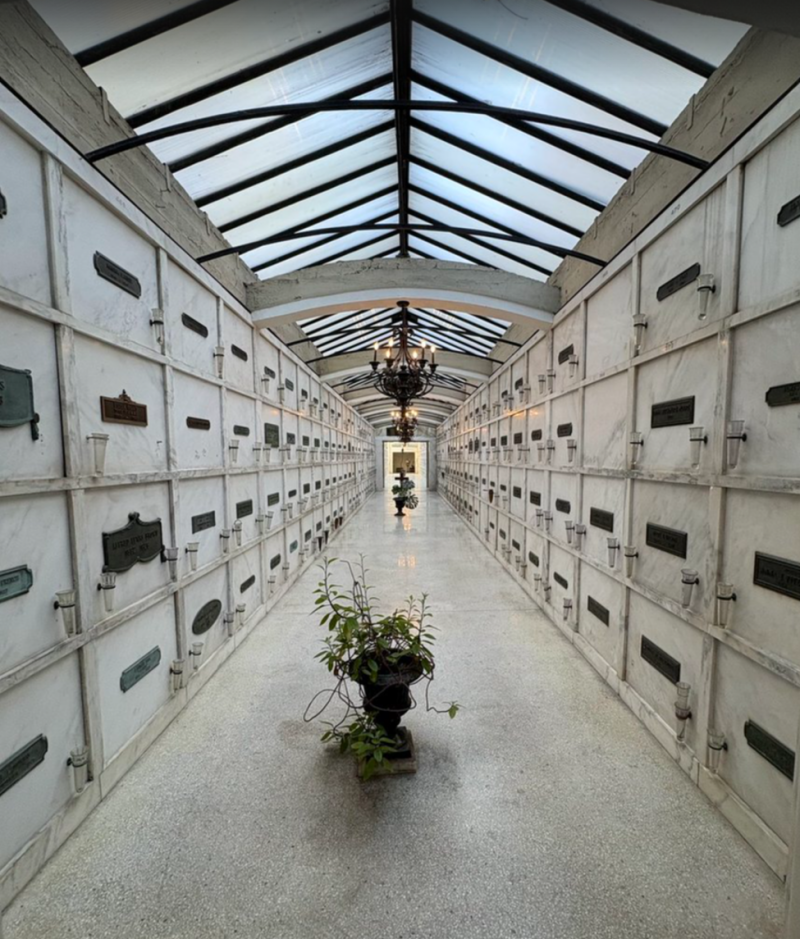
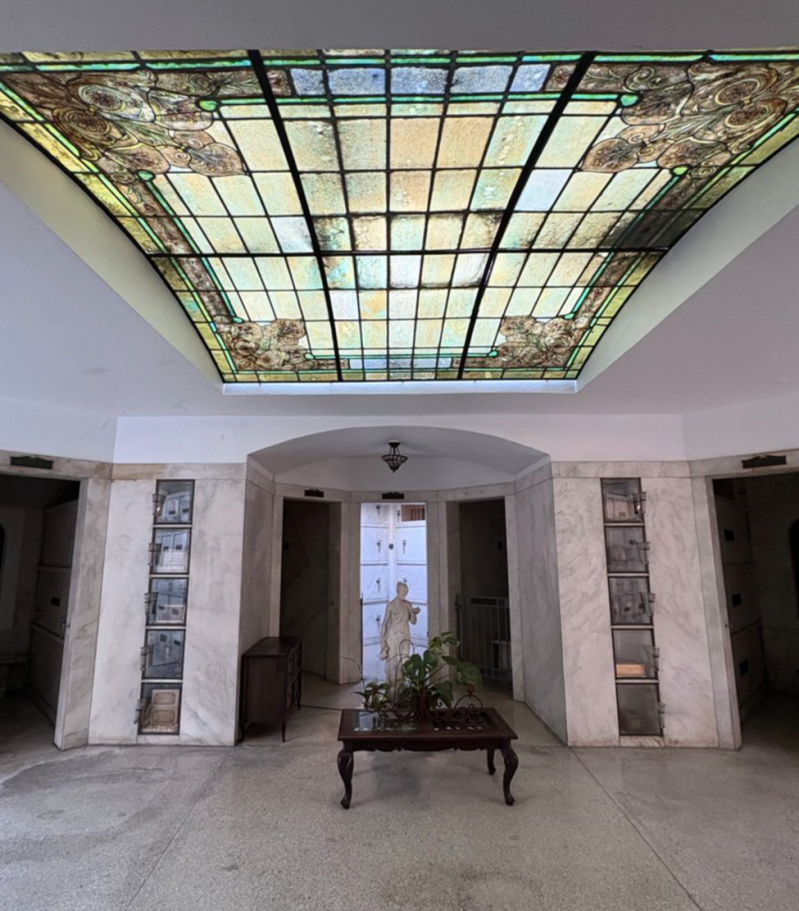
But the corridors remain. And when sunlight filters through aging glass overhead and pools silently across marble crypts, it is possible to understand exactly what Heron was attempting to create nearly a century ago: not just rooms for the dead, but a haven for the living.
On your next visit to Hollywood Forever, take a little time to wander through these often-overlooked corridors and pause to remember the people who rest within them. Among the fifty or more notable pioneers and Hollywood figures interred within the original three Corridor Mausoleum halls (ABC) include:
- Bert Adams (1891–1940) – Major League Baseball player
- “Big Otto” Breitkrentz (1866–1928) – Early film animal trainer
- Gertrude Claire (1852–1928) – Silent film actress
- Edward Connelly (1859–1928) – Silent film actor
- Priscila Duffield Colquhoun (1828–1931) – Centenarian, age 102
- Charles River Drake (1843–1928) – Long Beach pioneer; builder of the Virginia Hotel
- Jimmy Flood (1916–1926) – Ten-year-old son of director James Flood
- Tom Forman (1893–1926) – Silent actor-director; WWI veteran
- Ethel Grey Terry (1882–1931) – Silent film actress
- Nick Gulielimi (1905–1926) – Race car driver
- Jean Havez (1872–1925) – Songwriter; gag writer for Harold Lloyd
- Tom Kennedy (1885–1965) – Boxer, actor; ashes interred with daughter Mary
- Pearl Latta (1899–1937) – Script girl on Gary Cooper films
- Edward W. Rowland (1867–1934) – Theatrical producer
Each crypt tells a story — many forgotten until the mausoleums were reopened.
If you enjoyed exploring the history of the corridor mausoleums at Hollywood Forever, I’d love to hear your thoughts. Please take a moment to leave a comment, rate the article, and share it with others who enjoy cemetery history, architecture, and the stories hidden within one of Hollywood’s most historic landmarks. Your support helps The Hollywoodland Revue continue preserving and sharing these fascinating pieces of the past.
Add comment
Comments
I wandered some of these corridors before the current owners bought and renovated the cemetery and they were such a sad mess. Once when my mother was visiting I took her to see the cemetery and behind one of the fallen fronts we could see boxes of ashes, one of which had a particularly poignant label: “Our Mom.” You will forever have a warm place in my heart for making this cemetery a place of honor and dignity and…yes…fun again!!