

Long before Benedict Canyon became one of Los Angeles's most exclusive residential enclaves, its steep hillsides and twisting ravines belonged to a very different Southern California. There were no secluded celebrity estates, no procession of automobiles winding through the canyon, and certainly no paved Benedict Canyon Drive connecting Beverly Hills with the San Fernando Valley. There were oak and chaparral-covered hills, wildlife, streams, scattered homesteads—and a pioneer named Edson Abijah Benedict, whose family settled there in 1868 and gave the canyon the name it still carries more than a century and a half later.
By Allan R. Ellenberger
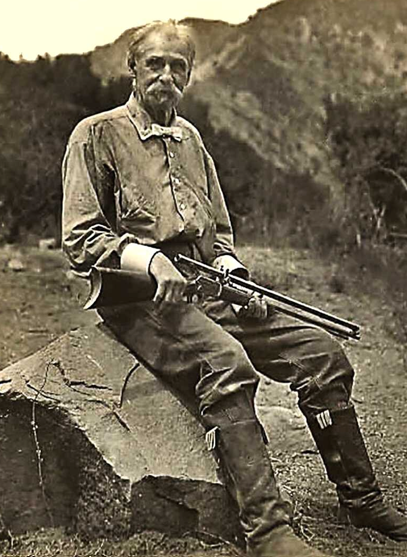
Edson Abijah Benedict
Edson Abijah Benedict was born October 8, 1819, in Elba, Genesee County, New York. Some later accounts confusingly describe him as a native of Missouri, but genealogical records identify Elba as his birthplace; Missouri was an important stop in his westward migration rather than the place of his birth.
Little has been firmly documented about Benedict's earliest years in New York, but like thousands of Americans of his generation, his life gradually moved westward. He eventually settled in Missouri, where he married Josephine Pierce on December 5, 1855. She was considerably younger than Edson, having been born in 1832, and their marriage would produce a family that became deeply entwined with the early history of the canyon. Their children included sons Pierce Edson, Frank Lee and Angelo Eliza Benedict.
By the early 1860s, California beckoned. Benedict came west to Los Angeles, arriving around 1862, when the city bore almost no resemblance to the metropolis that would eventually surround his ranch.
Los Angeles was still a small, dusty community whose economy depended heavily upon agriculture and livestock. Benedict operated a grocery business in downtown Los Angeles, but city commerce apparently did not hold him for long.
In 1868, he exchanged the grocery counter for the wilderness. That year Benedict established himself on roughly 150 to 160 acres at the mouth of what was then known as Cañada de los Encinos, the Ravine of the Oaks. A detailed historic-resource study prepared for the City of Los Angeles places his federal land claim at 150.12 acres in Township 1 South, Range 15 West, Section 14. The property lay within the larger historic Rancho Rodeo de las Aguas region, whose name—"Gathering of the Waters"—reflected the streams and springs descending from the surrounding canyons.
The land was rugged and isolated. Benedict and his family built a house near the mouth of the canyon and began turning their claim into a working ranch. Later accounts describe the Benedicts' property as Rancho Rodeo, although that name should not be confused with the much larger historic Mexican land grant Rancho Rodeo de las Aguas. What Edson possessed was a homestead within the canyon country associated with that old rancho.
The Benedict family became particularly successful at beekeeping. Edson, Josephine and their sons maintained an extensive apiary, taking advantage of the canyon's abundant natural vegetation. The operation eventually became remarkably productive. Pierce Benedict later claimed that in one exceptional year the family produced approximately 45,000 pounds of honey, an extraordinary amount for a pioneer ranch in the Santa Monica Mountains. They also cultivated the land, and later Benedict farming included walnuts, beans and vegetables.
Life there required genuine self-sufficiency. The canyon was still remote from Los Angeles, and the road that generations of Angelenos would know as Benedict Canyon Drive did not exist. The family's home stood amid undeveloped hills, reached by primitive trails and wagon routes. The glamorous associations that would eventually attach themselves to Benedict Canyon were decades away.

Benedict Canyon, circa 1890. (Photo: Beverly Hills Public Library Historical Collection)
Edson's son Pierce expanded the family's foothold by acquiring approximately 230 additional acres adjoining his father's property, making the Benedicts the principal landholders in the canyon. Their presence became so firmly associated with the ravine that maps were soon identifying it by the family name. A government survey from the late 1880s already shows Benedict Canyon, and historical accounts generally place the adoption of the name around 1887–1888, shortly after Edson's death. Thus, a name that today suggests extraordinary wealth began with a nineteenth-century farmer, his family, a homestead and thousands of bees.

Edson Benedict's death notice in the Los Angeles Herald, April 2, 1886.
Benedict did not live to see the canyon transformed. He died on March 30, 1886, in Stockton, California, at age 66, with senility given as the cause. Benedict was originally buried on the family ranch at Pleasant Hill in Encino Cañada, essentially returning him to the canyon landscape he had helped settle. There his remains stayed for more than two decades while Southern California changed around him.
The canyon bearing his name changed as well. A roadway through Benedict Canyon was proposed as early as 1914 as a more direct route between Beverly Hills and the San Fernando Valley. Development accelerated during the 1920s, and Benedict Canyon Drive was fully opened in 1926. By then wealthy Angelenos and members of the motion-picture community had begun discovering the secluded hills. In 1923, silent-film comedian Harold Lloyd purchased acreage near the canyon's southern entrance from Pierce Benedict and eventually created his magnificent Greenacres estate there.
Edson's own remains, however, had already made another journey. On June 6, 1909, twenty-three years after his death, Benedict was exhumed from his original grave on the ranch. His remains were transported by wagon to Hollywood Cemetery, the burial ground founded a decade earlier on Santa Monica Boulevard. There he was reinterred in what is now Chandler Gardens, Section 12, Lot 107, Grave 7.
The journey is an evocative one to imagine. The pioneer who had traveled west across nineteenth-century America made one final trip through a changing Los Angeles, carried by wagon from the canyon that bore his name to a cemetery that would itself eventually become one of the city's most historic landmarks.
Meanwhile, the wilderness he knew became some of the most valuable residential land in Southern California. Benedict Canyon would eventually attract generations of Hollywood figures and wealthy residents, its winding roads offering privacy only minutes from Beverly Hills. Yet beneath the glamour, some of the canyon's natural character survives. Its steep terrain and heavy vegetation still hint at the landscape Edson Benedict encountered in 1868.

Edson Abijah Benedict (1819-1886), his wife Josephine (1832-1921), and their granddaughter Dorothy (1892-1909) who died six months after Edson was reburied at Hollywood Cemetery are interred in Chandler Gardens, Section 12, Lot 107.
There is a pleasing symmetry to Benedict's story. He was not a movie star, architect, oil millionaire or developer. He never knew the Hollywood that would eventually make his canyon famous. He was a grocer who became a pioneer rancher, built a home in an isolated ravine, raised a family, cultivated the land and produced honey.
Yet every time someone writes Benedict Canyon on an envelope, sees the name on a street sign or drives the winding road through the Santa Monica Mountains, Edson Abijah Benedict is remembered. And several miles away, at Hollywood Forever, the man behind that famous name lies quietly in Chandler Gardens.
Tomorrow on The Hollywoodland Revue: this week’s “Coming Attractions” roundup featuring the newest theatrical releases, critical reactions, audience buzz, and recommendations on what may—or may not—be worth your ticket money.
If you enjoyed learning about Edson A. Benedict, one of the early figures whose story is tied to both Benedict Canyon and Hollywood Forever, I’d love to hear your thoughts. Please leave a comment, rate the post, and share it with others who enjoy discovering the forgotten people and stories of old Hollywood. Your support helps keep these histories alive.
Add comment
Comments