

For more than a century, Hollywood has been more than a word on a hillside. It has been shorthand for an industry, a workforce, a way of making movies and, perhaps most importantly, a place. Now that identity is being tested in a very public way. Paramount Skydance chief David Ellison has told senior executives that he is prepared to begin moving Paramount out of California—and potentially Warner Bros. as well if their proposed merger goes through—unless state officials enter settlement talks over the antitrust lawsuit challenging the deal. Variety reported that Ellison set October 1 as the point at which that process could begin, while the Los Angeles Times described the threat as part of Paramount’s effort to pressure California Attorney General Rob Bonta and other states to resolve the case. Against that backdrop, an uncomfortable question suddenly feels much less theoretical: what happens if Hollywood remains the symbolic capital of the movies? At the same time, fewer films are made here—and one of its most historic studios decides it no longer needs to call Hollywood home?
By Allan R. Ellenberger
It would be a strange ending to a story that began almost accidentally. When Hollywood joined Los Angeles in 1910, it was still largely a residential community surrounded by citrus groves and open land. That same year D. W. Griffith used the gardens of painter Paul de Longpré for Love Among the Roses. Soon afterward, the Nestor Film Company established a permanent studio at Sunset and Gower, and other companies followed with astonishing speed. Sunshine, varied scenery, available land, and distance from the East Coast patent battles helped make Southern California irresistible to filmmakers. Within a few years, studios were spreading across Hollywood and the surrounding communities.
Then came the infrastructure. Warner Bros. established itself at Sunset and Bronson. Columbia moved onto Gower. Chaplin built at Sunset and La Brea. Pickford-Fairbanks, United Artists, RKO, Paramount and dozens of smaller companies followed. Behind the glamorous names came laboratories, costume houses, prop companies, editing rooms, camera suppliers, carpenters, painters, electricians and thousands of workers who made the industry possible. Hollywood was not simply where stars lived. It became an enormous manufacturing town whose product happened to be dreams.
That accumulated ecosystem remains Los Angeles’ greatest advantage. California still has the largest motion-picture production workforce in the United States, more than two and a half times the size of New York’s, according to the state Legislative Analyst’s Office. Generations of craftspeople, technicians, writers, performers and vendors are concentrated here in a way that cannot be duplicated overnight.
But an industry can migrate gradually. For years, producers have been offered increasingly important reasons to work elsewhere. Georgia, New York, New Mexico, Canada and the United Kingdom are among the jurisdictions competing aggressively for production through tax incentives and lower operating costs. California’s own Legislative Analyst concluded in 2025 that this competition had contributed to a long-term erosion of the state’s market share. Technology has also made it less essential for every department of a production to remain physically close to Hollywood.
The decline is no longer theoretical. FilmLA reported that Los Angeles-area on-location production fell sharply in 2025, and the weakness continued into 2026. During the second quarter of this year, Greater Los Angeles recorded 4,711 shoot days, nearly 13 percent below the same period in 2025 and roughly 36 percent below the five-year average. Feature films and television were both down substantially.
There are occasional bright spots. Feature-film activity improved sharply in the first quarter of 2026 compared with the previous year, and several productions receiving California tax incentives have returned to Los Angeles. But the overall numbers still describe an industry operating far below its former level.
California has responded. Beginning with the 2025 expansion, the state increased the annual cap on its film and television tax-credit program from $330 million to $750 million. During the first year of the expanded program, the state awarded incentives to 170 projects that officials project will generate approximately $6.6 billion in economic activity and nearly 35,000 cast-and-crew jobs. Those figures are projections tied to approved productions, not proof that all the anticipated spending and employment has already occurred. Still, they demonstrate the scale of the effort to bring production back.
The program is not beyond debate. California’s Legislative Analyst has warned that tax credits cost the state revenue and that some subsidized productions might have filmed here anyway. At the same time, the office concluded that the credit is a legitimate tool for preserving California’s production market share and that expanding it should result in more activity than doing nothing.
Los Angeles has also begun attacking one of the complaints heard repeatedly from producers: that shooting here can be unnecessarily expensive and cumbersome. In March, Mayor Karen Bass announced a major reduction in filming fees at Griffith Observatory and reopened the Los Angeles Central Library to production after more than a decade. City officials have also pointed to more than three million square feet of approved studio and creative-office space and more than 120 soundstages under development in the region.
That matters because incentives alone will not determine Hollywood’s future. A production manager notices everything: permit delays, parking costs, police and fire requirements, location fees, stage availability, and how quickly a city can solve a problem. A tax credit can bring a project to California, but an unnecessarily expensive shooting day can still send the next one to Atlanta.
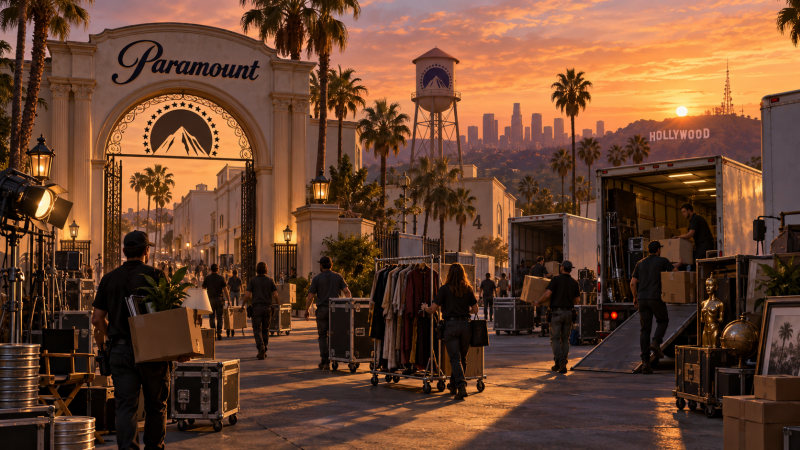
Then there is Paramount. Of all the current uncertainty surrounding Hollywood, nothing carries more symbolism than the possibility that Paramount might someday leave its historic home. The studio still owns approximately 62 acres at 5555 Melrose Avenue, with about 1.85 million square feet of soundstages, offices, theaters and production facilities. It is the last major traditional studio lot operating within Hollywood itself and contains buildings associated with both Paramount and the former RKO studio.
In September 2026, Paramount Skydance chief David Ellison floated the possibility of moving significant company operations outside Los Angeles amid the legal battle over Paramount’s proposed acquisition of Warner Bros. Discovery. California Attorney General Rob Bonta and other state attorneys general are challenging the merger on antitrust grounds, while Paramount argues that delays are imposing enormous financial costs. No decision has been announced to abandon the Melrose lot, and the dispute should not be confused with a completed relocation.
Still, the very suggestion sends a shiver through Hollywood because Paramount is not just another corporate headquarters. Sunset Boulevard, The Godfather and generations of films and television shows emerged from behind those gates. Hollywood Forever Cemetery shares its eastern boundary with the lot. The water tower, soundstages, and studio streets are part of Hollywood's physical landscape.
Losing Paramount would therefore mean something different from losing a single production to Georgia. Yet blaming one political party, one governor, one mayor or one tax would oversimplify what has happened. Runaway production has developed over decades. The 2023 strikes, the pandemic, the 2025 fires, changing television economics, streaming retrenchment, international competition, labor costs, and increasingly aggressive incentive programs elsewhere have all contributed. California policymakers have sometimes been criticized for responding too slowly, but they are now spending substantially more to compete, while Los Angeles officials are reducing some production costs.
The larger question is whether everyone involved can treat filmmaking as an industry rather than simply as Hollywood glamour. A movie employs far more people than the names on a poster. Someone builds the set, rents the generator, sews the costume, drives the truck, feeds the crew, styles the hair, supplies the lumber, and cleans the stage when everyone goes home. When a production moves, much of that spending moves with it. When enough productions move for long enough, experienced workers eventually follow. That is the real danger.
Hollywood probably will never lose its mythology. Tourists will still photograph the sign. People will still walk the boulevard looking for stars beneath their feet. The Oscars can still be held here, and the word “Hollywood” will continue to mean movies almost anywhere in the world. But Hollywood can lose something less romantic and far more important: the actual work of making them.
The fight now is not to recreate the studio system of 1935. That world is gone. It is to make Los Angeles competitive enough that when a producer looks at the budget for the next film or television series, staying home makes economic sense.
Hollywood became Hollywood because filmmakers once looked at Southern California and decided this was the best place in America to make movies. More than a century later, the challenge is persuading them to make that decision again.
If you found my commentary on the future of Hollywood thought-provoking, please take a moment to comment, rate the post, and share it with others. Do you agree? Is Hollywood doing enough to keep film and television production in California, or are rising costs and competition from other states putting its future at risk? Express your opinion below—I’d like to hear what you think.

Add comment
Comments