

Long before Hollywood had studios, movie stars, or even its famous name, Mary Croswell Gower lived and worked on a broad tract of farmland in the Cahuenga Valley. Wheat and barley grew where soundstages would eventually rise, and the future Gower Street was little more than the edge of a family farm. Mary belonged to an earlier Hollywood, one that existed before Harvey and Daeida Wilcox laid out their subdivision, before Mary Sackett and Mary Penman Moll, and decades before the motion-picture industry discovered Southern California. Yet the land she and her family occupied would eventually become part of Hollywood's geographical heart.
By Allan R. Ellenberger

Mary Gower Croswell was born on January 26, 1823, at Farmington Falls, Maine, the daughter of merchant Thomas Croswell and Mary Gower Croswell. Her father ran a business in Farmington Falls for nearly fifty years and became a respected community figure. Mary grew up in a deeply rooted New England family whose connections with the Gowers would eventually become even closer. In 1851 she married John Truman Gower, also a native of Maine and a relative through the extended Gower family.
John Gower had already led an unusually adventurous life. As a young man, he taught school and went to sea aboard whaling vessels. During one voyage, he stopped in the Hawaiian Islands, then known to Americans as the Sandwich Islands, and remained there. He initially worked as a clerk before acquiring an interest in a sugar plantation. Believing his prospects were secure, he sent Mary back to Maine, and the couple began their married life in Hawaii. A later biographical account of their son George stated that John eventually lost his plantation during an economic downturn, then worked as a surveyor, mill operator, farmer, merchant, and postmaster.
Mary and John remained in Hawaii for many years and raised a large family there. The couple had seven children, including Mary Love Gower, later remembered as one of Hollywood’s earliest educators, and George Truman Gower, who became a prominent farmer and horticulturist. The Gowers were not tourists passing through the islands. Hawaii was their home for nearly two decades. In 1869, however, the family made another major move, leaving the islands for Los Angeles.
The Los Angeles they encountered bore little resemblance to the city that would emerge during Mary’s lifetime. Beyond the compact pueblo were ranches, vineyards, and miles of lightly settled countryside. The Cahuenga Valley north and west of Los Angeles was still agricultural land, broken by scattered farms and rough roads. In 1871, Mary C. Gower herself filed a possessory claim to 160 acres of public land in what is now Hollywood. Los Angeles’ official historic documentation places the tract approximately between present-day Sunset Boulevard on the north, Melrose Avenue on the south, Gower Street on the west, and Bronson Avenue on the east, although later descriptions of the family’s holdings sometimes give slightly different boundaries.
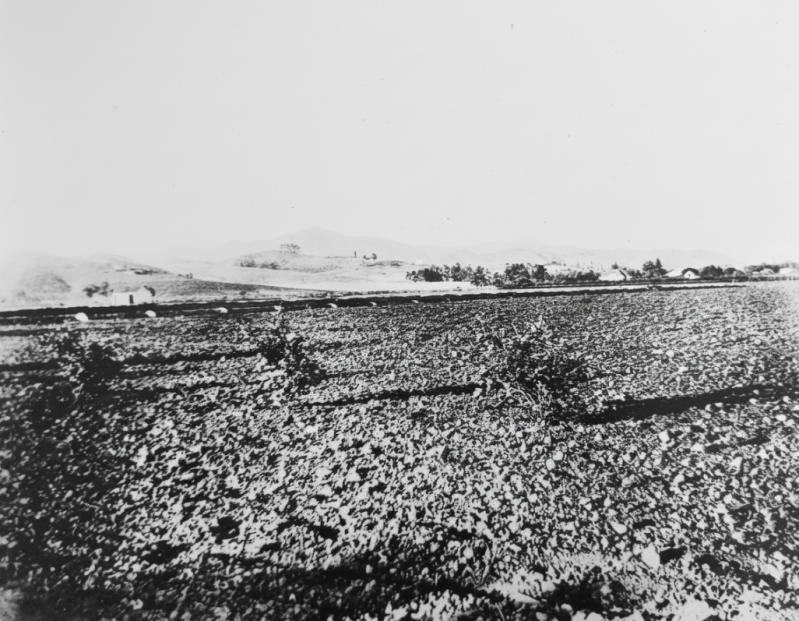
Above is a view of Hollywood looking north in the late nineteenth century, when the area was still largely open and undeveloped. Much of this land was then part of the acreage owned by pioneer Mary Croswell Gower and her family, decades before streets, studios, and neighborhoods transformed the landscape.
That detail is especially important to Mary’s story. She was not simply accompanying her husband onto land he had claimed. The surviving record specifically identifies Mary C. Gower as the person who filed the 1871 possessory claim. The underlying title history was complicated: the acreage had originated with a military bounty warrant granted to John Holt for War of 1812 service, and the federal land was subsequently assigned to John Truman Gower in 1880. But Mary’s name appears at the beginning of the Gower family’s documented claim to the property.
The Gowers turned their acreage into a working farm. Wheat and barley were early staples, while later family operations included almonds, cotton, and sugar beets. Farming in nineteenth-century Southern California demanded physical labor, persistence, and cooperation among every member of a household. The Gowers also owned agricultural equipment and performed threshing work for neighboring farmers. An early account credits family members with threshing the first wheat crop on the Lankershim Company Ranch in the San Fernando Valley in 1875.
Their daughter Mary Love Gower became an important figure in her own right. Local histories remember her as Hollywood’s first schoolteacher, teaching children in the sparsely settled district long before formal schools became common. That distinction occasionally causes confusion between mother and daughter because both women are frequently referred to simply as “Mary Gower.”
Tragedy struck the family in 1880, when John Truman Gower died at the Hollywood homestead at the age of fifty-nine. A contemporary biographical account later stated that seventy acres of the original property remained in Mary’s possession and that sixty acres had been sold after John’s death for about $400 an acre—a considerable sum for land that only a few years earlier had been valued primarily for agriculture.
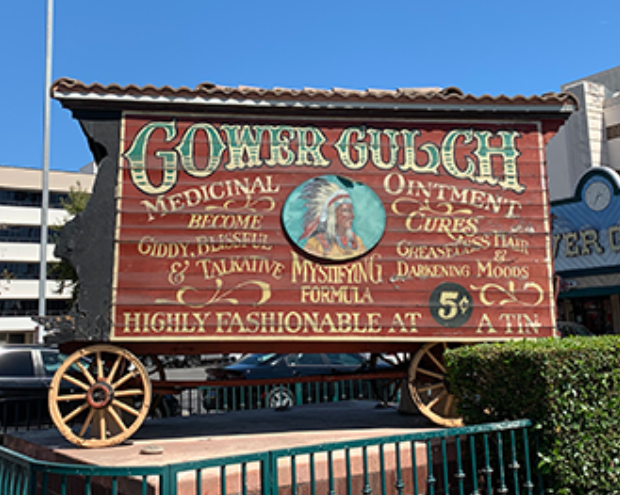
Mary was now a widow approaching sixty, but she remained connected with the property during the years when the Cahuenga Valley began changing dramatically. The population increased, roads improved, and subdivisions appeared. Gower Street, named by 1893, marked the western edge of the old family farm and permanently placed the Gower name on the map of Los Angeles. In later decades, that same street would become inseparable from motion-picture history. “Gower Gulch” became a gathering place for extras and would-be cowboys seeking work in westerns, while Paramount, Columbia and other studios operated on or near land once associated with the Gower farm.
The most enduring connection between Mary and modern Hollywood, however, lies beneath the lawns and monuments of Hollywood Forever Cemetery. The cemetery was established in 1899 as Hollywood Cemetery on acreage that had once formed part of the broader Gower holdings. Some retellings simplify the transaction by saying that Mary sold sixty acres directly to cemetery founder F. W. Samuelson. The land history was actually more complicated, involving several transfers. What we can say with confidence is that the cemetery arose on land intimately connected with the Gower pioneer holdings. A fitting symmetry followed. A family that had helped work this land as farmland would eventually become part of the history preserved beneath it.
Mary spent her later years in Los Angeles, and by the opening years of the twentieth century she had witnessed an extraordinary transformation.

Mary Love Gower, a member of one of Hollywood’s pioneer families, became the first teacher at Hollywood’s first school, a log cabin erected in 1880 on the future site of the Warner Bros. studio on Sunset Blvd.

John Truman Gower owned 160 acres of what was then open land in early Hollywood. Portions of that former property are now occupied by Hollywood Forever Cemetery and the Paramount Pictures studio lot.
The isolated agricultural district where her family had planted wheat was becoming a residential community connected with downtown Los Angeles by electric railway. Prospect Avenue was filling with homes and businesses, and Hollywood was rapidly acquiring an identity of its own. The movies had not yet taken over, but the farmland was disappearing.
Mary Croswell Gower died on the night of September 12, 1904, at the age of eighty-one. Two days later, the Los Angeles Times remembered her simply but appropriately as “one of the early settlers of the Cahuenga Valley.” Her funeral was announced for the First Congregational Church of Los Angeles, where its pastor, the Rev. Dr. Day, would conduct it, with burial to follow at Hollywood Cemetery at approximately 3:30 in the afternoon.

Her husband, John Truman Gower, who had died twenty-four years earlier, is also buried at what is now Hollywood Forever, along with several members of the Gower family, including their daughter Mary Love and sons George and Henry.
Mary Croswell Gower never saw a Hollywood movie studio. She died before filmmakers began arriving in force and before anyone could imagine that the name Hollywood would become shorthand for an international industry. Yet every day, thousands of people drive along Gower Street, pass Paramount Studios, or enter Hollywood Forever Cemetery without realizing the name belongs to a family there before almost everything else.
Her contribution was not glamorous, and perhaps that is why it has been so easily overlooked. Mary crossed a continent after nearly two decades raising a family in Hawaii, put her name on a claim to 160 acres of California land, helped establish a working farm in an undeveloped valley, endured her husband's death, and remained as the world around her changed. The studios would come later. Mary Croswell Gower belonged to the generation that prepared the ground on which Hollywood itself would be built.
Check back this Sunday for the beginning of Halloween Week with my latest Hollywood Forever Immortals post, featuring Maila Nurmi, the unforgettable actress and television personality who became famous as Vampira. I’ll be looking back at her life, career, enduring cult status, and her final resting place at Hollywood Forever Cemetery.
If you enjoyed this look at Mary Croswell Gower and her place in early Hollywood history, I’d love to hear your thoughts. Please leave a comment below, rate the post, and share it with others who enjoy discovering the people and stories that helped shape Hollywood before it became the movie capital of the world.
Add comment
Comments