

Hollywood history is full of people whose names have been on the marquee at the theatre. Margaret Herrick wasn't one of them. She never acted in a film, she never directed one, and she never stood on the podium at the Oscars with a statuette in her hand. What she did was to take the Academy of Motion Picture Arts and Sciences from a fledgling trade body to a major international organization and in the process to create the bedrock of what is now one of the most important archives of motion picture history in the world. Today, of course, thousands of researchers will know her name as they go into the Margaret Herrick Library in Beverly Hills. The vast majority of them will have no idea what a remarkable woman she was.
By Allan R. Ellenberger

Margaret Florence Buck was born in Spokane, Washington on September 27, 1902, daughter of attorney Nathan Kimball Buck and Adda Myrtle Morie Buck. She was brought up in Washington and went on to study library science at the University of Washington. She completed her studies at the end of the 1920s and became head librarian of the Yakima Public Library. That was a very impressive position for a young woman of thirty or under and it was the position which gave her the professional credentials which would later see her become absolutely vital to Hollywood.
Her life was transformed by her marriage to Donald Gledhill in 1931. Gledhill was connected with the newly formed Academy of Motion Picture Arts and Sciences (it was only four years old at that point) and Margaret moved out to Los Angeles with him. The Academy at that time did have a library (though it was a very different thing to the library we know today). When the Academy was based in the Roosevelt Hotel offices the 'library' was really just a reading room with a selection of current periodicals.
Margaret realized straight away that the motion pictures were creating a history which could quite easily be lost if it wasn't collected. She began to help the Academy in an unofficial capacity, getting books, sorting the material and building up clipping files on films and the people who made them. When Donald became the Academy's executive secretary in the mid-1930s, Margaret continued to build up the collection. In 1936 the Academy formally appointed her as their librarian (she was reportedly paid a symbolic one dollar a year salary).
She didn't regard it as a symbolic exercise at all. Herrick was actively seeking out books, trade journals, photographs, scripts, clippings and all the other sorts of ephemera that the studios would have regarded as completely disposable working material. Her instincts were absolutely spot on. In an age when even the film prints themselves could be thrown away or destroyed once they'd served their commercial purpose, she realized that the paper trail of the movies was in itself of immense historical value.
Her ambition was not simply to amass material. In 1941 she produced with Frances Mary Christeson a Classification Scheme for Motion Picture Collections, an attempt to bring some order to an archive where the traditional library systems were not always of much use. She wasn't just preserving the paper of Hollywood; she was in fact helping to lay the foundations for the serious study of film history.
WWII brought another watershed moment. In 1943 Donald Gledhill left the Academy to serve as a Captain in the Signal Corps. The Board of Governors at the Academy appointed Margaret to take over his duties. Daily Variety were all over the news with the very typical period headline: "Academy Gets Femme Boss as Gledhill Joins Army."
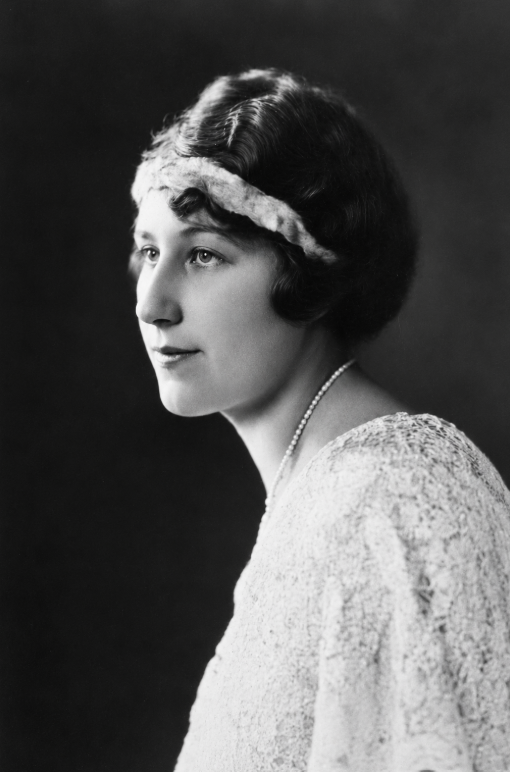
Above: Margaret Buck in 1923, during her tenure as head librarian of the Yakima Public Library in Washington.
What could have been a temporary wartime appointment became Margaret Herrick's career. She and Gledhill divorced in the mid-1940s and when he came back from the war and was ready to go back to his old job, the Academy governors decided to keep Margaret. She had been shown to be too good a fit to be replaced. By 1945 she was in the job permanently as the Academy's Executive Director, a woman in the administrative chair of one of the most powerful organizations in the motion picture industry at a time when the executive offices in Hollywood were still almost entirely male.
Photos from that period speak volumes in terms of telling the story. Herrick was frequently the only one in the room amongst the studio heads, the producers, the directors and the Academy governors. She was always impeccably dressed and invariably smiling, yet she had real authority. She stayed on as Executive Director for over a quarter of a century.
Her tenure completely transformed both the Academy and its library. In 1947 she was instrumental in acquiring the papers of the pioneering producer William Selig, which was the library's first major archival acquisition. Other filmmakers and industry figures came along after that, and the Academy collection gradually went from being a useful reference library to a proper repository for motion picture scholarship.
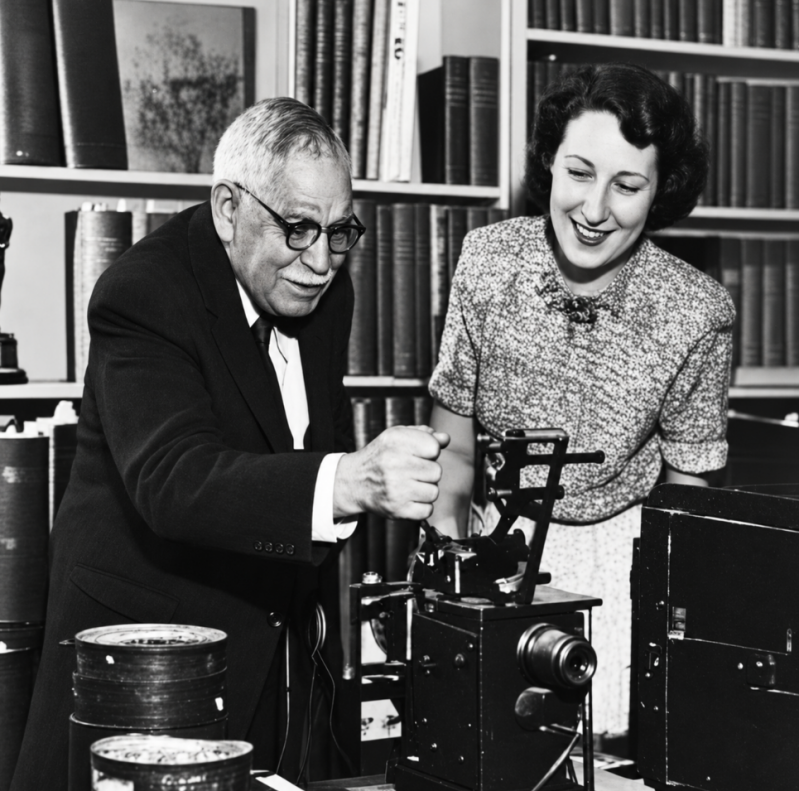
In August 1947, William Selig demonstrates his Polyscope projection machine for Margaret Herrick. Selig’s donation to the Academy—which included the projector, a 1909 Selig motion-picture camera, company records, early press books, and production stills—became the library’s first major archival collection.
Herrick was also deeply involved in film preservation. She was a strong backer of the work to save the early motion pictures which had been preserved as paper prints (the copyright deposits in which the entire film had been reproduced frame by frame onto photographic paper). She supported the work of preservationist Kemp Niver in transferring those images back onto film and through that work helped to rescue hundreds of early American films which would otherwise have been lost.
Her influence went well beyond the library. In 1953 Herrick secured the Academy's first television deal for the Oscars. That one decision was to change the Academy forever. Television transformed the Oscars from an industry occurrence into a truly international event and provided the Academy with a source of income which in turn meant it could become less reliant on the Hollywood studios. It enabled the Academy to expand its activities in the areas of education, preservation, public events and so on.

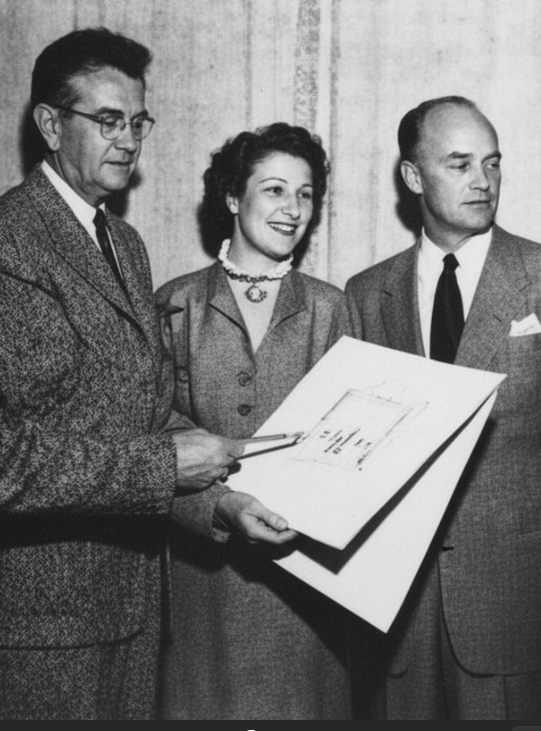
In October 1947, the Hollywood Ad Club honored the Academy with an “Academy Day” luncheon at the Roosevelt Hotel. Seated, from left, are director Delmer Daves, Margaret Herrick, and actress Janet Blair. Standing, from left, are club president Tom Lewis; Academy official Sam Brown; actor George Murphy, then vice president of the Academy; and David Lipton of Universal Studios.
She also went a long way towards establishing the Academy's international profile. Between 1963 and 1968 she was off visiting film schools, film academies, festivals, studios and universities all over the world. Her 1966 trip alone took her to eleven countries, and she was promoting international co-operation as well as the Foreign Language Film Award (which was only a decade old as a competitive category at that point).
And then there's Oscar. For as long as the Academy has had its statuette, one of the favorite stories about the Oscar is that Margaret Herrick was the one who gave it the name. The story is that she looked at the statuette and said it looked like her Uncle Oscar and the staff then started to refer to it as such.
It's a lovely tale but its veracity cannot be established. The Academy will admit that the origin of the nickname is unknown. Sidney Skolsky of the Hollywood Courier was using "Oscar" in print by 1934, other versions of the story point to Bette Davis or various other sources. The Academy didn't officially take up the nickname until 1939. However, Herrick is one of the most likely candidates for the origin of the nickname.
Margaret's private life was pretty much kept out of the public eye. She married Philip A. Herrick in 1946 following her divorce from Gledhill and that marriage ended in divorce in 1951. She never had any children and for the rest of her life she was known as Herrick. The Academy became her family.
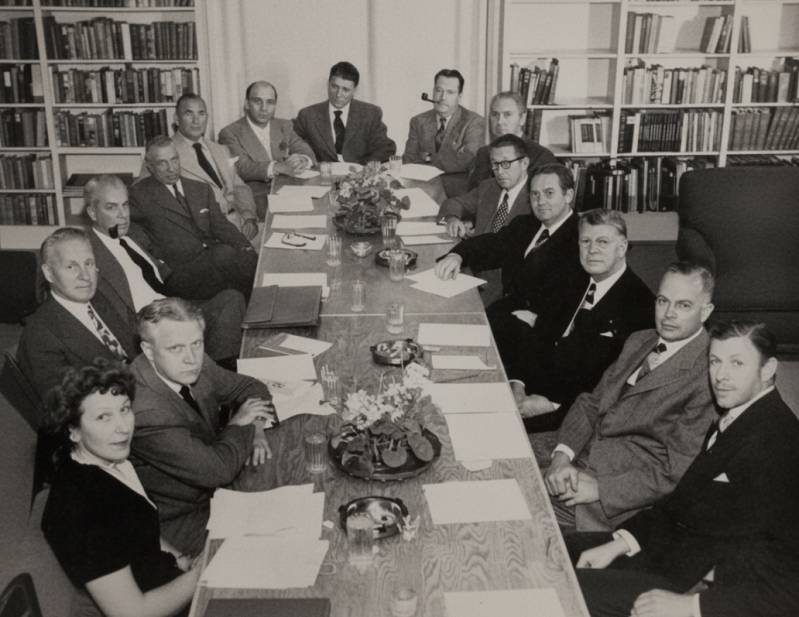
February 1950. Members of the Academy’s Board of Governors. Left to right: Margaret Herrick; Charles Brackett, president; Fred L. Metzler, treasurer; Walter Wanger, Henry Blanke, Harry Warren, Johnny Green, assistant secretary; George Stevens, Gordon Sawyer, Rudolph Sternad, Robert Haas, G. Carleton Hunt, assistant treasurer; Frederick Quimby, Kenneth Lambert, George Murphy, vice-president.
She retired in January 1971 after some forty years with the organization. Academy president Daniel Taradash described her retirement as the end of an era and paid tribute to her "flair and vigor." She was made Director Emeritus and the library she had built up from a very small collection of trade publications was officially renamed the Margaret Herrick Library in her honor.
Herrick died on June 21, 1976, at the Motion Picture & Television Country House and Hospital in Woodland Hills following a long illness. She was 73 and was cremated with her ashes scattered in the Rose Garden at Pierce Brothers Westwood Village Memorial Park.
At the memorial service Taradash was quite direct about the reports that Herrick had left 'no immediate survivors'. He flatly denied that, pointing out that she had literally thousands of survivors in the form of the entire Academy membership. She'd been instrumental in the survival and indeed the success of the Academy. It was a perfectly fitting tribute. Herrick's true monument wasn't a headstone. It was the organization she'd bequeathed.
Today the Margaret Herrick Library holds tens of millions of photographs, scripts, books, posters, production records, correspondence, design drawings, clippings and all sorts of other material relating to over a century of filmmaking. It's used by scholars, biographers, historians, filmmakers, students and researchers on a daily basis. A great deal of what we know about Hollywood's past is thanks to people who at the time realized that these records were important and therefore worth preserving.
Margaret Herrick realized this long before most of Hollywood did. The stars created the images that the public would remember, but Herrick made sure that the history of those images wasn't lost. In that respect she was one of the most important keepers of Hollywood memory.

Above is the Margaret Herrick Library, the Academy of Motion Picture Arts and Sciences’ principal repository for print, graphic, and research materials. The library is located at 333 South La Cienega Boulevard in Beverly Hills.
If you enjoyed learning about Margaret Herrick and the woman who helped build the Academy’s library into one of the world’s great motion-picture research collections, I’d love to hear your thoughts. Please leave a comment below, rate the post, and share it with others who enjoy Hollywood history. Your support helps more readers discover the forgotten people and stories behind the movies.
Add comment
Comments