

For ten years after Harry Houdini died, his widow waited for the impossible. Beatrice “Bess” Houdini did not mean that figuratively. She quite literally waited for a message from the dead. Few stories from old Hollywood combine love, loss, show business and the supernatural as perfectly as hers. After Houdini died in 1926, Bess held onto the hope that the man who had escaped from handcuffs, prison cells, straitjackets and locked trunks might somehow accomplish one final feat: escaping death itself.
By Allan R. Ellenberger
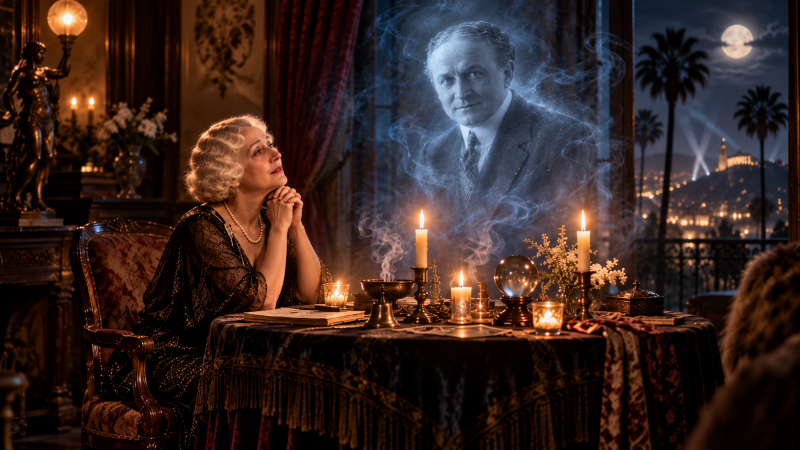
Born Wilhelmina Beatrice Rahner on April 23, 1876, in Brooklyn, Bess came from a large German Catholic family. She entered show business as a teenager and in 1894 met a young magician named Erich Weiss, already performing under the name Harry Houdini. The attraction was immediate. They married soon afterward and remained together for the rest of his life. For more than thirty years, they were nearly inseparable.
Long before Houdini became internationally famous, Bess was his stage partner, assistant, confidante and business adviser. They performed mind-reading routines, illusions and vaudeville acts together and spent years traveling across the United States and Europe. They had no children, and much of their shared life revolved around Harry’s career and the act they built together.
By the 1920s, Houdini was one of the world's most famous entertainers. His death on October 31, 1926, at age 52, after suffering from a ruptured appendix, shocked the public and devastated Bess. Yet the strange irony was that Houdini had spent years exposing fraudulent mediums and fake spiritualists. He attended séances, publicly challenged supposed psychics and denounced those he believed were exploiting grieving families. Even so, he had not necessarily ruled out the possibility of life after death. What he demanded was proof.

Thousands of mourners crowded the streets of New York for magician Harry Houdini’s funeral at the Elks Club on West 43rd Street.
According to friends and associates, Harry and Bess had arranged a secret code before his death. If he found a way to communicate from the other side, he would use that code to identify himself. It was a safeguard against fraud, a private test meant to prove that any message supposedly coming from Houdini really was his.
After his death, mediums began stepping forward almost immediately. Some claimed they had already contacted Houdini. Others announced that they were receiving messages from him. Newspapers eagerly reported each new claim. Spiritualism was still popular in America during the 1920s and 1930s, particularly in the aftermath of the First World War, when millions of bereaved families had become interested in séances and the possibility of communicating with the dead.
For Bess, however, none of this was simply entertainment. Each year on or near the anniversary of Harry’s death, she took part in séances and listened for the code. Candles, mediums, mysterious voices, and sensational newspaper reports filled the air, but nothing ever convinced her. Again and again, people made claims. Again and again, Bess came away without the proof she wanted.
The annual séances gradually became a national curiosity. To some, the idea of a widow waiting year after year for a message from her dead husband seemed deeply romantic. Others dismissed the entire affair as publicity. Skeptics saw it as more evidence of the same kind of spiritualist nonsense Houdini himself had spent years exposing. Yet Bess continued, hoping that somewhere beyond the darkness Harry might still be trying to reach her.

Above is the Hollywood Knickerbocker Hotel at 1714 Ivar Avenue, where Bess Houdini held her final séance on the roof in 1936 in hopes of receiving a message from her late husband, Harry Houdini.
By the mid-1930s, Bess was living in Hollywood. No longer wealthy, she remained a recognizable figure and frequently gave interviews about Houdini. In many ways, she had become a living link to vaudeville and turn-of-the-century show business. Then came Halloween night, 1936, and the séance that would become the most famous of them all.
The setting was the Hollywood Knickerbocker Hotel at 1714 Ivar Avenue, a fashionable gathering place for actors, writers, directors, and other entertainment figures. On the rooftop that Halloween night, reporters crowded together in the damp air while photographers prepared their cameras and magicians and curious spectators waited below. At the center stood Bess, dressed in black and facing the moment she had prepared for every Halloween since her husband’s death ten years earlier.
Beside her was Edward Saint, her manager and companion, who conducted the proceedings with deliberate theatricality. Microphones carried the séance over the radio, candles flickered around the gathering, and once again the call went out for Houdini to make himself known through the secret message he and Bess had arranged before his death. The code was intended to eliminate trickery, coincidence, and wishful thinking. If the message came correctly, Bess would know.
For a time, there was only silence. Hollywood glittered below as the minutes passed. Everyone listened for the slightest sound. Every movement, every breeze, every unexplained noise seemed capable of becoming the sign they had all come to witness. Perhaps this would be the night Houdini finally performed the one escape he had never achieved in life.
For a time, only silence remained. Hollywood glittered below as the minutes passed. Everyone listened for the slightest sound. Every movement, every breeze, every unexplained noise seemed capable of becoming the sign they had all come to witness. Perhaps this would be the night Houdini finally performed the one escape he had never achieved in life.
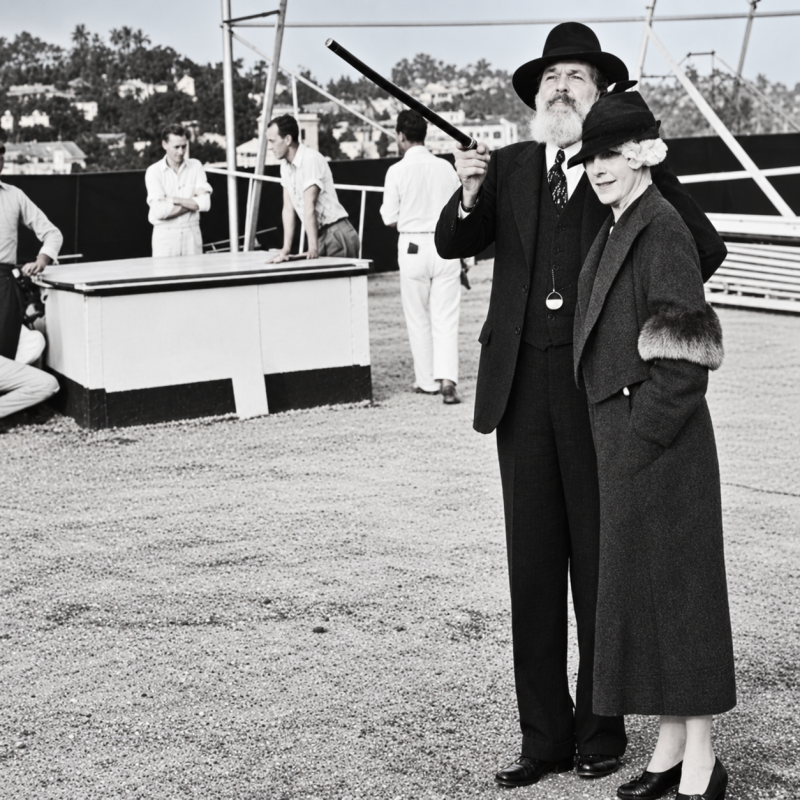
Above, Edward Saint, Bess Houdini’s business manager and companion, stands with Bess on the rooftop of Hollywood’s Knickerbocker Hotel as workmen prepare the setting for the séance in which she would once again attempt to contact the spirit of her late husband, Harry Houdini.
Nothing happened. As the hour slipped away and the candles burned lower, the hope that had sustained Bess through ten years of public vigils finally ended. “Houdini didn’t come through,” she said. “My last hope is dead.” No ghostly apparition, no coded signal, and no message from the man who had promised that, if communication after death were possible, he would find a way.
The séance ended not with a supernatural revelation but with something more human. After ten years of waiting, Bess allowed herself to stop. She extinguished the candle and delivered the line that would become forever associated with the final séance: “Ten years is long enough to wait for any man.”
The remark held humor, but also finality. The public séances were over. Bess continued to speak about Harry and about the possibility of life after death, but as the years passed, she became increasingly skeptical of those who claimed supernatural powers. Near the end of her life, she acknowledged that she had never received a genuine message from Harry and regarded many supposed communications as frauds. Harry himself likely would have understood that conclusion.
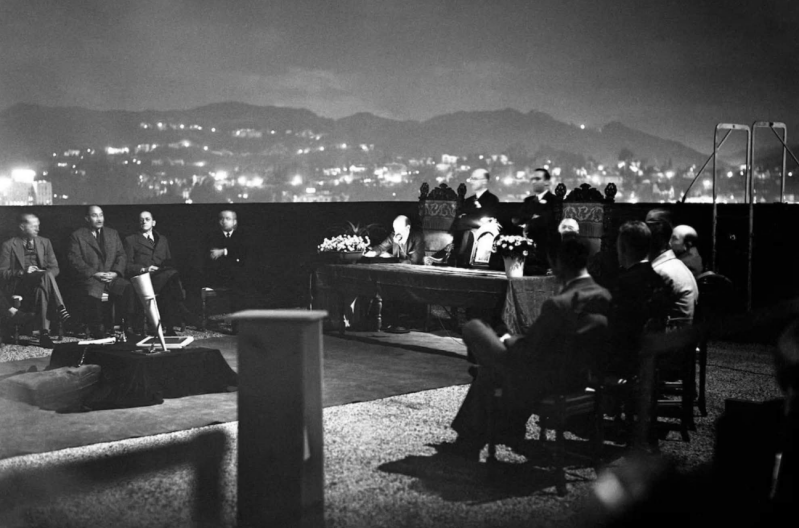
Above, participants gather on the rooftop of Hollywood’s Knickerbocker Hotel during the final 1936 séance conducted in hopes of receiving a message from Harry Houdini. With the lights of Hollywood Hills spread out behind them, Bess Houdini and those assembled waited for the secret signal that never came.
By the early 1940s, Bess’s health had declined. She suffered from heart trouble and had been under medical care in Hollywood. In February 1943, she decided to return east. On February 11, while traveling by train from Los Angeles to New York, she suffered a fatal heart attack near Needles, California. Friends reportedly said she hoped the journey would improve her health and allow her to visit family. It became her final trip.
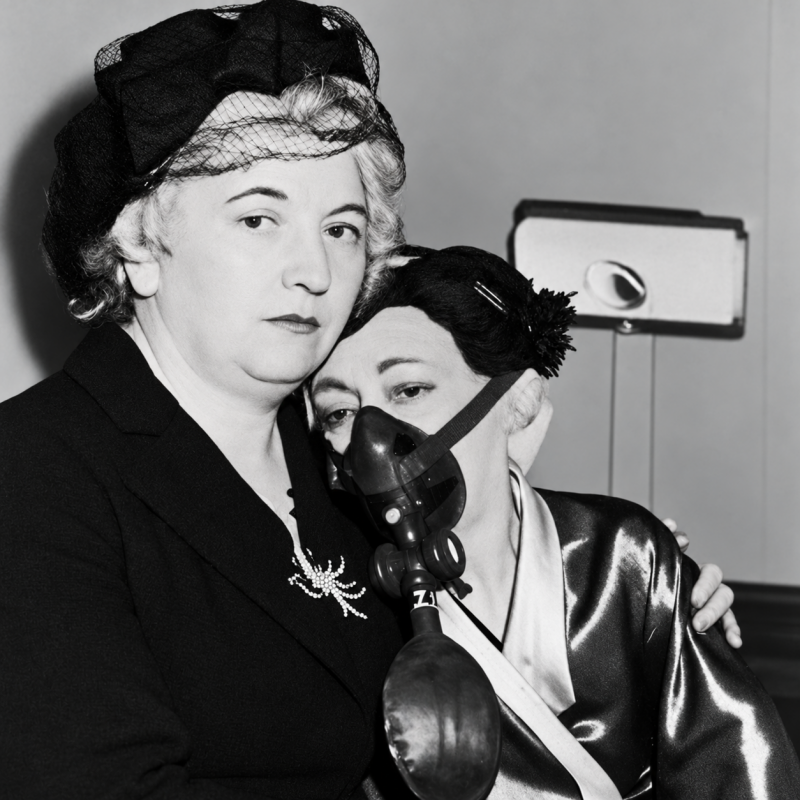
Wearing an oxygen mask to help her breathe, Bess Houdini, accompanied by her sister Marie Hinson, boards a train bound for New York.
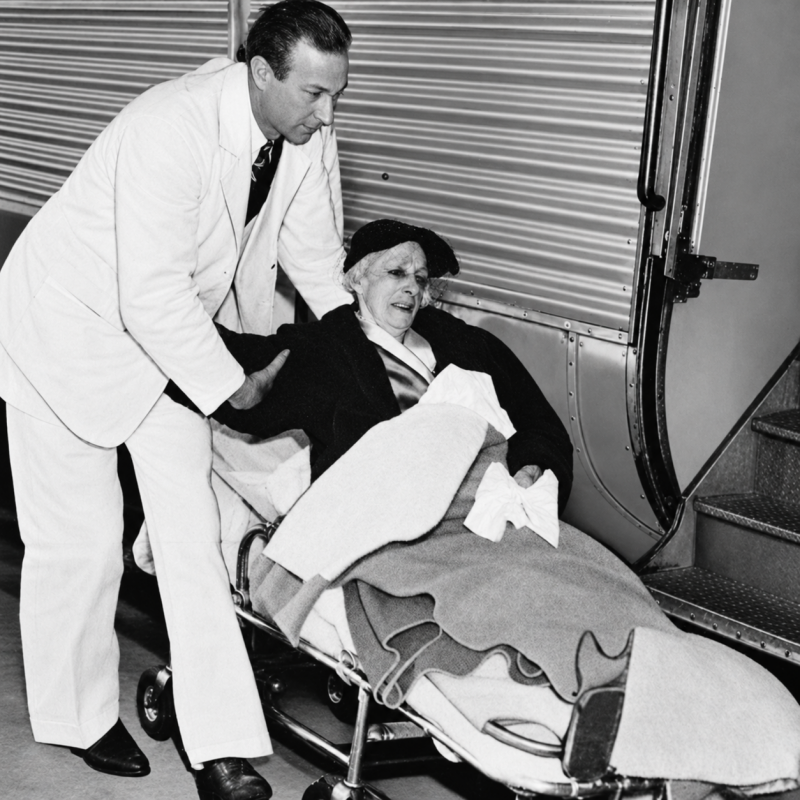
Bess Houdini is wheeled from an ambulance to the train at the beginning of what would become her final journey. Just hours later, she suffered a fatal heart attack aboard the train at Needles, Calif.
Even her burial brought one final twist to the Houdini story. For years, people assumed Bess would eventually be buried beside Harry in the Houdini family plot at Machpelah Cemetery in Queens. Her name had been added to the monument and space apparently reserved for her. Instead, she was buried at Gate of Heaven Cemetery in Hawthorne, New York, a Catholic cemetery some thirty miles away.
The most likely explanation is that Bess’s Catholic family objected to her burial in a Jewish cemetery. She had been raised Catholic and never formally converted, and relatives reportedly believed she should be buried in consecrated Catholic ground. Whatever the circumstances, the outcome carries a poignant irony. Harry and Bess Houdini spent decades traveling the world together, sharing triumphs, failures, secrets and dreams. In death, they were separated. Visitors to Machpelah Cemetery can still see Bess’s name carved into the Houdini monument. Her remains are elsewhere, but her place in Harry’s story is permanent.
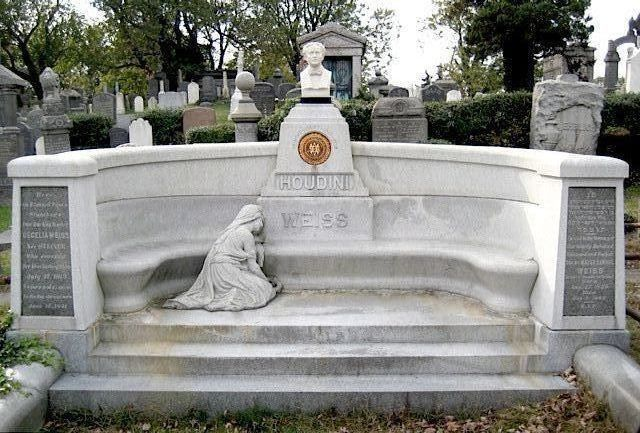
Above is Harry Houdini’s grave at Machpelah Cemetery in Queens, where Bess had long been expected to be buried beside him. Instead, she was laid to rest some thirty miles away at Gate of Heaven Cemetery in Hawthorne, New York (right). (Photo credits: Findagrave/ronzoni/T).
For ten years, Bess Houdini waited for a message from beyond the grave. None came. The secret code was never delivered, the candle was finally extinguished, and the vigil ended. In the end, the world's greatest escape artist could not perform the one escape his wife had hoped for most.

COMING TOMORROW! Before Pierce Brothers became one of Hollywood's most recognizable names in the funeral business, there was James Washington Pierce, the father of the ten brothers who established a mortuary legacy. Join me tomorrow as I explore the life of this remarkable family patriarch and the roots of a business that became closely associated with Hollywood Forever Cemetery and the history of Los Angeles.
If you enjoyed this look at Bess Houdini’s decade-long attempts to reach her husband beyond the grave, I’d love to hear your thoughts. Do you think her séances were an act of hope, grief, devotion—or all three? Please leave a comment below, rate the post, and share it with others who enjoy Hollywood history, mystery, and the strange stories that live just beyond the spotlight.
Add comment
Comments