

Hollywood is absolutely masterful at filming its own history while the places where that history took place disappear. Mansions get torn down; larger developments replace apartment buildings and the streets themselves are pretty much unrecognizable. Yet at 1851 North Ivar Avenue, looking out over Franklin Avenue, one of Hollywood's most distinctive residential properties has survived for nearly one hundred years. Chateau Alto Nido with its red tile roof, pale stucco walls, arched openings and wrought iron balconies is a very real physical manifestation of the astonishing transformation of the area during the early days of the talking picture.
By Allan R. Ellenberger
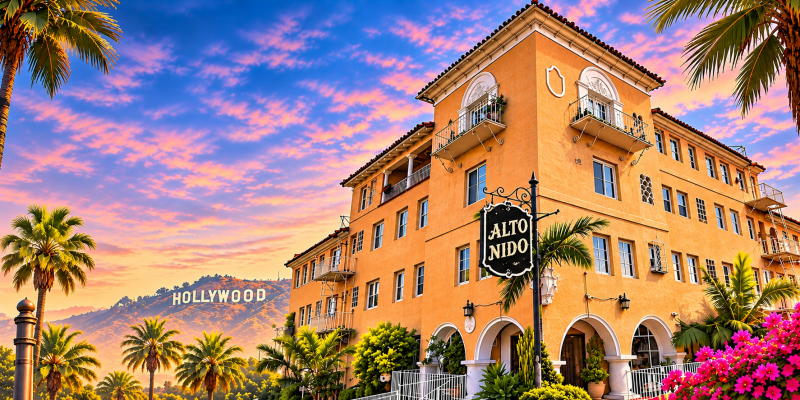
The building is of course familiar to anyone who's seen Billy Wilder's Sunset Boulevard (1950), and it's quite possibly the most famous building in the area to a certain section of the population. It's the building where William Holden's Joe Gillis had his apartment in the film, the one where he was living in the world of Norma Desmond, which was so strange and so desperate. Chateau Alto Nido has a history that goes well beyond its appearance in that film, though. The architecture, the hillside location, and the fact that it's still a residential building all point to a story of people who came to Hollywood hoping to make a living, build a career, and/or become famous.
Now that history is getting a bit of a revival. Hollywood Heritage has nominated Chateau Alto Nido for designation as a Los Angeles Historic-Cultural Monument, and the Cultural Heritage Commission is set to vote on the nomination on Thursday, November 5, 2026. It's a chance to acknowledge a building that has just hung on while so much of the surrounding Hollywood has gone.
It all started in the late 1920s with another wave of development in Hollywood. The movie industry turned the area from a fairly quiet residential suburb into an international entertainment mecca, and the arrival of sound brought in a whole new cohort of people: workers, technicians, actors, and writers. Apartments had become a viable alternative to the detached house, particularly in the Hollywood and Vine area, where you could get to the theatres, restaurants, offices, and entertainment venues without having to go too far.
The hillside at Ivar and Franklin was an attractive site for such a development. Some earlier residential construction in the area took the form of Craftsman houses in the 1910s, when Hollywood was still very much a "town" rather than a city. Chateau Alto Nido would be a far more ambitious use of the land. What is known is that the apartment building came into being during the period when the area was moving towards a more densely populated residential character.
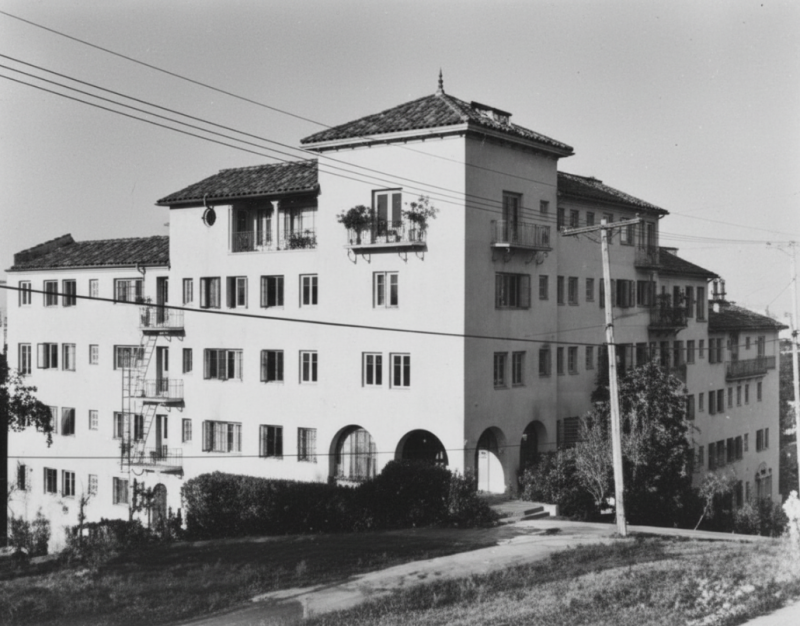
The Alto Nido Apartments in May 1930, shortly after construction was completed at the corner of Ivar and Franklin avenues in Hollywood.
Henry J. Hedin (who in the preservation research was listed as a singer and real estate developer) was the one who commissioned the building. Stanley J. Pedersen (1899-1971) was the architect. Construction began in 1929 and generally finished the following year. Alto Nido is a fairly literal translation of "high nest" which is a perfectly appropriate name for a large residential building set so high above the streets around it. The Spanish Colonial Revival style was very much in vogue in Southern California at the time with developers all over the place using the romantic notion of a Spanish or Mediterranean building to give their new construction a sense of history and permanence.
Pedersen's design made excellent use of the slope. From certain angles the Chateau Alto Nido appears to be four or five stories high, with the massing dropping down below the principal street entrance. There was a full subterranean garage for the residents' cars, which was a very significant consideration in late 1920s Los Angeles. The irregular massing, the tiled roof, the decorative balconies and the arched details all gave it the appearance of a substantial multi-family development in a very soft, almost non-existent form. Rather than being a conventional rectangular apartment block facing the street it was in fact a château on a hillside, quite appropriately designed for the climate and the landscape of Hollywood.

Henry J. Hedin, a singer and real estate developer who commissioned the construction of Hollywood’s Chateau Alto Nido Apartments.
The building was intended to be a place where people could live right in the heart of Hollywood. Like so many of the apartment buildings in the area, Chateau Alto Nido acquired some associations with entertainment figures. Ethel Clayton, Roscoe "Fatty" Arbuckle, Claudette Colbert, Pat O'Brien, director George Cukor and actor Al Lewis are all reportedly connected with the building.



Above are three Hollywood personalities reportedly among Chateau Alto Nido’s former residents: silent-film comedian Roscoe “Fatty” Arbuckle, director George Cukor, and actor Al Lewis, best remembered as Grandpa Munster on The Munsters.
The surrounding neighborhood was equally steeped in literary history. Right down the street at 1817 North Ivar Avenue was novelist Nathanael West living in the Parva-Sed Apta Apartments while he was writing The Day of the Locust (1939), his brilliant and devastating portrayal of the Hollywood dreamers who had all failed. The book is a study in the lives of the failed performers, the hustlers and the ordinary folk whose dreams had been crushed by the realities of the business. West's former home still stands, and the literary and cinematic connections are quite extraordinary over that short stretch of Ivar Avenue.

Just down the street from Chateau Alto Nido, at 1817 North Ivar Avenue, novelist Nathanael West lived in the Parva-Sed Apta Apartments while writing his celebrated Hollywood novel, The Day of the Locust (1939).
Chateau Alto Nido's most famous film connection came with Sunset Boulevard (1950). The film was a dark satire of Hollywood and starred William Holden as Joe Gillis, a writer who's not exactly succeeding and whose debts are piling up. He's eventually at the dilapidated mansion of the former silent film star Norma Desmond (Gloria Swanson) and the film is based on that encounter. Prior to meeting Norma, Joe lives in an apartment house above Franklin and Ivar which is a very deliberate choice to place him at the bottom of the Hollywood ladder.
The actual building was Chateau Alto Nido. The film shows the exterior of the building and that's clearly sufficient to identify Joe's place of precarious existence. There's a later account of the property which states that some of the scenes with Holden were actually shot inside one of the apartments (that would need to be confirmed via production records). Film location historians and the Los Angeles Conservancy have both well documented the exterior.
Wilder's choice is spot on. Joe Gillis is close enough to the heart of Hollywood to be able to see the opportunities all around him, but he's perpetually broke and can't seem to get a career going. Chateau Alto Nido, with its romantic architecture, provides no refuge from the practicalities of making a living in the film business. It's a very effective piece of the film's portrait of Hollywood as a place where there are dreams in abundance, but success is just out of reach.
Not like Norma Desmond's fictional mansion whose actual location on South Irving Blvd was eventually torn down. Joe Gillis's apartment building on the other hand, Chateau Alto Nido, has survived. It's been through all the fashions, all the population shifts, all the up and down periods of Hollywood and it's still there. It's quite remarkable in a neighborhood where so many of the early apartment buildings have gone or have been completely gutted.
In 2001, Universe Holdings purchased the building and carried out a program of rehabilitation designed to preserve its historic character. Original flooring and fixtures were restored wherever possible, the landscaping was improved and the lobby was furnished with antiques, historical photographs and period pieces. A 2018 property profile listed forty-five residential units (thirteen studios and thirty-two one bed) and noted that the building did have parking and other facilities appropriate to modern apartment living.
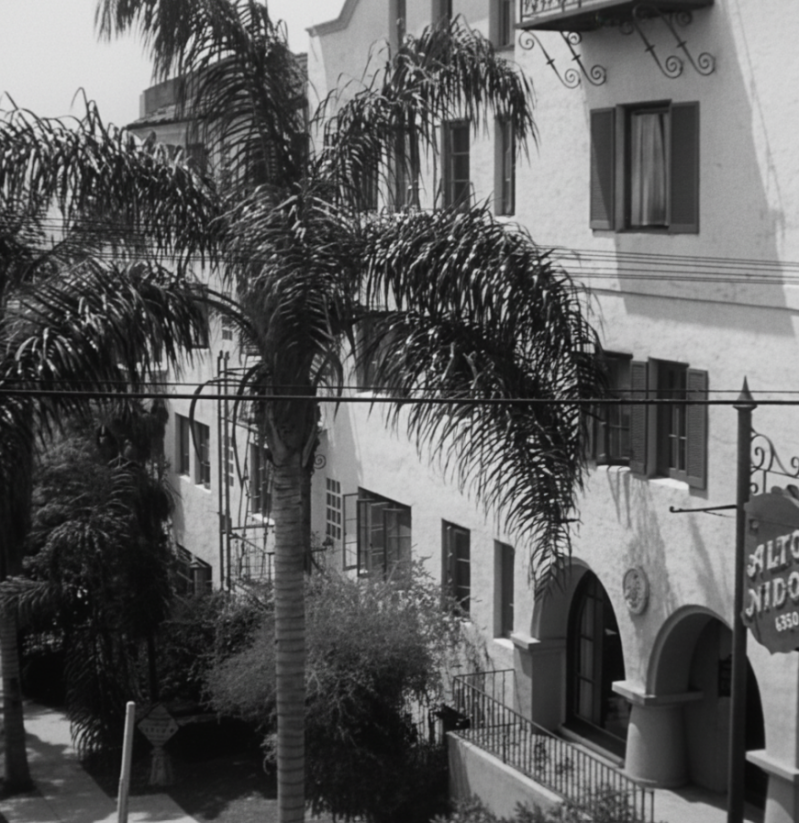
A screenshot from Billy Wilder’s Sunset Boulevard (1950) showing the exterior of Chateau Alto Nido, the Hollywood apartment building where William Holden’s character, screenwriter Joe Gillis, lived.
Chateau Alto Nido has already been formally recognized for its architectural significance in the Los Angeles Historic Resources Survey. A report from October 3, 2026, lists it as part of the Ivar Hill Multi-Family Residential Historic District and as a particularly good example of Spanish Colonial Revival apartment architecture. The report notes its excellent state of preservation, its significance as an example of the type of housing that was built in Hollywood in the 1930s and its very distinctive signage (a wall mounted neon and a freestanding pole sign). That's the point really, it's not just about the architecture, it's about the appearance of a streetscape from that period.
Hollywood Heritage's current nomination is an attempt to build on that recognition. The Cultural Heritage Commission voted to consider the property at its September 17, 2026, meeting and a site visit was conducted. The nomination will return to the Commission on November 5 at 10 a.m. (case number CHC-2026-4299-HCM). A formal Historic-Cultural Monument designation would recognize the building's architectural and cultural significance and would subject any significant future alterations to the city's historic preservation review process. It would not in any way preclude all change, but it would provide a level of protection that plain survey recognition does not.

The case for preservation shouldn't be based on the celebrities who may have once lived there or even on the fact that it's in Sunset Boulevard. Chateau Alto Nido is significant as a very well-preserved example of the multi-family housing that was so important in the development of Hollywood at a pivotal time. It's a hillside house with a great deal of architectural detail, the original signs are all there, it's still a residential property and it's a very rare surviving example of the type of house that helped form the Hollywood neighborhood as it was when it was becoming the movie capital of the world.
There's a certain irony in that a building which was the very embodiment of one of cinema's most famous stories about Hollywood illusion has actually survived so well in the real world. Joe Gillis never got the happy ending he was after, but his old apartment building has certainly outlived a whole host of the more grandiose buildings in the vicinity. It's nearly a hundred years since it was built and Chateau Alto Nido still looks out over Hollywood with its tiled roof and balconies, a perfect evocation of the era when the area was full of new arrivals, all chasing a rather uncertain future.
Hollywood has lost more of its architectural history than it's probably ever going to regain, and so survival is no longer a given. Chateau Alto Nido has earned its place in that history not just because the cameras have been on it, but because it's a building that continues to tell the story of the city and the people who lived in it. The proposed Historic-Cultural Monument designation is a chance to make sure that this particular piece of Hollywood's past is part of its future.
Help Preserve Hollywood History: Chateau Alto Nido's Landmark Nomination
Hollywood Heritage's nomination of Chateau Alto Nido, at 1851 North Ivar Avenue, for Los Angeles Historic-Cultural Monument designation will be considered by the Los Angeles Cultural Heritage Commission on Thursday, November 5, 2026, at 10:00 a.m. The property is listed as Agenda Item #5.
Readers interested in Hollywood's architectural and cinematic heritage have an opportunity to participate in the preservation process. Members of the public may attend the meeting in person or join remotely to offer comments on the proposed designation.
Cultural Heritage Commission Meeting
Thursday, November 5, 2026, at 10:00 a.m.
Los Angeles City Hall
200 N. Spring Street, Room 1010
Los Angeles, CA 90012
Attend via Zoom:
https://planning-lacity-org.zoom.us/j/87568419912
Meeting ID: 875 6841 9912
Passcode: 934777
Whether you attend in person or participate online, this is an opportunity to make your voice heard about the future of one of Hollywood's surviving historic landmarks. Every building saved helps preserve another chapter of the community's remarkable past.
Discover the story behind this surviving piece of old Hollywood. Have memories or photographs of Chateau Alto Nido? I’d love to hear from you! Please leave a comment, rate the article, and share it with fellow Hollywood history enthusiasts. Every share helps keep Hollywood’s history alive!
Add comment
Comments