

October 6, 2026, saw another major event in Hollywood's long and often messy history as Paramount Skydance completed its $110 billion acquisition of Warner Bros. Discovery. The new entity will be called Skydance and will be run by David Ellison (son of Oracle co-founder Larry Ellison). For the investors it's a golden opportunity to build a very serious competitor in an industry that's increasingly being run by streaming and tech companies. For us folk who are genuinely interested in the history of Hollywood though, it's a bit of a worry. The future of Paramount and Warner Bros. (the two studios that essentially created the motion picture industry) is now very much in doubt.
By Allan R. Ellenberger
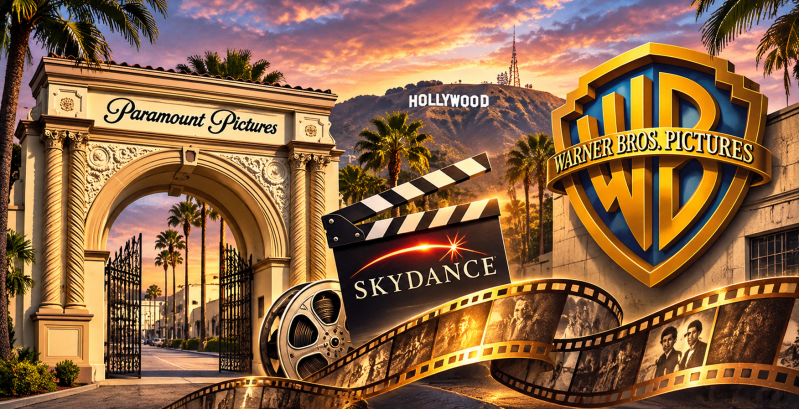
The deal brings together Paramount Pictures, Warner Bros, CBS, CNN, HBO, Nickelodeon, DC Studios and a host of other TV networks and entertainment companies. Paramount+ and HBO Max will be operating under the same corporate umbrella. It's a very significant deal for a company that is already saddled with around $80 billion of debt and under enormous pressure to cut costs. Skydance have already announced their intention to deliver $6 billion of annualized savings in three years and that will almost certainly be achieved through further job cuts, more consolidation and a great deal of uncertainty about the future of these very historic studio brands.
To properly understand what is at stake we need to go back to the history of these companies. Paramount dates back to 1912 when Adolph Zukor founded the Famous Players Film Company. It went on to merge with Jesse L. Lasky and the Paramount distribution unit and became one of the original Hollywood studios. The mountain logo was the face of the company for all those generations of moviegoers. It made films for Mary Pickford, Gloria Swanson, Rudolph Valentino, Clara Bow, Gary Cooper, Marlene Dietrich and so on.
In 1926, Paramount was developing its Hollywood studio at 5555 Melrose Avenue (which is still its headquarters). That lot has been the site of the production of a number of films, from Sunset Blvd (1950) and The Ten Commandments (1956) through to The Godfather (1972) and Chinatown (1974). It has also been a major center for television production and so is a very real link between the silent era and today.
Warner Bros. have an equally illustrious history. The Warner Bros. were founded in 1923 by the Warner brothers (Harry, Albert, Sam and Jack) and were instrumental in the move to sound with The Jazz Singer (1927) which was the first feature film with synchronized singing and dialogue. The studio was of course closely associated with Cagney, Robinson, Davis, Bogart, Flynn and de Havilland. Their filmography is of course legendary with films such as The Public Enemy (1931), 42nd Street (1933), The Adventures of Robin Hood (1938), Casablanca (1942) and Mildred Pierce (1945).



The Warner Bros. lot in Burbank (developed in 1926 as a result of the purchase of First National Pictures) became one of the great film lots of Hollywood and has been the home of film production for nearly one hundred years. The streets, soundstages and production buildings have all been used throughout that time. For generations of employees (actors, directors, all sorts of technicians) Paramount and Warner Bros. were more than just companies. They were identities. They were traditions. They were histories.
Both studios are now owned by Skydance. The new management have made it very clear that the merger is going to be a good thing. Ellison has committed to making at least thirty films in cinemas each year and over 180 television programs and series, as well as to maintaining a viable window for theatrical releases. That's all very encouraging, particularly given the headwinds currently being faced by the cinema attendance market. The fact that they are committed to making films and to preserving the studios that make them is obviously a positive thing, but it's worth noting that those are two very different things.
One of my big worries is what's going to happen to the studio properties themselves. Hollywood has a very poor track record of letting go of its landmarks for the sake of cost. The MGM Culver City backlot is a case in point (it was sold, knocked down and redeveloped). Twentieth Century Fox got rid of a large portion of its western backlot in the early 1960s which then became Century City. There are a number of other historic studio lots that have either been lost or have been extensively redeveloped.
Could Paramount's Melrose Ave lot or Warner Bros' Burbank lot be next? There's some comfort in that at least. As part of the settlement with the twelve states that challenged the acquisition, Skydance is required to keep both lots until the end of 2031. That at least gives us some reassurance for the immediate future. What happens beyond that is unknown. No sale or closure has been announced, but Skydance's wider cost cutting program could well see offices, production facilities and the like consolidated at some point.
Another big issue is the future of the studio logos. Will the Paramount mountain and the Warner Bros. shield remain at the start of the films, or will both of them eventually be replaced by the Skydance logo? At the moment there's been no announcement at all about getting rid of either brand identity. In fact, there's a very good business case for keeping them. The Paramount mountain and the Warner Bros. shield are both over a century old and represent a huge amount of brand equity in terms of audience recognition and reputation. You can't just buy that sort of thing in a modern-day advertising campaign.
Nonetheless, there are grounds for skepticism regarding corporate history. When Disney acquired the entertainment assets of Twentieth Century-Fox in 2019 the studio was rebranded as 20th Century Studios (the Fox name was effectively dropped from the films). A lot of the original imagery was retained but a significant amount of the heritage was lost.
Could the same thing happen to Paramount or Warner Bros.? Absolutely. I think both of those studios will continue to operate in the theatrical space for the foreseeable future, even as the business reporting will increasingly be about the parent company Skydance. The more insidious threat though is that the independent studio cultures that have been the very essence of those studios will be slowly and inexorably eroded.

Another thing which genuinely concerns me as a film historian is the state of the Hollywood archive. Between Paramount and Warner Bros. there's an absolutely enormous amount of film stock, production records, photographs, costumes, scripts, music recordings etc. The ownership of that archive is at times a bit of a mess but there's no doubt whatsoever about the scale of the cultural heritage it contains.
What will happen to these archives if the departments are amalgamated and the budgets are slashed? Will they continue to be properly cared for? Can the preservation program survive the pressure of cost cutting? Will the executives realize that a file of old studio correspondence or a long-lost production photograph may well contain information of an irreplaceable nature which would have been lost if it had simply been discarded?
These are not just sentimental concerns. Hollywood has already lost a huge chunk of its early history through neglect, fire, change of ownership and the simple fact that people thought old films and old records were of no value whatsoever. Digital technology is going to be a huge help in the preservation of the archive, but it doesn't in any way remove the need to protect the original materials.


The merger could of course have its advantages. A financially sound Skydance could well be in a position to do more in the way of film restoration, archival work and re-releases of classic films. Warner Bros. has a very substantial preservation program, and Paramount has a huge cinematic heritage. That heritage could be put to good use in a combined company, as long as the new owners are conscious of their duty in that respect.
Hollywood has changed in the most fundamental way over the years (silent to sound, the demise of the studio system, television, home video and now streaming). Changes in ownership aren't new either. What makes this merger so significant is the sheer scale of it and the fact that it's being driven by the new generation of tech companies.
I hope David Ellison and his team realize they've got so much more than just a pile of profitable entertainment assets. They've got institutions with real history which have been fundamental to the development of American cinema. Paramount and Warner Bros in particular have been absolutely central to the story of Hollywood and their contribution to the art form is immense. That history is not something that can be simply glossed over in an annual report.
Five years from now the famous studio gates may well still be there, the Paramount mountain may still be up in the clouds, and the Warner Bros. shield may still be on the screen in the theater. I really hope that it will. Preserving Hollywood is not just about preserving the names and the logos. It's about preserving the buildings, the archives, the traditions and the actual creative work that gives those names any meaning at all.
For the rest of us who care about Hollywood history, Skydance's success will be judged not just on the box office and the returns to shareholders but on what's left when the restructure is all done. Paramount and Warner Bros have both lasted for over a century. I hope the new owners understand the weight of that legacy and that they will look after it for another one hundred years.
Check back tomorrow for a delicious slice of Hollywood history! Take a nostalgic trip back to old Hollywood as we explore the fascinating history of Tiny Naylor’s Restaurant & Drive-In, once a popular landmark at Sunset Boulevard and La Brea Avenue. Discover the story behind this beloved Hollywood hangout, its heyday, and what eventually became of it.
What does the future hold for two of Hollywood's most legendary studios? Will Paramount and Warner Bros. preserve their historic identities under the growing influence of Skydance, or are we witnessing the end of an era? I'd love to hear your thoughts! Please leave a comment, rate the article, and share it with fellow film lovers and Hollywood history enthusiasts. Your opinions and support are always appreciated!
Add comment
Comments