

The extent to which the American electorate and Congress’ work habits are at odds with one another is apparent—and widening every day. Congressional schedules—especially during election years—paint a picture lawmakers will soon struggle to defend. Few accomplishments will outweigh the reality of congressional calendars filled with repeated weeks-long recesses, bloated “district work periods” and what feels like an obsession with legislating off session. In 2026, Congress took roughly a two-week vacation for Easter and Passover. It was nothing out of the ordinary. Both chambers went home for recess from the last week of March until the middle of April. Only to come back into town for three days, kick off a month filled with short work weeks, long weekends and more breaks on their never-ending summer vacation.
By Allan R. Ellenberger
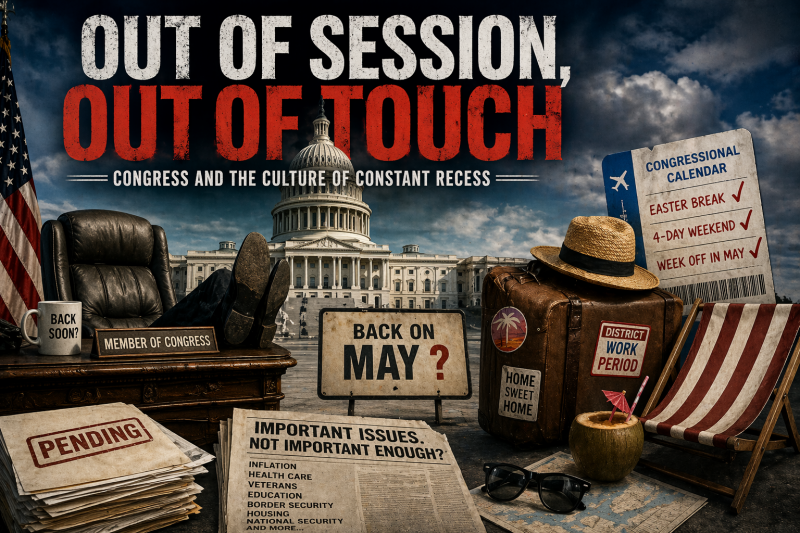
To understand why this occurs we must first look past the optics of “being on vacation” and focus on how Congress defines their work. Technically these breaks are not vacations at all. Congress refers to these breaks as “district work periods.” During these times members are expected to go home, meet with constituents, attend events and assess the public’s pulse. There is some truth to that statement. During these recesses Congress was meant to reconnect with their constituents and bring the issues back to Washington. Unfortunately, that is far from reality these days. These recesses have become hyper-partisan too. Add relentless fundraising and a never-ending campaign season and you’ve got district work periods filled with photo-ops for donors and cable news stops rather than time to craft legislation.
Leadership wants and needs it to be this way for a variety of reasons as well. First, with how hard it is to pass legislation with a divided Congress there is very little reason to be in session. Members have narrow majorities and the partisan division between the parties runs deep. There has been a significant decrease in laws passed in recent years. Just last month, it was reported that Congress has seen one of the lowest amounts of legislation passed in recent sessions. Second, members like it that way. They have to keep campaigning and fundraising to get reelection, so they want to be back home. While the needs of the members and the needs of the institution can conflict at times, leadership recognizes that they need to keep members happy if they want to keep them listening to leadership.
Okay, but what about individual members? Do they like it? Well publicly they'll defend it because it forces them to communicate with their constituents. Privately? Well, some gripe that they never have time to actually do their jobs. Others are quietly thankful for the free time. But either way, members of Congress are not singular beings. Congress is 535 people with very different attitudes about how and why they serve. Especially when many of them are juggling competing motivations to govern, fundraise, toe the party line and get reelected at the same time. The schedule is a manifestation of that struggle.
What is more remarkable is how little outrage there has been. For the average worker citizen chained to a much stricter timetable, Congress seems to have the privilege of taking as many vacations as they want with little consequence. School children, educators, and professionals in any field do not enjoy this luxury, but voters rarely hold their disdain for this fact up to public scrutiny. One reason for this is habituation. Congressional vacations have been occurring for generations, so most Americans have accepted it as a necessary truth. Fragmentation is another reason. There are so many issues for the public to focus on that Congressional schedules never become a prolonged topic of discussion.
And yet, the frustration is there, simmering beneath the surface, occasionally erupting in more populist expressions of anger. One recent example is the TMZ series OWTA — “Out With Their Asses,” spearheaded by Harvey Levin, which channels public dissatisfaction with political inaction into a blunt, media-driven critique of elected officials. The very existence of such a series speaks to a broader sentiment: that many Americans feel their representatives are not doing enough, not working hard enough, and not being held accountable for it.
One can’t help but compare lawmakers to the everyday working world. Most Americans can’t take weeks off from their jobs without penalty. Schools have set calendars that students must adhere to. Businesses require their workers to produce. Careers are often judged by how much you produce. Congress has no such production that we can physically measure. They meet, negotiate, work in committees and more...behind closed doors we aren’t even aware of (or even question why we should care about).
How can this change? Voters. Congressional calendars don’t flow from laws of nature. They’re made by leadership that’s selected by members that are selected by voters. If voters start demanding more responsiveness—if they reward hard work and punish slacking with their votes—the incentives will change. Force members to take tough stances in primary elections. Call them out in general elections. Make their lives miserable until they shape up. Share information so voters can see how Congress works.
Frankly, it’s not about time off and session time. The question is priorities. Expecting Congress to operate as if it were a full-time legislative body shouldn’t be considered too much to ask in a time where we face national and global issues that require diligent attention—it should be demanded. If they can’t do the job, perhaps we need to ask ourselves why we allow them so much time off. Are we doing them a favor?
Until that question is answered—and acted upon—the perception will remain that Congress, despite its immense power and responsibility, is too often out of session, and too often out of touch.
If this look at Congress being “out of session and out of touch” resonates with you, please take a moment to comment, rate, and share the post so your voice is part of the conversation.

Add comment
Comments