

Most people walking along Hollywood Boulevard today only look down to read the stars names embedded in the sidewalk. They notice the handprints, the souvenir shops, the superheroes posing for tips, the flashing signs, the traffic, and the constant noise. But hidden beneath all that is another Hollywood, buried under years of demolition, respectability, and selective memory. At 6724 Hollywood Boulevard, below what used to be the glamorous Christie Hotel and next to the now-gone Hotel Glidden, there was once one of the boldest queer nightspots Los Angeles had ever seen: the Club New Yorker.
By Allan R. Ellenberger
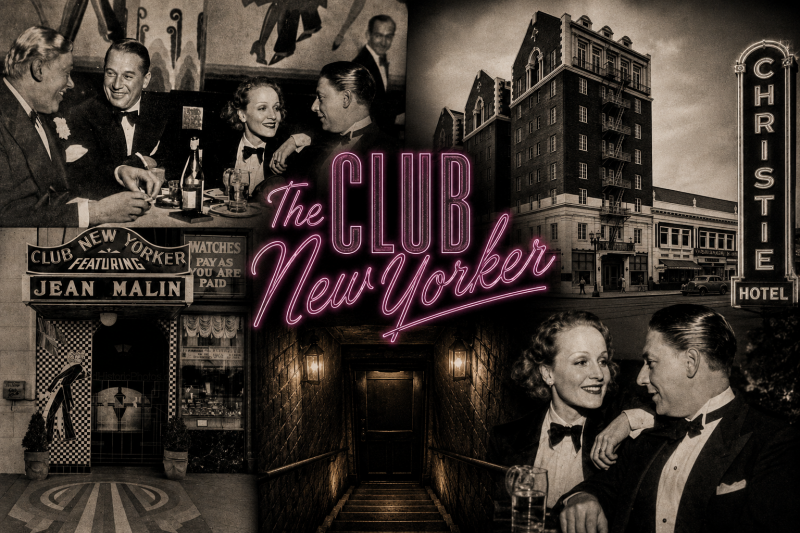
What makes the Club New Yorker so remarkable is not just that it existed, but that it did so openly, loudly, and without apology at a time when homosexuality was still illegal, closely watched by police, and seen as immoral. Yet for a few bright years in the early 1930s, queer Hollywood went down a narrow staircase beneath the Christie and Glidden buildings into a basement filled with jazz, drag shows, cigarette smoke, illegal drinks, and sexual freedom.
To understand the club, you need to know about the buildings above it. Before Hollywood Boulevard became a bright tourist spot, it was a modest street with small hotels, cafes, drugstores, and shops serving the growing film industry. In 1917, local businessman W.B. Glidden built the Hotel Glidden at 6738 Hollywood Boulevard. It was a simple three-story brick building with shops on the ground floor and about seventy guest rooms above. It was not fancy, just practical—the kind of place early Hollywood relied on. Salesmen, secretaries, aspiring actors, vaudevillians, extras, and drifters all stayed there as the movie business grew around them.
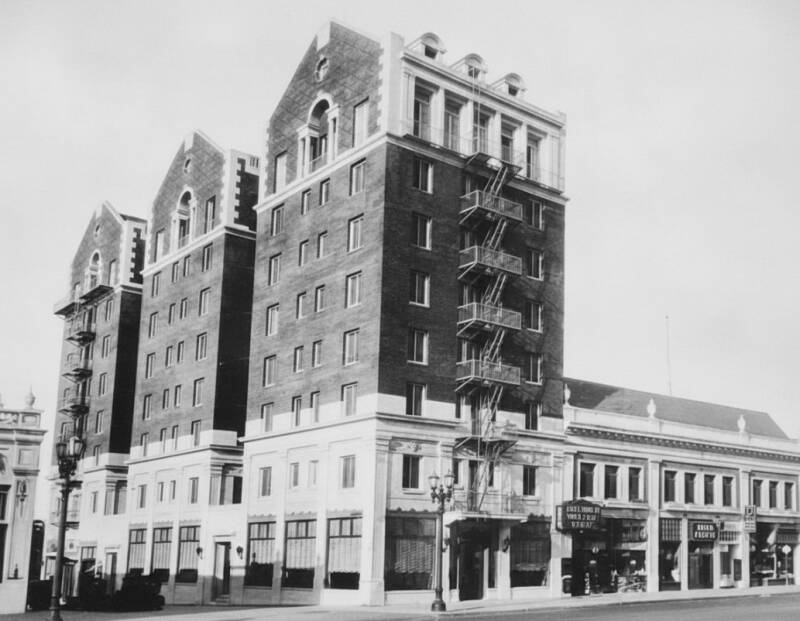
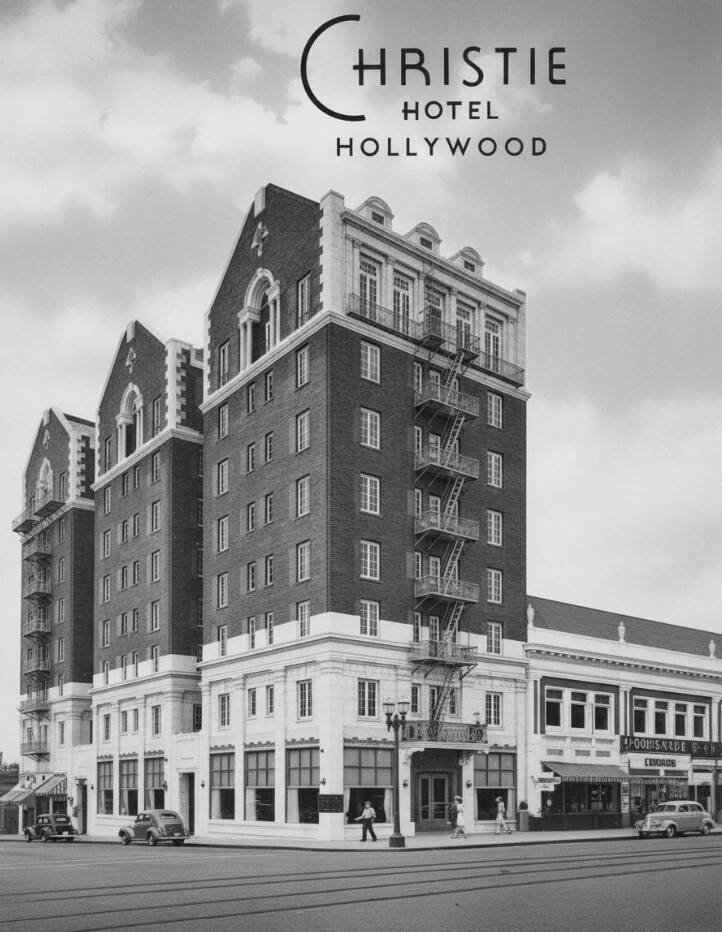
Above is the Christie Hotel, which opened at the southwest corner of Hollywood Boulevard and McCadden Place in 1922 and became one of Hollywood’s most prominent early high-rise hotels. At lower right is a rare view of the neighboring Hotel Glidden, whose basement housed the famed Club New Yorker, one of the city's most celebrated nightlife destinations during the early 1930s. Today it is a parking lot for Scientology.
Five years later, the neighborhood changed a lot when developer Haldane H. Christie bought the Glidden and opened the tall Christie Hotel next door in 1922. The Christie was Hollywood’s first big luxury high-rise hotel, showing off the city’s growing ambitions. With telephones in every room, cold water on tap, rooftop views, and stylish public spaces, it showed that Hollywood wanted to compete with New York and Chicago in style.
The smaller Hotel Glidden was suddenly overshadowed by its glamorous neighbor, but the two buildings ended up working together. The Glidden became the annex for the Christie, offering more commercial space and cheaper rooms for people connected to the luxury hotel. But their real connection was underground.
In the late 1920s, the basements under the Glidden and the Christie were joined together. At first, one part was home to the Oriental Café, a restaurant that did not last long. Then, in September 1932, the space changed completely. The basement turned into the Club New Yorker, an Art Deco cabaret hidden below the respectable world above. The timing could not have been better.
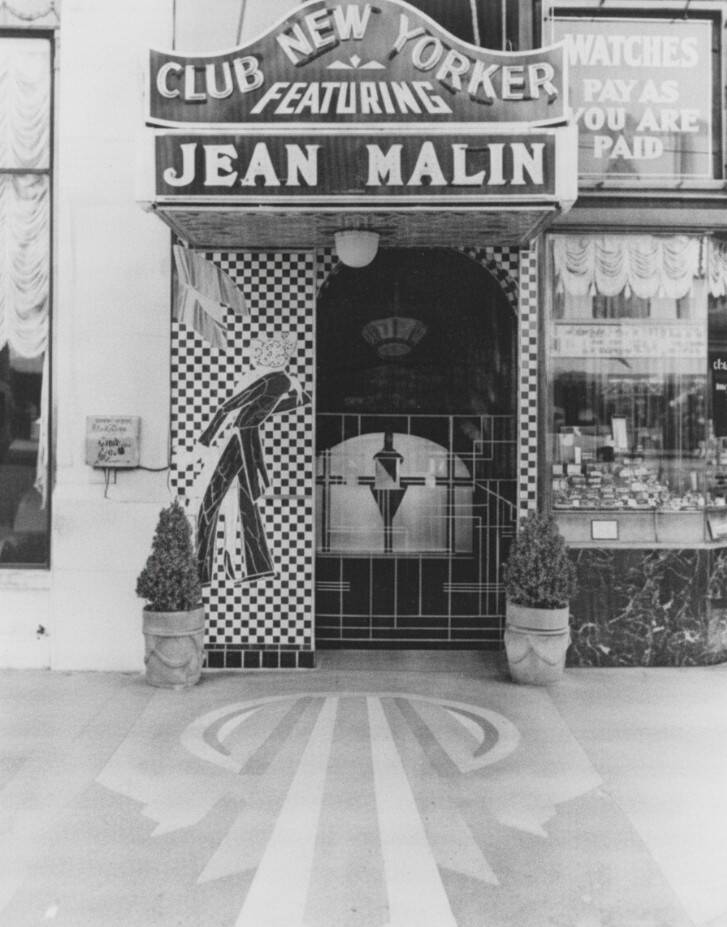
The entrance to the Club New Yorker as it appeared in the early 1930s, leading patrons down into the legendary basement nightclub that became one of Hollywood’s most colorful and influential gathering places.

The site as it appears today. The Hotel Glidden has long since disappeared, replaced by a parking lot, but the black gate marks the original entrance to the Club New Yorker, and the staircase leading down to the former basement nightclub still survives.
At that time, America was experiencing what historians later called the “Pansy Craze,” a short but exciting period when drag performers and openly effeminate entertainers became very popular in city nightlife. In places like New York, Chicago, and Los Angeles, people crowded into clubs to see female impersonators, queer comedians, camp singers, and performers who challenged traditional ideas about gender. For a short while before backlash came, queer nightlife was in style. Hollywood, of course, joined in with special excitement.
The Club New Yorker was said to be beautifully redesigned with stylish Art Deco interiors and murals by Fox Studios art director Jack Schulze. Guests walked down a steep staircase into a smoky underground room lit by soft amber lights, with mirrored walls, jazz music, and a sense of excitement that polite society ignored. Upstairs, tourists and businessmen checked into the Christie Hotel. Downstairs, Hollywood’s hidden world came to life. And it was quite a world.

Patrons arrive at the entrance to the Club New Yorker on Hollywood Boulevard. Visible at left is a man standing on the staircase leading down to the nightclub—a surviving architectural feature that can still be seen today.
The club soon became one of Los Angeles’ first and most important LGBTQ gathering spots. It was not just a “gay bar” as we think of today. It was stranger, riskier, and more exciting for the culture. The crowd included studio workers, chorus girls, drag queens, socialites, closeted actors, wealthy thrill-seekers, screenwriters, musicians, and curious straight couples who wanted to see something forbidden.
People came because the Club New Yorker offered something rare in early 1930s Los Angeles: permission. Permission to flirt openly. Permission to play with gender. Permission to laugh at inside jokes everyone understood but no one talked about outside the club. Permission to stop pretending, at least for one night.
The club’s main attraction was the amazing Jean Malin, one of the most famous female impersonators in America. Malin stood out—over six feet tall, broad-shouldered, dressed in a tuxedo, witty, bold, and openly gay. One trade paper memorably described him as “a six-foot-tall, 200-pound bruiser who also had an attitude and a lisp.”

Above: Guests enjoy an evening of dining and conversation at the Club New Yorker. Below: The elegant main dining room located in the basement level of the Hotel Glidden, where the famed nightclub welcomed its patrons.

Malin had already made a name for himself in New York nightlife before coming to Hollywood, but the Club New Yorker was the perfect stage for him. Night after night, he entertained the crowd with bold camp humor, songs full of double meanings, and quick-witted jokes aimed at both celebrities and guests. He flirted with men, teased women, poked fun at Hollywood egos, and broke gender rules just by being himself in public. Audiences loved him. What is surprising is how many people from the movie industry attended openly.
Hollywood studios at that time were full of queer talent—actors, directors, costume designers, decorators, choreographers, writers, and hairstylists—but it was still taboo to talk about it openly. The Club New Yorker became one of the few places where this hidden community could gather, at least somewhat openly. Studio secretaries danced with chorus girls. Male actors quietly found seats in corner booths. Wealthy socialites came downtown looking for excitement that was dressed up as sophistication.
The room was said to have an exciting atmosphere. Unlike the fancy Ambassador Hotel or the Roosevelt, the Club New Yorker felt close and a little risky. The low ceilings held in the cigarette smoke and laughter while jazz music echoed off the mirrored walls late into the night. Everyone knew police raids could happen, that gossip could get out, and that careers could be ruined. That risk was part of the thrill. But it could not last.
By 1933, America’s mood was changing fast. The Depression made people more anxious about morality and masculinity. Police raids became more common. The film industry started using stricter censorship rules with the Production Code. Queer visibility, which had been briefly accepted as trendy nightlife, became seen as a threat again. The Pansy Craze ended almost overnight.
Then tragedy struck. In August 1933, Jean Malin died in a terrible car accident at just twenty-four years old. His death seemed to mark the end of the era. Without Malin and with growing social pressure, the Club New Yorker quickly disappeared from Hollywood nightlife.
The Hotel Glidden eventually faded away as Hollywood changed. By the years after World War II, both the Glidden and Christie had lost much of their shine. The Glidden was torn down before 1958, almost erasing it from the street. The Christie survived, was restored, and became part of the growing Church of Scientology buildings that now line Hollywood Boulevard. Still, if you look closely, you can see a piece of the past: a set of old concrete steps next to the former Christie, leading down to what was once the Glidden basement and the entrance to the Club New Yorker. Those steps might be the last physical sign of one of Hollywood’s first queer safe spaces. And that is important.
Too much queer history is lost because cities save buildings but forget what happened inside them. The Club New Yorker was not important just because drag performers worked there. It mattered because it gave queer Hollywood a place to be seen before it was safe to be visible. It offered community before that was legal. It let people exist in public, even if only for a short time, without shame.

Jean Malin, the celebrated female impersonator whose performances helped make the Club New Yorker one of Hollywood’s most fashionable nightlife destinations. Following his untimely death in 1933, the club gradually lost much of the notoriety and excitement that had fueled its success.
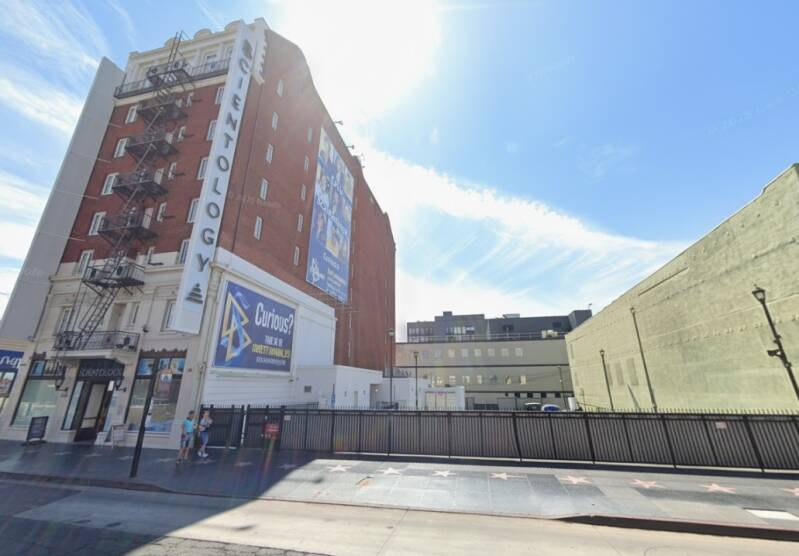
Above is the former site of the Hotel Glidden, which once stood beside the Christie Hotel and is today part of a Scientology empty lot. The couple standing at the lower left marks the approximate location of the entrance to the Club New Yorker, where patrons descended a flight of stairs into one of Hollywood’s most celebrated basement nightclubs.
For a few amazing years under the Christie Hotel and the old Glidden Building, Hollywood’s outsiders stopped hiding. The jazz got louder. The drinks flowed more freely. Gender became a show. Desire was out in the open. And deep below Hollywood Boulevard, in that smoky basement cabaret that is now almost forgotten, queer Hollywood danced openly beneath the city long before the rest of America was ready to admit it existed.
If you enjoyed my latest feature on the legendary Club New Yorker, please take a moment to comment on, rate, and share the article with fellow lovers of Hollywood history, LGBTQ history, and forgotten Los Angeles landmarks.
Add comment
Comments
The establishment was owned by my Great Grandfather Jack Dragna and his business partner Johnny Roselli, though Bonnie Hyman was the public face. When they couldn’t get a liquor license after repeal they turned it over to Billy Wilkerson, who opened the first location of Ciro’s there. It didn’t last and became Club New Yorker again. The Kerwin brothers were owners with Dragna and Roselli.
Thanks J. Michael for sharing that bit of family history. Very interesting.