

Hollywood in the 1930s was built as much on illusion as it was on labor, and nowhere was that more evident than in the world of child actors. For every recognizable face who carried a scene, there were others — smaller, quieter presences — who stood just outside the frame, ready to step in when needed. Among them was Alan Howard Hirst, a boy whose brief life intersected with one of Hollywood’s most beloved comedy traditions and whose story, though largely forgotten, remains etched into the margins of film history.
By Allan R. Ellenberger

Alan Hirst was born on June 8, 1930, in Hollywood, California, a child of the industry’s own backyard. Unlike many who journeyed west in search of opportunity, Hirst’s life began at the center of it. He grew up in an environment where studios, soundstages, and film crews were not distant curiosities, but part of the everyday landscape. By the mid-1930s, he had entered that world himself, not as a star, but as what the industry then called a “film moppet”—a child performer used in small roles, background action, and, most notably, as a stand-in.
It was in this latter capacity that Hirst found his most consistent work. He served as a stand-in for George “Spanky” McFarland, the central figure of Hal Roach’s immensely popular Our Gang comedies. The role of a stand-in was both technical and essential. Before the cameras rolled, before the lighting was perfected, and before the child star was placed in harm’s way, another child would step into position, testing the scene, the timing, and, at times, the safety of the action. Hirst was one of those children—a quiet professional presence behind the laughter that millions would later see on screen.
One account of such dangers remains. On location for the filming of a mock battle in Wheeler and Woolsey comedy Kentucky Kernels (1934), Hirst was to stand-in for McFarland to test safety on the mechanics of the stunt, which called for simulated effects of exploding machine-gun fire (electric light bulbs run through a wringer); raspberries blowing through phonograph horns; and blast waves made from homemade devices. But director George Stevens was a little afraid of the scene and insisted that he try it first. In the chaos of everyone checking the set one big lamp was knocked over, hitting Stevens's arm and severing a vein. Steven's wounds were not life-threatening but could have been fatal to the kid playing second chair, proof positive of how even the youngest personnel on a film crew were vulnerable before modern safety standards came into existence. Stevens became a hero to Hirst and his parents.


Hirst's film appearances were few, but actual. He is best known for his work with the Our Gang troupe. Other films were said to have been finished at the time of his death that hadn't been released yet such as Quality Street (1937) at RKO, History Is Made at Night (1937) at United Artists and Penrod and Sam at Warner Bros. (1937), so it can be seen that his involvement in the business was picking up steam, though minor.
These fragments of a career point to a child who was beginning to establish himself, not as a leading player, but as part of the working fabric of studio production. Like many children employed in Hollywood at the time, Hirst’s life straddled two worlds: school and set, routine and performance. Records indicate that he was a student in public school, balancing education with the irregular demands of film work.
His home life was rooted in a modest apartment (118) at 6434 Yucca Street in Hollywood, a building that would later gain its own quiet place in cultural history as the childhood residence of Carol Burnett. For Hirst, however, it was simply home — a place he would never leave. On January 15, 1937, at the age of six, he died there, his life cut short by acute hemorrhagic pneumonia, an aggressive and often fatal complication of influenza in that era. The speed and severity of the illness shocked those around him. Newspaper accounts described his death as unexpected, noting that what began as what “seemed to be a cold” quickly escalated beyond recovery.
Reaction was swift, if not momentary. Funeral arrangements quickly took place. Services were conducted at W.H. Strother’s Chapel on Hollywood Blvd with burial in Hollywood Cemetery soon after. In death, he would lay to rest amongst the actors, technicians, directors and legends whose lives became his world for a short time. He now rests in the Garden of Ancestors, Sec. 1, Grave 175 CH.
Hirst was survived by his mother, Vina Hirst, his father, Howard H. Hirst, and his siblings, Gloria and Phyllis, a family left to reconcile the sudden loss of a child whose life had only just begun to take shape. Yet his story remains significant precisely because of its quietness. Alan Hirst was not a star, not a household name, not a child whose face audiences would recognize decades later.
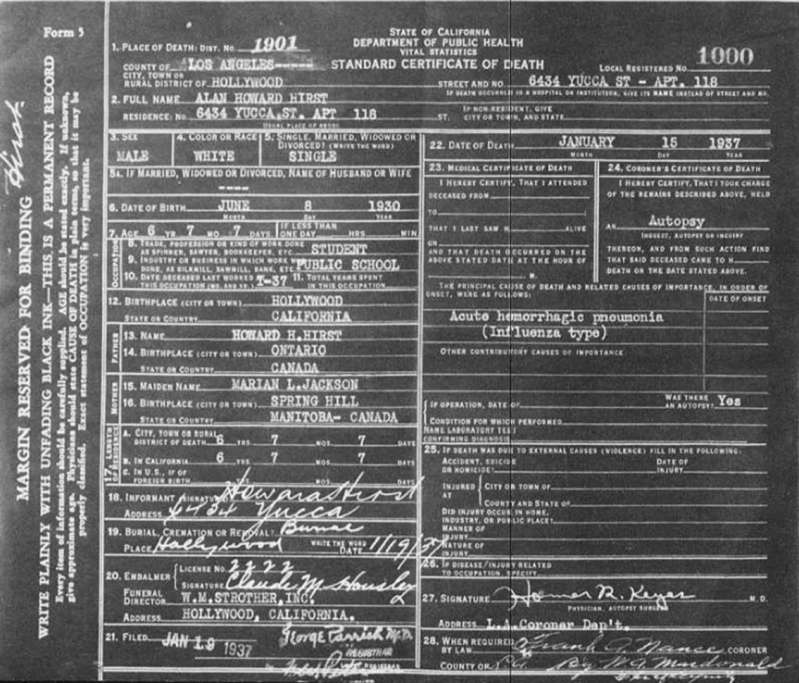

Hirst died at his home, 6434 Yucca Street, Apartment 118; years later, comedienne Carol Burnett would reside in the same building, in Apartment 102, adding another chapter to its storied history.
He was something more representative: one of the many young performers whose contributions were essential but largely invisible. He stood in the light so that others could shine more safely, tested scenes before they were deemed ready, and participated in a system that depended on such unseen labor.

In the broader history of Hollywood, where legends often overshadow the lives that supported them, Alan Hirst occupies a small but meaningful place. His life reminds us that the magic of early cinema was built not only by those whose names appeared above the title, but by those who worked quietly behind them—sometimes, quite literally, in their place.
In the end, Alan Hirst’s story is not one of fame, but of presence. For six brief years, he was part of Hollywood’s great experiment in storytelling and illusion. And though his name may fade from memory, his place within that history—however small—remains.
If Alan Hirst’s brief but poignant story moved you, please take a moment to comment, rate, and share the post to help keep his memory alive.
Add comment
Comments