

Prior to Hollywood’s broader recognition of Native American performers and their contributions, a Cheyenne and Arapaho actress known as “Indian Minnie” emerged as one of the most prominent figures in silent film. Born Minnie Provost and sometimes credited as Minnie Devereaux or “Minnie Ha-Ha,” she was recognized for her warmth, wit, and charisma, distinguishing herself among Native actresses in the 1910s and early 1920s. Despite her comic roles, her life was characterized by struggle, perseverance, loss, illness, and survival.
By Allan R. Ellenberger

Minnie Provost was born in Indian Territory, now Oklahoma, in 1869 and was a member of the Cheyenne and Arapaho Tribes. She grew up in the post-Civil War era, a time when Native nations across the West faced devastation due to forced removal, conflict, treaty violations, and disease. These experiences shaped her perspective throughout her life. In interviews, Minnie recounted that as a child, her family fled from General Custer’s troops during the period surrounding the Battle of the Little Bighorn in 1876. Regardless of the precise accuracy of these recollections, Minnie represented a generation that witnessed the decline of Native life during Westward Expansion.
Little is known about Minnie’s parents, and documentation from her early life remains limited. Nevertheless, Minnie maintained a strong awareness of her heritage and expressed pride in her tribal identity, even while working in a film industry that frequently relied on stereotypes.
In the early 1900s, Minnie began her career in show business, likely starting with Wild West shows that featured Native performers and romanticized depictions of western life. At that time, entertainment was among the limited avenues available for Indigenous people to earn a livelihood. Subsequently, Minnie transitioned to the emerging film industry in Southern California, where producers sought Native actors for cowboy films.
Although many Native performers were overlooked by history, Minnie achieved significant public recognition. Her name was familiar to audiences, and trade journals frequently referred to her as “Indian Minnie” or “Minnie Ha-Ha.” These nicknames reflected both the prevailing racial attitudes and her notable comedic talent. While she often played supporting roles, she remained one of the most recognizable figures in silent films.
Minnie’s film career developed in parallel with the emergence of slapstick comedy and early feature films. Her most prominent role was in Fatty and Minnie He-Haw (1914), in which she starred alongside Roscoe "Fatty" Arbuckle during the peak of Keystone-style comedy. Like many Native actors of the era, she was frequently cast in stereotypical roles; however, Minnie infused even the most limited characters with vitality and distinct personality. Audiences remembered her for her expressive facial expressions and precise comedic timing.
Over the following decade, Minnie appeared in numerous films, including Mickey (1918) with Mabel Normand, a leading figure in silent cinema. This successful comedy ranked among the highest-grossing films of its era and further increased Minnie’s visibility in Hollywood. She also appeared in Suzanna (1923), again with Mabel Normand, as well as in various westerns and frontier dramas that incorporated Native themes and settings.
Most Native actors during the silent era remained in uncredited roles. In contrast, Minnie earned respect within the industry and received rare commendation from her peers. Newspaper obituaries later described her as "a moving picture institution," indicating her status as a familiar and significant figure in early Hollywood.
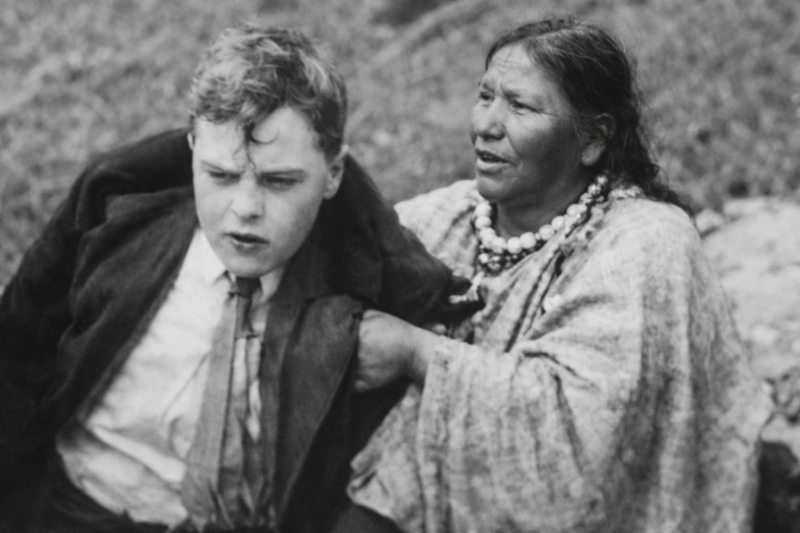
A scene from Fatty and Minnie He-Haw (1914)

Minnie and Mabel Normans in Mickey (1918)
By the early 1920s, Minnie’s health had significantly deteriorated. Minnie Provost died on June 5, 1923, at her home, 3817 Sunset Boulevard, at approximately 52 years of age, from pulmonary tuberculosis, with influenza also noted as a contributing condition. She had reportedly been ill for several months. Silent western star William S. Hart reportedly financed Minnie’s funeral as a final tribute to an actress he admired. This gesture demonstrated the affection and respect Minnie inspired among her colleagues in early Hollywood.
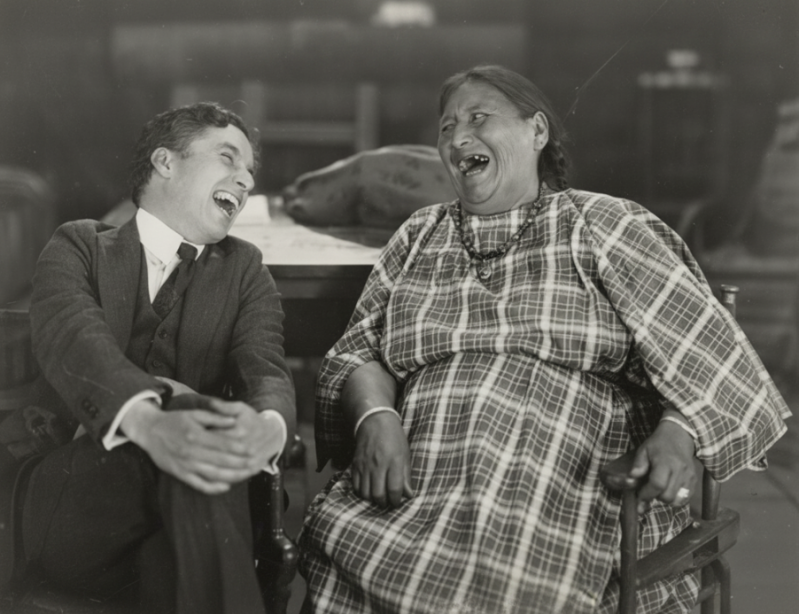
Charlie Chaplin visiting Minnie on the set of Rose of the West (1919)
Minnie was interred at Hollywood Cemetery in an unmarked grave beside her two daughters in Section 20-A, Grave 79, on the border of Paramount Studios. Like many silent-era performers, she was largely forgotten by Hollywood history. Minnie was part of the first generation of Native American screen actors, pioneers who entered a new and frequently exploitative industry while striving to maintain their identity and pride in roles that were often stereotypical. She demonstrated resilience, humor, spirituality, and determination, persevering in a profession that offered Native actors minimal protection or recognition.
Today, as film historians reexamine the overlooked pioneers of silent cinema, Minnie Provost stands out not only for her appearances in early films but also for her perseverance. She experienced the violent settlement of the American West, participated in the nascent film industry, performed for early audiences, and consistently honored her heritage. Minnie’s contributions to early Hollywood history merit recognition.
Tomorrow on The Hollywoodland Revue: this week’s “Coming Attractions” roundup featuring the newest theatrical releases, critical reactions, audience buzz, and recommendations on what may—or may not—be worth your ticket money.
Please take a moment to comment on, rate, and share my new feature on silent film actress Minnie Provost — the remarkable Cheyenne and Arapaho performer whose life and career remain one of early Hollywood’s most overlooked stories.

Add comment
Comments
Read much of her bio in Hollywood's Native Americans: Stories of Identity and Resistance in 2022, much first reported by Angela Aleiss Ph.D.