

Karie Bible did not come to Hollywood Forever Cemetery looking for a job. She came looking for history—and found a calling. Long before she ever guided her first tour, her life had already been shaped by a love of the past. “I fell in love with the Universal horror movies of the 1930s,” she says, calling them her “gateway drug to film history.” At the same time, her parents’ fascination with the Civil War meant childhood trips to cemeteries and battlefields, places where stories lingered in the ground itself. “I’ve always loved living history and film history,” she explains.
By Allan R. Ellenberger

When Bible moved to Los Angeles in 2000, a visit to Hollywood Forever changed everything. “I saw the cemetery, and I fell absolutely in love, as I hope everybody that moves here does,” she recalls. Curious, she asked if the cemetery had a tour guide. “It was like a lightbulb going off over my head, and I thought, well, maybe that could be me.” With encouragement from film historian Marc Wanamaker, who became an important mentor, she met with cemetery management, gave a sample tour of what she envisioned, and was told simply: go for it. Her first public tour took place in February 2002. “I’ve been there since then,” she says. “It’s my joy, and I don’t get tired of it.”
What sustains her, after more than two decades, is the people she introduces to visitors. “I love these people so much,” Bible says of Hollywood Forever’s residents. “They were pioneers, and they were building the foundation of the entire entertainment industry. They were artists.” Her concern is that time will erode their legacy. “I worry that as time goes on, people will forget them and forget what they’ve done, and I don’t want that to happen.”
Bible’s tours are famously flexible, shaped as much by the audience as by the cemetery map. “I keep it fluid based on my audience,” she says. One afternoon, she was guiding a group of French women and decided to add a stop not usually on her route: singer Joe Dassin. “They were so excited to see that grave,” she remembers. “One of them whipped out her iPhone and played one of his songs… and all of them stood around and started singing Joe Dassin’s songs all around his grave.” It was spontaneous, joyful, and deeply human—exactly the kind of moment she lives for.
No figure, however, illustrates the endurance of old Hollywood stardom quite like Rudolph Valentino. Bible recalls standing at his mausoleum with a sizeable group when she noticed a young woman, barely twenty-one, crying uncontrollably. “In my head, I wondered what I could have said that had upset her,” Bible says. The woman rushed out, and Bible quietly asked her companion if she’d misspoken. “Oh no,” he told her. “Whenever his name comes up, she gets really emotional.” For Bible, it was a revelation. “I thought, that is enduring star power—when you’ve been gone that long, and some young person is still devastated hearing you talk about you.”


She often finds herself translating that kind of fame for younger audiences. Once, facing a group of blank-faced thirteen-year-olds at Valentino’s tomb, she improvised. “I asked, ‘What star do you love, like if they walked in here right now that you would flip out?’ and they all said Beyoncé.” Then she posed a hypothetical: “Say your iPhone went off tomorrow morning, and you read that Beyoncé is dead.” One girl immediately began crying. “You could have heard a pin drop in that mausoleum,” Bible says. “And they got it.” She compares Valentino’s death to modern shocks like Kobe Bryant’s. “It was shocking, out of the blue, unexpected, and they were young. I try to find a parallel so modern-day people can connect the dots.”
Judy Garland, however, requires no translation. “Having Judy Garland on the tour has been a whole new experience,” Bible says. “She has such tremendous power to this day.” Visitors react viscerally. “I’ve had people walk inside the room where she is and start crying hard. I’ve had people walk in and start singing at the top of their lungs.” Bible has guided tours past countless legends, but Garland stands apart. “You don’t get that type of experience in other areas the way you do with Judy.”
Other figures attract fascination for different reasons. Vampira, Bible notes, is one of the cemetery’s most frequently requested names. “She is one of these pulp culture icons,” she says. “There are books about her, documentaries, and Vampira t-shirts—something about her, her beauty, mythology, her life… people are fascinated by her.”
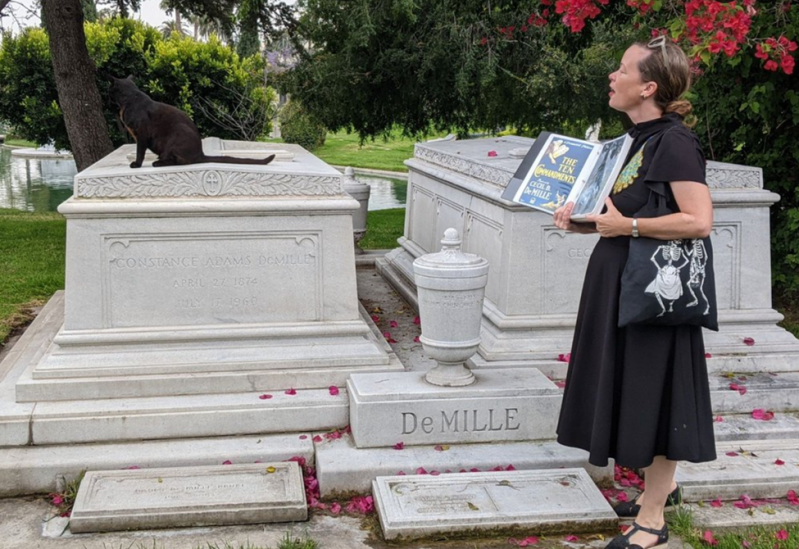
Over time, Bible learned not to assume visitors recognize the faces behind the names. “In the beginning, I just assumed that these people knew what the stars looked like, but that isn’t true,” she admits. Her solution was practical and effective: a binder filled with black-and-white headshots and color posters from each star’s most famous film. “I get people that don’t know the stars or can’t speak English,” she explains. “So I point, and they see the star, the poster, and it’s a way to connect the dots.”
Hollywood Forever, she emphasizes, is not simply a place of mourning. “I hear people say it’s about death, but it’s also about life,” she says. Concerts, movie screenings, Día de los Muertos celebrations, and an abundance of wildlife give the grounds an unexpected vitality.

“You’ve got ducks, peacocks, cats, turtles. It’s pulsating with life, and there’s this life force there.” Unlike uniform cemeteries with flat markers, Hollywood Forever embraces creativity. “We have a couch covered in dachshunds, a rocket ship, and a vinyl record,” she laughs. “Something about that spirit draws people to it.”
The cemetery is home to about sixty cats, but one stood out to Bible. In November 2019, a black cat jumped onto Cecil B. DeMille’s grave and started following her on tours, even though Bible is “violently allergic” to cats. She called him Close-Up because he liked to stay near DeMille’s tomb and was happy to pose for tourists’ photos. Over time, this friendly cat became known for quietly comforting grieving families during funerals and visits, and regulars saw him as an emotional support cat. Close-Up later became popular on social media. In January 2024, he left cemetery life behind when Bible adopted him and brought him home for good.
Not all moments are lighthearted. Bible once spoke candidly on tours about former owner Jules Roth and the cemetery’s period of decline. During one tour, a woman who hadn’t visited since her mother’s burial grew increasingly upset. “She finally thrust her hand in the air and said, ‘Where is he? I’m going to go spit on him.’” Bible defused the tension with humor, but the encounter stayed with her. “People’s grief and history are deeply intertwined here.”
Though she offers a nighttime tour, Bible remains skeptical about the supernatural. “I’ve never had a single paranormal experience” at the cemetery, she says, despite being there at all hours. Her one true scare came elsewhere at the Silent Movie Theatre. After hearing unexplained keys rattling in a locked building, she and a friend fled into the night. “There was a Buster Keaton movie unspooling all over the floor,” she laughs. “We just ran.”

One of the most touching aspects of cemetery life for Bible is the Silent Cemetery Project, a volunteer group that “adopts” neglected graves. “They care about people that the world has forgotten,” she says, describing how they tend the resting places of silent-era figures like Karl Dane and Virginia Rappe. “Some of these graves have never looked prettier.”
At the heart of Bible’s work is nuance. “People don’t understand that life is murky and grey and very complicated,” she says. She’s seen visitors demand the removal of controversial markers one day, only to watch another group deeply understand and appreciate their historical context the next. For Bible, history is not about comfort—it’s about truth.
“My joy, my takeaway from it all,” she says, “is I want to keep these artists and their artwork alive—from the super famous like Valentino to people like Karl Dane or Virginia Rappe.” If someone leaves her tour curious, emotionally moved, or newly aware of a forgotten life, she considers her mission accomplished. “If I can interest anybody in these people’s lives and stories,” she says, “that’s the ultimate thing I can ever hope to do.”
To schedule a tour with Karie Bible at Hollywood Forever, visit the Hollywood Forever Cemetery Tours website to book daytime spots, or contact her directly for private or night tours.
If you enjoyed my latest profile of Hollywood historian and cemetery tour guide Karie Bible, please comment on, rate, and share the post with fellow lovers of classic Hollywood history and Los Angeles lore.

Photo Disclaimer: Certain photographs used in this article originated from Yelp photos and videos associated with the “Walking Tour of Hollywood Forever Cemetery” listing and are presented here strictly for educational, historical, and commentary purposes.
Profiles & Remembrances is an ongoing series at The Hollywoodland Revue devoted to writers, historians, archivists, collectors, and cultural stewards whose work has helped preserve and interpret Hollywood’s past. These profiles are independently researched and written to document contributions, context, and legacy—ensuring that the people who keep Hollywood’s history alive are not forgotten.
Add comment
Comments