

There was a time, in the flickering light of silent cinema, when Marie Prevost was one of Hollywood’s most luminous faces—a woman whose charm, timing, and mischievous spark made her a favorite of both audiences and directors. Yet her story remains one of the great parables of early Hollywood: a rise shaped by wit and beauty, followed by heartbreak, decline, and a death later twisted into one of the most enduring myths ever attached to a fallen star.
By Allan R. Ellenberger for The Hollywoodland Revue

Marie Prevost was born Mary Bickford Dunn in Sarnia, Canada on November 6, 1899. Like thousands of others, she followed her dream to California at the turn of the century, in time to witness Hollywood's transition from fields and farmers to fantasy factory. She didn't have to wait long before she caught the attention of "King of Comedy" Mack Sennett, who added her to his harem of Bathing Beauties at Keystone Studios. In a sea of sequins and slapstick, Marie stood out. She had big, bright eyes, a natural comic sense and an on-screen allure that was instantly appealing.
Sennett's two-reel comedies made her name, but Marie soon transcended the pratfalls. She quickly became a leading lady, co-starring with Wallace Reid, Harry Langdon and other marquee names of the day. Her breakthrough was 1920's The Married Virgin, but it was Ernst Lubitsch's The Marriage Circle three years later that re-cast her reputation. Under his tutelage, Marie showed a more sophisticated, more nuanced side of her nature, and proved to be more than just a bathing-suit novelty. By mid-decade she was under contract to Warner Bros., a studio which had made her a celebrity as the embodiment of the Jazz Age's modern woman.
In many ways, Marie was the very image of a 1920s flapper: independent, flirtatious, stylish and a free spirit. Hollywood magazines raved about her, and she became part of the social swirl of the industry with seeming ease. But life was not all glitter, and in 1926 she was dealt a serious blow when her mother died in a car accident. Friends later claimed that grief took a serious toll, dimming the lively spark that had characterized her early stardom.
Then there was sound. Marie's voice was fine, but the new vocal tone of the industry left many mute players floundering. The studios wanted new voices, new rhythms, new faces for their more brazen, talking pictures. Marie's film career stuttered.
Her contract at Warner Bros. expired; her roles became smaller, less prestigious. By the early 1930s Marie was taking any role she could; bit parts, uncredited roles and walk-ons that were maddeningly beneath a woman who had once graced so many marquees. Marie faced financial and personal pressures. The silence and the drink added to her despair.
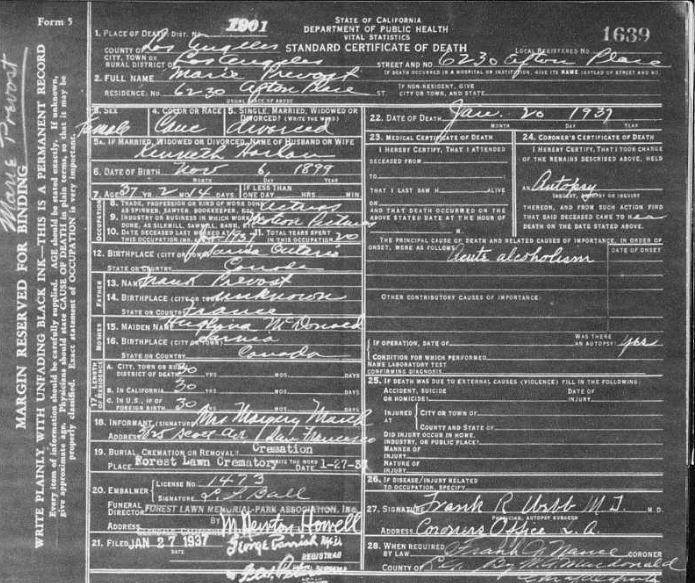
On the afternoon of January 24, 1937, the corpse of Marie Prevost was discovered in her one-room apartment at 6230 Afton Place, just 37 years old. The coroner estimated that she had died on January 20 (death certificate) and determined the cause of death to be acute alcoholism and malnutrition. It was a sad end but not an uncommon one for those who had fallen through the cracks of the movie industry, particularly among silent stars. When Marie Prevost's neighbors heard her little dachshund whining, they called for help. The dog had been trying to awaken her. It was frantic and bewildered.
It was at this point that the making of Hollywood myths overtook the truth. Over the ensuing decades, sensationalists and scandal-mongers – most notably Kenneth Anger in his book Hollywood Babylon – would distort the scene in grotesque fashion, transforming Marie's tragic death into a piece of ghoulish tabloid theatre. According to Anger, she was found as a "half-eaten corpse" having been devoured by her dog. Contemporary newspaper and magazine articles, along with police and coroner's reports, show a different story. The dog had bitten at her legs in a panic; it was an attempt to awaken her, rather than a canine case of the Cannibal-Magnon-Man. As for Anger's tale of a half-devoured corpse, it was pure fiction.
Her funeral, modest and paid for by the Motion Picture Relief Fund, reflected both her faded fortunes and the industry’s belated recognition that it had too often abandoned its own. Her passing inspired columnist Louella Parsons to advocate for better care for destitute film workers and helped spark momentum for what became the Motion Picture Country House and Hospital—a refuge Marie herself never lived to see.
But she lives on, quietly and tenaciously. In the few surviving prints of Marie Prevost's films, her performances continue to sparkle with the wit, charm and intelligence of a woman who was a natural, a woman who was as comfortable in a broad comedy as she was in a quiet drama. For years a mythical monster overshadowed the actress' memory.


Where Marie Prevost died: 6230 Afton Place, Hollywood
It took many, many years for people to realize that Marie was not a horror story but a sad tale of a very talented actress who was destroyed by a combination of tragedy, a rapidly changing industry and utter disregard.
Today, in reassessing her life with compassion and clarity, Marie regains what the rumor mill stole from her—the dignity of truth. She remains a haunting reminder of the fragile line between stardom and obscurity in early Hollywood, and of the real human stories hidden behind the myths of Babylon.
But Marie's story ends on another final mystery. After her small, private funeral, her body was transported to Forest Lawn in Glendale. Marie was cremated there, and her ashes were commingled with those of her mother, who had predeceased her by more than a decade. Her sister then picked up the urn containing both sets of cremains, but what happened next was never recorded. There is no record of a niche, a marker or a burial of either woman ever being placed or purchased. The records at Forest Lawn still list the ashes as simply "returned to family." Over the decades, with Marie's sister's death and no surviving family plot, the trail was lost. To this day, we do not know where Marie Prevost is laid to rest; her cremains, in effect, are lost. This is Hollywood, after all, but one of its earliest stars is not the only one without a marked grave.
What do you think? Please share your thoughts and comments below:

Add comment
Comments