

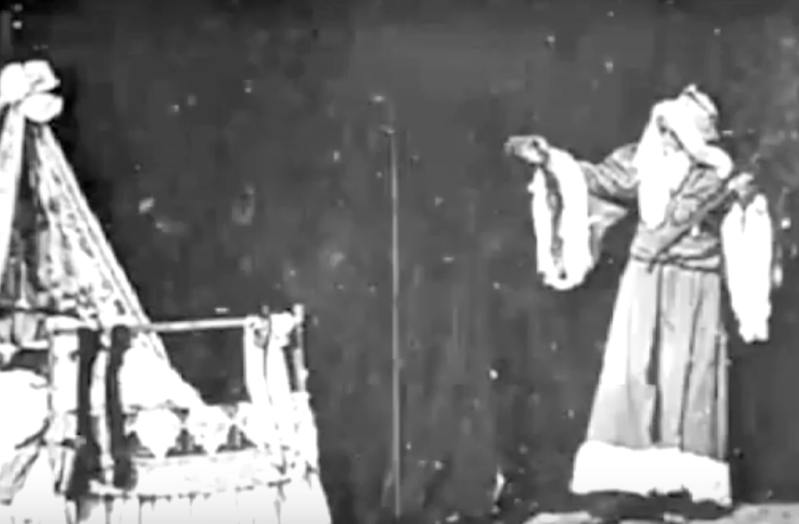
Santa Claus made his first trip to the screen as he has always made his first trip to the world: in silence, without announcement or record, and with no name. The year was 1898 and the motion picture was still such a marvel that the movies themselves still hadn’t mastered the art of remembering their players. So when an early British film, simply titled Santa Claus, offered the public’s first glimpse of Christmas on film, there was no record of the man in the film, nor the man behind the film.
By Allan R. Ellenberger

The 77-second movie, which was part of a series directed by George Albert Smith, shows Santa Claus peering into a nursery and then delivering toys before drifting off into the night—a complete mythology packed into several magical seconds. But the man who played the part is lost to history. In the annals of silent film history he is, quite literally, uncredited, unknown and unrecorded. Which, when you think about it, is somehow appropriate. The world’s first screen Santa is anonymous, a man known by his actions and his purpose, nothing more.
The proto-Santa became the archetype for the ones who followed. As the 20th century progressed and the vocabulary of film found its legs, Santa did what few characters ever do; he grew faster than the medium that claimed him. Hollywood had not yet figured out how to manufacture stars when it already had the most permanent one. Centuries before there were agents, contracts, and billing orders, there was Santa Claus, a part so ego-free that it could only be played with sincerity, not celebrity. By the time Santa Claus went West and made himself at home in American popular culture, he was no longer simply a folkloric holiday visitor. He was an actor in need of a studio system to keep pace.
From that point on, the story of Santa Claus became inseparable from the story of American entertainment itself. What began as a fourth-century saint’s quiet reputation for generosity evolved, through folklore and immigration, into a figure uniquely suited to mass media—instantly recognizable, endlessly adaptable, and renewed annually by belief alone. And when the finishing touches were finally applied in the twentieth century, they came not from a monastery or a manuscript, but from advertising art and Hollywood craft. In 1931, illustrator Haddon Sundblom’s Coca-Cola images helped standardize Santa’s now-familiar appearance—rosy-cheeked, human-scaled, warmly amused—transforming him from a regional folk figure into a global icon. It was a redesign as precise as any studio rebrand, and Hollywood immediately understood the value of what it had been handed.
Los Angeles, ever eager to turn myth into spectacle, gave Santa a home on its most theatrical boulevard. Beginning in the late 1920s, Hollywood Boulevard itself transformed each December into Santa Claus Lane, a civic fantasy of lights, parades, and storefront magic that folded Christmas directly into the city’s public identity. Santa ceased to be a distant visitor from the North Pole and became, instead, a reliable seasonal headliner—arriving on cue, waving from convertibles, anchoring parades, and closing the year like the final shot of a beloved film.
The above short, Santa Claus (1898) is considered to be the first Christmas film at just 77 seconds.
From that point on, Santa’s Hollywood career progressed with considerable uniformity. He became a screen presence beyond genre and era, a character who could be sincere or comic, sacred or commercial without ever losing his essential authority. In film and on television specials, in department-store appearances and parades, Santa morphed into something peculiarly cinematic: a myth that never aged, a star who never stumbled, and a role that could be passed from actor to actor without losing its soul. Long before Hollywood perfected the franchise, Santa Claus had already mastered it—renewing his contract every year, arriving on time down to the second, and leaving behind nothing but belief.
I’d love to hear your thoughts—when did Santa Claus first feel “real” to you on screen, and which version of Santa has stayed with you the longest? Share your comments below.
Add comment
Comments