

On Christmas Eve 2025, Annette Dionne died in Canada at age ninety-one, the last surviving member of the Dionne quintuplets and the final living witness to one of the most troubling child-celebrity stories ever produced. Where so many recalled the miracle and the novelty, now at Annette’s passing the story of the Dionne sisters might be remembered as a cautionary tale.
By Allan R. Ellenberger

An undated photo of Annette Dionne, one of the famed Dionne Quintuplets as a child at 'Quintland.' (Photo Credit: Callander Bay Heritage Museum/Facebook)
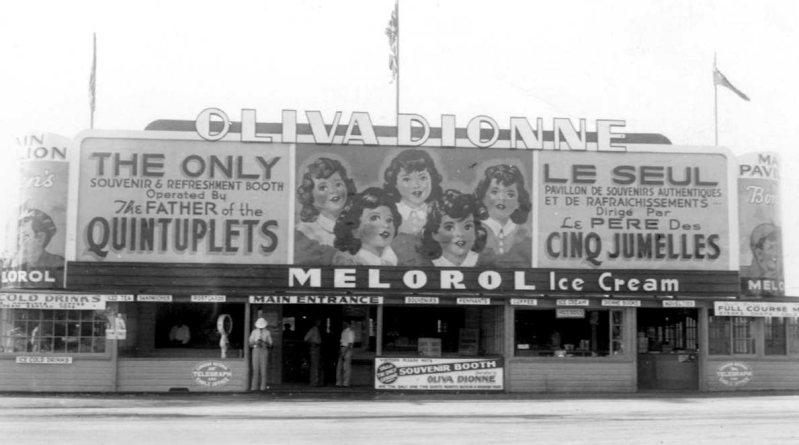
Annette Dionne was born on May 28, 1934, to Elzire and Oliva Dionne in rural northeastern Ontario. She was one of five identical girls, the others being Yvonne, Cécile, Émilie, and Marie. Prematurely delivered, the quintuplets, as they were known from almost the moment of their birth, were the survivors of a new kind of miracle, for although identical births did occur with some frequency in mammals in the wild, multiple births in women were often fatal to both the infants and the mother. What followed was unprecedented. In the depths of the Great Depression, the quintuplets were transformed almost immediately into international attractions symbols of hope marketed to a desperate public.
Within months, the Ontario government assumed control of the girls, declaring itself their guardian “for their protection.” What resulted was "Quintland," a purpose-built compound where the sisters were raised under constant supervision and displayed to tourists several times a day. Millions visited. Cameras recorded every movement. Annette’s earliest memories were not of a home, but of schedules, nurses, observers, and the relentless awareness of being watched. Childhood became a public performance.

The contradiction was stark. Officials claimed the girls were being shielded from exploitation, yet their images sold everything from souvenirs to movie tickets. Hollywood joined in while the sisters were still toddlers, featuring them in films that folded their real lives into sentimental fiction. The world consumed the illusion of five happy children, identical in dress and smile, while the reality—rigid control and emotional deprivation—remained carefully offscreen.
In 1943, at age nine, the quintuplets were returned to their parents. The reunion did not bring safety or normalcy. As adults, Annette and several of her sisters would allege abuse by their father, revelations that reframed the entire narrative of “rescue” and “family restoration.” The girls left home at eighteen, not so much stepping into independence as escaping a life that had never belonged to them.
Adulthood scattered the sisters, but tragedy followed. Émilie died in 1954 at just twenty. Marie died in 1970 at thirty-five. Yvonne died in 2001. Cécile lived longest among them until her death in July 2025. Annette, private by nature, became the last carrier of the story’s living memory.
When she spoke publicly, it was with purpose. In 1997, Annette joined her surviving sisters in a widely read open letter warning parents of another set of famous multiples not to trade their children’s privacy for fame. The message was blunt and hard-earned: celebrity does not compensate for a stolen childhood. Around the same time, the sisters sought accountability from the province that had claimed to protect them. Ontario eventually issued a settlement and apology, a belated acknowledgment that the state had profited from their confinement.

Last Dionne quintuplet, dies at 91
In later years, Annette participated in efforts to ensure the Dionne story was told honestly. Recognition of the quintuplets as a National Historic Event did not celebrate cuteness or novelty; it explicitly named the girls’ separation from their family and their exhibition to the public. For Annette, that reframing mattered. The myth had finally been forced to tell the truth.
Her death closes the circle. With no living quintuplet to counter nostalgia, it is tempting to dull the narrative’s edges: to remember dolls and dresses rather than control and damage. Annette’s life refuses that temptation. Hers is the proof that what was done to the Dionne quintuplets was not harmless curiosity but the template for modern child celebrity culture, decades before the internet learned to monetize childhood at scale.
Annette Dionne spent much of her life trying to be normal after being made exceptional without consent. In the end, the miracle of her birth is not her legacy, but the lucidity of her warning: Children are not attractions, privacy is not optional, and no amount of public affection can heal the damage inflicted when innocence is treated as property.
What do you think the story of Annette Dionne and the Dionne quintuplets reveals about fame, childhood, and exploitation—share your thoughts and reactions in the comments below.

Add comment
Comments
My late mother gifted me on my birthday many years ago, a collection of scrapbooks she had made during her teen years (1939 - 1944). One of them contains clippings of written articles, advertising campaigns and pictures of the Dionne Quintuplets. She told me their story when I was a teenager and I, now 66, am still saddened and shocked how not only her family treated the girls, but her own country. To Annette, I say "Rest in Peace".