

Hollywood has always been good at hiding its bodies. Long before the neon sins of Sunset Strip hardened into cliché, men drank too much, stayed up too late, and settled arguments with their fists—or worse—behind respectable doors. One such door closed forever on the morning of July 31, 1944, when Harry Lucenay, a thick-shouldered, middle-aged gambler and dog owner, fell dead on the floor of the Hollywood American Legion Post 43, shot down after an all-night poker game curdled into accusation, fear, and gunfire.
By Allan R. Ellenberger

Lucenay was fifty-seven years old at the time of his death. He had been born May 8, 1887, in Marseilles, France, but had been American as long as he could remember. His build was described in papers as “robust,” a word reporters used when they meant dangerous without quite saying it. Lucenay belonged to the generation that saw the Spanish-American War turn to myth. He grew up in the trenches of World War I, weathered Prohibition and the Depression, and now found himself old before his time in the shadow of another global conflict. Lucenay had kept mostly company with veterans his whole life. He understood them and their ways like few others did. He fit right into their smoke-filled clubs as if he belonged. It would eventually be his undoing.
By the 1940s, Lucenay was known less for his past than for his present. He was a man with money enough to gamble through the night and time enough to do it often. He was also the owner of two of Hollywood’s most recognizable canine stars—Pete and Pal, the dogs who would later carry the “Little Rascals” tradition into a new generation. The irony is thick enough to taste: a man associated with movie dogs and lighthearted screen comedy meeting his end in a veterans’ clubhouse over a handful of poker chips.
The Hollywood American Legion Post 43 was no back-alley dive. Located at 2035 North Highland Avenue, the 1929 building exuded Egyptian Revival-meets-Moroccan-fantasy architecture. It was built by veterans seeking respectability, camaraderie -- and yes, escape. Beneath its theatrical arches, card games went late into the night, drinks were served whenever anyone asked nicely and discretion was encouraged. In wartime Los Angeles, it was a volatile mix.
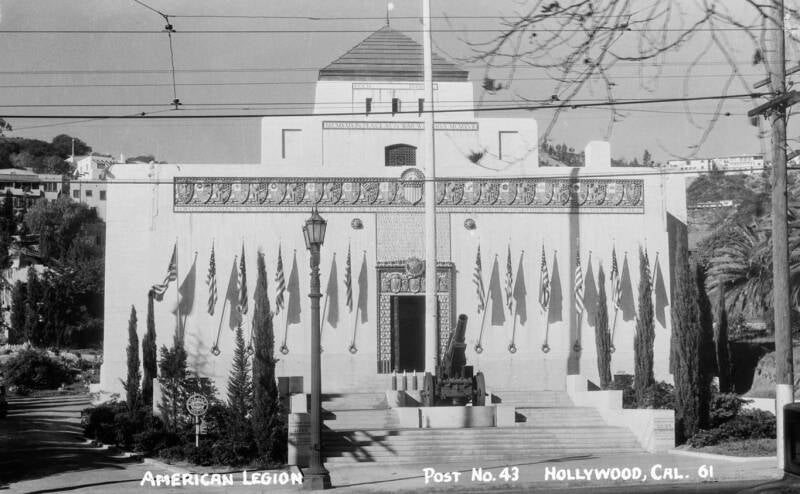
The Hollywood American Legion Post 43, 2035 North Highland Avenue, not far from the Hollywood Bowl (Photo credit: Author's collection)
Downstairs in the basement buffet room, after midnight on July 31, an all-night poker game continued on, run mostly on fatigue and stubborn pride. At around 5:30 a.m., Lucenay had reached his limit. He accused the other man playing poker, Charles Z. Bailey, of cheating. Cheating at poker was no small accusation in the gentlemen's code of the day. By calling someone else a cheater, Lucenay was challenging Bailey's honor - and his right to sit at the table, period. Lucenay didn't murmur it discreetly. He didn't just ignore it either. Witnesses later testified Lucenay harangued him, size and temper booming.
Bailey was seventy years old, a Spanish-American War veteran and former bugler—smaller, older, and by all accounts aware of his physical disadvantage. What happened next would be argued over in court and whispered about afterward. Words were exchanged. Lucenay advanced or appeared to. Bailey retreated through a doorway, produced a gun, and fired. The bullet struck Lucenay directly in the heart, unarmed except for a poker chip still in his hand. He collapsed where he stood. The game was over.
Officers responded to Highland Avenue before sunrise in Hollywood. The scene that greeted them was messy, humiliating, and quietly scandalous. Over two hundred servicemen sleeping upstairs hadn't even heard the gunshots nor learned of tragedy until investigators concluded. This was meant to be a dignified veterans' club, not a gun range. The questions came thick and fast. Why was there a gun at a card game? Did Lucenay actually present a deadly threat? Was the cheating accusation legitimate, or merely the proverbial straw?
Bailey's subsequent trial in the fall of 1944 could have been written by Hollywood a thousand times over. Bailey's defense was based almost entirely around the self-defense claim and the age and size difference between Bailey and Lucenay. Witness testimony piled on top of witness testimony painting Lucenay as a big, angry man who wouldn't take no for an answer. It was difficult for the prosecution to overcome a tale of Bailey being an elderly war veteran backed into a corner. Lucenay having no weapon besides a poker chip mattered little to an all-white jury primed to look at fear through stereotypes of who appeared scary.

Harry Lucenay training his dog Pete, of Our Gang fame.
The verdict was delivered in October: not guilty. Bailey went free. Legally speaking, the case was closed. Morally speaking, it never was. To some people it was justice--affirming that a seventy-year-old man had every right to protect himself. To others it was a tacit acceptance of lethal extremism, another instance where an unarmed man could be killed and made responsible for his own murder.

Charles Z. Bailey was found not guilty of murder
Lucenay didn't live to hear the verdict. The authorities had his body, his name was removed from the news cycle, and Hollywood had found its next distraction. He was buried Harry Santille Lucenay and laid to rest at the Los Angeles National Cemetery as tidily as the courts had wrapped up his case. The particulars are unimportant. Quiet. Unspectacular. Short. Lucenay deserved no more and no less considering the life he spent so close to, but not really in, the spotlight.
Today, visitors to the Hollywood American Legion Post gaze at its architecture. They go to parties there, drink under its arches. Once, a man died of a gunshot wound over a card game in one of those arches. Few stop to consider Harry Lucenay. Fewer still see the connection between a slain gambler and the famous dogs he once owned. His story haunts Hollywood like cigarette smoke in an empty room. It is a reminder that wartime Hollywood wasn't always about sparkle and victory reels. It was also about tiredness and rage and the men who brought home old wars, carried them inside into the early morning of a summer day.
Harry Lucenay’s life ended not in a blaze of celebrity, but in a doorway, shot down while demanding fairness from a crooked deck. The law said his killer was justified. History is less certain. And in that uncertainty—where memory fades and moral clarity blurs—his story belongs exactly where it now rests: in the shadows of Hollywood noir.
If the story of Harry Lucenay’s fatal last hand left you unsettled, please share your thoughts in the comments, rate the article, and pass it along to others interested in Hollywood’s darker true-crime history.
Add comment
Comments