

For decades, the 61st Academy Awards has occupied a notorious place in Hollywood lore—an evening whispered about with the same mixture of disbelief and theatrical shudder usually reserved for colossal box-office bombs. It was the night Snow White flirted with Tom Hanks, Rob Lowe crooned “Proud Mary,” and producer Allan Carr’s bold, glittering dream came crashing down in full view of a bewildered global audience. The evening was swiftly branded a fiasco, a cautionary tale in how not to produce the Oscars.
By Allan R. Ellenberger

But in the softening glow of hindsight, that judgment tells only half the story. The 1989 ceremony, for all its excess, bewilderment, and subsequent condemnation, now plays like a strange, shimmering time capsule—one that captured an industry on the brink of transformation, paid unexpected tribute to its Golden Age, and inadvertently gave Hollywood one last look at some of its cherished legends.
Production on the 1989 telecast began with producers being privately briefed that they needed to figure out how to make the Oscars "fun again." The man they turned to was Allan Carr, the legendary producer of Grease and La Cage aux Folles. Carr took the gig as seriously as if it were a personal crusade to resurrect Hollywood entertainment. He set out to stage a hostless ceremony that reveled in old-fashioned razzle dazzle and featured countless indulgences of spectacle, nostalgia, and movie-palace grandeur. It was a noble goal in theory. An extravaganza whose opening twelve minutes would be dissected for years.
The curtain rose on a young actress, Eileen Bowman, costumed as Snow White, gliding through a shimmering Art Deco dreamscape like a lost visitor from Disneyland who had stumbled into the wrong soundstage.
She greeted stars in the audience—Meryl Streep, Tom Hanks, Glenn Close—with breathless exuberance before joining Rob Lowe, then still navigating the embers of Brat Pack fame, for a reimagined “Proud Mary.” Their duet—equal parts camp, confusion, and musical mischief—played out amid dancing tables, singing showgirls, and Merv Griffin appearing to croon “I’ve Got a Lovely Bunch of Coconuts,” a sight that left even the most seasoned Hollywood faces blinking in disbelief.
Within hours, a storm of outrage broke across the entertainment world. Critics sharpened their knives, columnists howled, and seventeen prominent Hollywood figures—including Julie Andrews, Paul Newman, and Sidney Lumet—signed a blistering open letter condemning the number as an “embarrassment” to the industry. Disney promptly threatened a copyright infringement lawsuit for unauthorized use of Snow White’s likeness, forcing the Academy to issue a swift and contrite apology. The damage was done: the show became a punchline, and Allan Carr’s once-brilliant Hollywood star dimmed almost overnight.
But even amid the uproar, something else was happening on that Oscar stage that would be overshadowed by headlines. A devotee of Old Hollywood glamour himself, Carr packed the evening with legends of the Golden Age still alive to attend. For a fleeting moment, the ceremony felt like a living museum of cinema history. All the greats of studio-era Hollywood were there: Loretta Young. Alice Faye. Cyd Charisse. Dorothy Lamour. Roy Rogers and Dale Evans. An all-star tribute unlike any other, and as it turned out, the last trip to the Oscars for many of them. Watching so many familiar names pass across the stage, many near the twilight of their years, gave the evening a certain melancholy now easier to appreciate than it was in the firestorm of 1989.
And in one especially poignant moment, Lucille Ball, paired with Bob Hope, stepped onto an Oscar stage for the last time in her life. Lucy, radiant and sharp as ever, and poignantly just weeks from her passing—stepped to the microphone to introduce a high-energy song-and-dance salute showcasing “The Stars of Tomorrow.” The number, “I Wanna be an Oscar Winner,” conceived as a bridge between Hollywood’s golden past and its emerging future, featured a lineup of then-rising young performers including Patrick Dempsey, Ricki Lake, Chad Lowe, Keith Coogan, Corey Feldman, Tracy Nelson, Matt Lattanzi, Corey Parker, Patrick O'Neal Jr., Christian Slater, Joely Fisher, Carrie Hamilton, Tricia Leigh Fisher, Melora Hardin, Blair Underwood, Holly Robinson (Peete), D.A. Pawley, Tyrone Power Jr., and Savion Glover, each presented as heir apparent to the studio-era tradition the Academy so reveres. Remarkably, as of this writing, none of these performers have been nominated for an Oscar.
Carr’s creative team enlisted choreographer Kenny Ortega—already known in industry circles for his dynamic staging and later to become synonymous with projects such as Newsies, Hocus Pocus, and Dirty Dancing—to give the sequence youthful polish and Broadway snap. The result was a glossy, exuberant production number reminding viewers that, in Hollywood, there is always another generation waiting in the wings to step into the spotlight.

Producer Allan Carr

Rob Lowe croons to Eileen Bowman as Snow White (Photo Credit: AP)
Seen from today's perspective — often sleek, efficient, and restrained — the Carr spectacle almost feels quaint. Sure, it was sloppy. Way too long. Too chaotic. Too sincere. Too unironically bombastic. But it also gambled. Loved Hollywood. Took chances. Celebrated its wackiness. Blended Oscar tradition with cutting-edge vision. And most importantly, it reminded everyone that the Oscars used to swing wide open like the town itself.
In the aftermath, the Academy convened an internal inquest, vowing never again to gamble on such an experiment. The following year brought Billy Crystal—wry, controlled, and dependable—and with him a renewed insistence on tradition. Whoopi Goldberg followed suit shortly thereafter, solidifying Hollywood's revival of the "safe" host. Hollywood seemed to unanimously decide that Carr took things too far with his glitzy spectacle and they overcorrected back to playing it safe.

Bob Hope and Lucille Ball (in her final public appearance) introducing "The Stars of Tomorrow."
However, the impact of the 1989 Oscars runs deeper than its history indicates. In many ways, it perfectly encapsulates Hollywood's ongoing battle of progress vs. familiarity. It captured the final parade of many Golden Age luminaries before time carried them away. It offered Lucille Ball her last bow. And it preserved, in all its glittering absurdity, a moment when the Oscars dared—however clumsily—to shake off their own gravitas and put on a show.
Today, in an era of endless commentary about the Oscars’ shrinking cultural impact, back in 1989 the show felt strangely vital. Chaotic, misdirected and roasted alive by jackals. But alive. And for one unforgettable night, Hollywood was too.
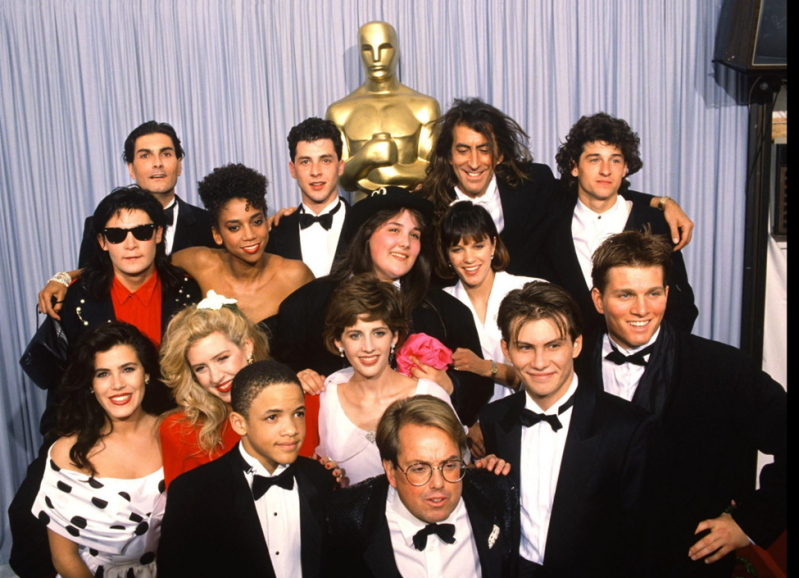
Some of the performers from "The Stars of Tomorrow" number with producer Allan Carr (front)
If you dare, click on the video below to watch the 11 minutes that nearly brought down the Academy Awards. Is it as bad as history claims? You be the judge.
Add comment
Comments