

Tucked into the narrow slope of West Hollywood’s Norma Place stands a building that has long traded in rumor, memory, and the durable afterglow of silent Hollywood. Today it reads as an apartment house, its clapboard and porch details evoking the early 1920s domestic optimism that once defined the Sherman district. But in the earliest days of the movie colony, locals claimed that it sat at the westernmost boundary of the Norma Talmadge studio lot, located at 812 North Robertson Boulevard. In the years since, the cottage has been rumored to house Hollywood's residual ghost population both figuratively and literally.
By Allan R. Ellenberger

The story opens in the 1910s and early 1920s, when West Hollywood was part of an unincorporated community called Sherman. The area was populated with movie studios; Norma Talmadge, already a huge star at the time, and her sister Constance shot films nearby, and there were lots of ancillary operations keeping the neighborhood buzzing. According to longtime residents quoted in later accounts, the building on Norma Place once formed part of the orbit of the Talmadge operation. One resident recalled that Norma and Constance used apartments there, that Joseph Schenck—Norma’s husband and producing partner—maintained office space in the building, and that the suites functioned as a private refuge adjacent to the working studio.
While definitive production records tying the house formally to a “Norma Talmadge studio” remain elusive, the building’s proximity to the old Talmadge lot is not in dispute. What survived the studio’s closure in 1927 was not a soundstage but a memory—a structure that retained architectural hints of a commercial past. Decades later, it was described as an apartment house “filled with ghosts of Hollywood past,” its rooms still whispering of dressing mirrors and star entrances.
Ownership in the mid-twentieth century passed to a man named Paul Millard, who came upon the building thirteen years after the studio era had ended. He reportedly discovered what he believed to be the former Talmadge dressing rooms—specifically, a space associated with actress Carol Veazie—and became so enchanted with the site’s theatrical lineage that he purchased it outright. Veazie herself eventually became a tenant. Millard undertook extensive remodeling, knocking out walls and sealing doorways that once connected what were described as the Talmadge suites. Two adjoining structures that had served as garages were refurbished as studio apartments. He landscaped the grounds, added sundecks and patios, and, in a flourish befitting the mythology of the place, affixed a balcony said to have been salvaged from a set used in Gone With the Wind.

The property in 1971, rumored at the time to be the former offices and dressing rooms for the Norma Talmadge Studios
By the 1950s and 1960s, the address had evolved into a curious hybrid: part residential enclave, part shrine to a vanished film era. Actors and writers as well as assorted others passed through and lived here during its history. Actress Tuesday Weld's mother lived here for many years in an apartment and knew the Norma Talmadge lore by heart. "My dressing room used to be part of Norma Talmadge's dressing room," Mrs. Weld said. "And I can't begin to tell you how thrilled I am."
Film actress Nina Foch is said to have owned the adjacent house. Actress Estelle Winwood once lived there, entertaining guests and serving tea in a bizarre British tradition. Tallulah Bankhead and Lucille Ball were visitors. Millard's friend, Judy Garland, reportedly attempted to purchase the house after claiming it reminded her of the set of Meet Me in St. Louis. Rather than a museum piece, the house thrived as a living social center where history and performance mingled past and present.
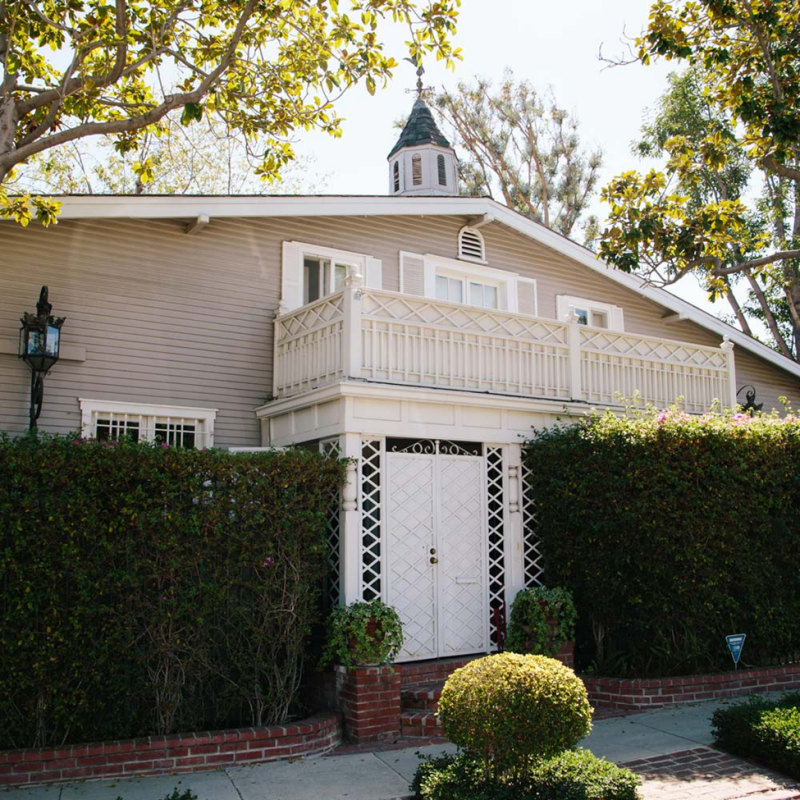
The property at 8954 Norma Place, West Hollywood today. Please do not disturb the residents. (Photo Credit: West Hollywood Historic Preservation)
Architecturally, the house reflects its 1921 origins in Colonial Revival style, its domestic detailing at odds with its rumored past as an annex to a silent film enterprise. That tension—between residence and workplace, between fact and legend—has defined its identity ever since. What had stood on the parcel before its construction appears to have been undeveloped or sparsely improved land typical of the district prior to the housing boom that followed the film industry’s westward consolidation. The building itself has survived successive waves of redevelopment that erased so many early Hollywood structures. In the late twentieth century it was formally recognized as a cultural resource by the City of West Hollywood, preserving at least its exterior character within the rapidly transforming Norma Triangle.
The connection to the Talmadge years has been passed down through generations by oral tradition, newspaper articles and residents who thought they were living in stars' old apartments. In that way it matters less as film history but as film memory. The transformation of studio-industrial space into personal palimpsest, workplace into apartment building, history into myth.


Today, 8954 Norma Place stands as a layered artifact. It began as a house in a district shaped by cinema; it may have served, in some capacity, the operations of a major silent-era actress; it became an apartment building animated by tenants who embraced its mythology; and it now survives as part of West Hollywood’s protected architectural fabric. If ghosts linger there, they are not merely those of actors and producers, but of the city itself—of a moment when Hollywood’s boundaries were porous, when dressing rooms stood beside dining rooms, and when the private lives of stars unfolded just behind the clapboard walls of an ordinary street.
What do you think? Could this building have been Norma Talmadge's studio office and dressing rooms? Have you heard the legend? Please comment, rate below and share with interested friends.
Add comment
Comments
Knew Paul Millard and Bob Cundall (owner after Paul Millard) I have pictures of the original house (different than yours, mine older) got to meet Judy Garland and Hedy Lamar there for dinner. Paul was a great friend of mine as was Bob Cundall.
Hi Glenn, how exciting that you met those legends there. Bet you have some great stories. If you'd like to share them let me know.