

In the spring of 1922, at the very height of his meteoric rise to international fame, Rudolph Valentino found himself not on a film set but at the center of one of Hollywood’s most sensational legal scandals—a case that revealed both the rigid morality of the era and the volatile intersection of celebrity, law, and public fascination.
By Allan R. Ellenberger

Valentino and Rambova on their wedding day, May 13, 1922, in Mexicali, Mexico, which resulted in Valentino's arrest for bigamy.
The trouble began with a romance that had captivated Hollywood. Valentino, newly divorced from actress Jean Acker in January 1922, had fallen deeply in love with designer and artistic collaborator Natacha Rambova. Their relationship, intense and impulsive, culminated in a dramatic decision: on May 13, 1922, the couple crossed the border into Mexicali, Mexico, where they were married. But the union, romantic as it appeared, collided immediately with California law. Though Valentino had secured an interlocutory decree of divorce from Acker, the law required a full year before remarriage. By marrying within months, he had violated that statute—placing himself squarely within the definition of bigamy.
The trouble began with a romance that had captivated Hollywood. Valentino, newly divorced from actress Jean Acker in January 1922, had fallen deeply in love with designer and artistic collaborator Natacha Rambova. Their relationship, intense and impulsive, culminated in a dramatic decision: on May 13, 1922, the couple crossed the border into Mexicali, Mexico, where they were married. But the union, romantic as it appeared, collided immediately with California law.
Though Valentino had secured an interlocutory decree of divorce from Acker, the law required a full year before remarriage. By marrying within months, he had violated that statute—placing himself squarely within the definition of bigamy.
The press seized upon the story with relentless intensity. Within days, headlines blazed across Los Angeles and beyond, announcing that the “Latin Lover” had taken a new wife while “not legally free.” Authorities moved swiftly. Valentino turned himself in at the office of District Attorney Thomas Lee Woolwine on May 20, 1922, and he was officially charged with bigamy. News sources at the time describe the moment as both procedural and theatrical: the actor, already a national idol, faced the machinery of the law as if stepping into another kind of performance—one with real consequences. Bail was set, and he was released pending further proceedings, but the scandal had already reached fever pitch.
Much of the interest centered around events surrounding the case and the defendant himself. Daily papers covered his every move and reported on his expressions and gestures. Valentino, who showed remarkable poise during the trial, was clearly under stress and sometimes seemed. One report famously noting that he chewed on his finger while awaiting proceedings. Large crowds gathered outside the courthouse in anticipation of seeing him. Many in attendance were female fans fascinated by Valentino's portrayals of sexuality onscreen. The atmosphere was less that of a legal hearing than of a public drama, with Valentino cast as both defendant and tragic romantic hero.
The June preliminary hearings brought forward a series of witnesses whose testimony attempted to establish whether Valentino and Rambova had cohabited in California as husband and wife—a necessary element for conviction.

Actor Thomas Meighan and screenwriter June Mathis furnished bail to free Valentino when the actor was arrested on a bigamy charge.
The prosecution focused on their stay at a Palm Springs cottage following the Mexicali ceremony. Witnesses testified to having seen the couple there, including the detail of what Valentino was wearing—silken pajamas, variously described as “Chinese clothing,” worn in the desert heat. One witness testified they slept together there; another witness testified they slept apart. Valentino's attorney argued that the couple could not be convicted unless they lived together in California.
The case unfolded as a collision between technical law and public morality. California’s statute was clear, yet its application in Valentino’s case exposed its ambiguities. The marriage itself had occurred outside the state, and while morally suspect in the eyes of many, it required precise legal proof to sustain a conviction. Even as testimony accumulated, doubts began to emerge regarding whether the state could meet that burden.
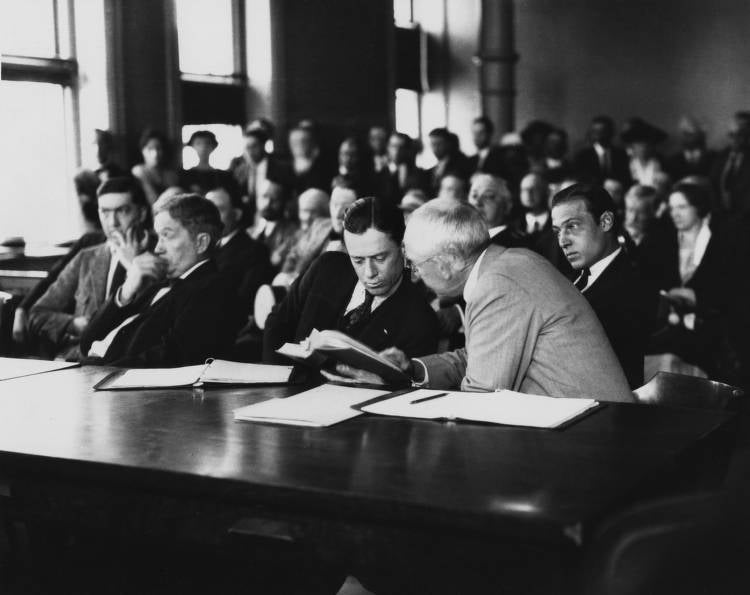
Rudolph Valentino, right, in court during a trial on bigamy charges in Los Angeles, California, 1922. (Photo Credit: Margaret Herrick Library, Academy of Motion Picture Arts and Sciences)
On June 5, 1922, the matter reached its decisive turning point. Justice Hanby ruled that the evidence presented was insufficient to hold Valentino for trial, effectively dismissing the charge. He went further, reportedly questioning the constitutionality of the statute under which the case had been brought, suggesting that it could not be fairly enforced in its current form. The ruling did not validate Valentino’s marriage to Rambova—nor did it erase the legal complications—but it freed him from the immediate threat of prosecution. In the eyes of his adoring public, it was nothing less than vindication.

A camera-shy Valentino leaves the courthouse with an attorney.

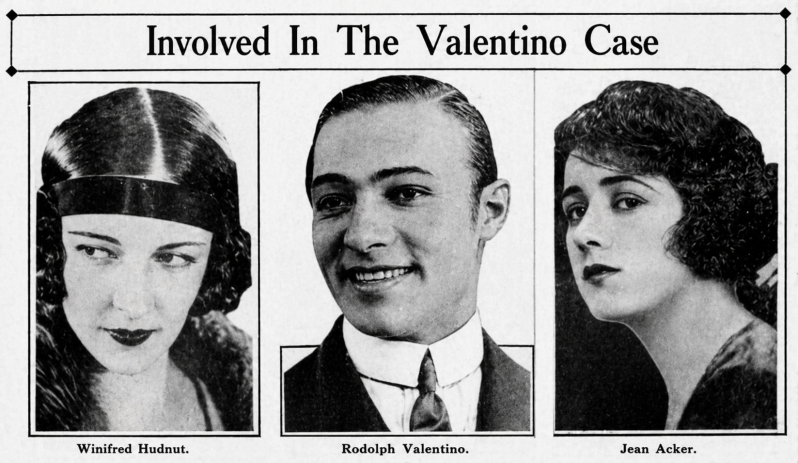
Valentino's first wife, actress Jean Acker testifies at his bigamy trial.
Within a day, Valentino returned to work at the Famous Players–Lasky studios, resuming his role as one of the screen’s most beloved figures. Newspapers reported that he was once again “the idol of the screen,” as if the entire episode had been but an intermission in his larger career. Yet the scandal lingered. District Attorney Woolwine issued warnings about cross-border marriages designed to circumvent California law, using Valentino’s case as a cautionary example. The incident had broader implications, highlighting the ease with which couples could evade state restrictions and the difficulty authorities faced in enforcing them.
In many ways it was intensely private and profoundly public for Valentino. Revealing was his impetuosity, his decisions to go with his heart instead of his head, his susceptibility to the laws and ethos of his adopted homeland. Public too was Valentino's situation as it highlighted the strange phenomenon of celebrity in the 1920s when almost every detail of a star's private life was news.
In the end, the bigamy case of 1922 stands as one of the defining off-screen dramas of Rudolph Valentino’s life—a moment when the fantasy of the “Great Lover” collided with the realities of law and society. It is a story that reveals not only the man himself, but the era in which he lived: a time when Hollywood was still inventing its myths, and when even its brightest stars could find themselves, suddenly and dramatically, at the mercy of the world beyond the screen.
If this deep dive into Rudolph Valentino’s sensational bigamy trial intrigued you, please take a moment to comment, rate, and share the post with fellow classic film enthusiasts.
Add comment
Comments